
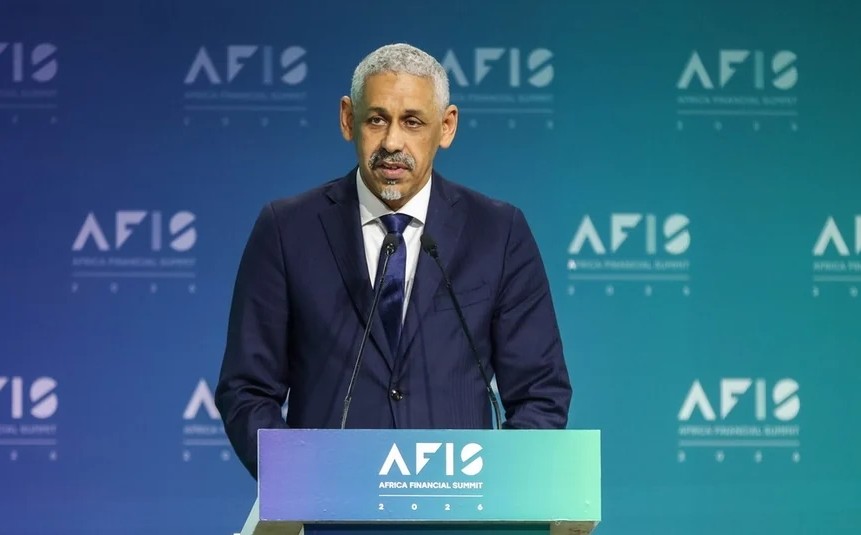
LUANDA, Nov 5 – African Development Bank Group President Dr Sidi Ould Tah has called for stronger coordination among African financial institutions, arguing that fragmented financing systems and slow institutional processes are limiting the ability of businesses to expand and contribute to economic growth.
Speaking at the opening of the Africa Financial Summit (AFIS) in Luanda on 3 November, Ould Tah presented the New African Financial Architecture for Development (NAFAD) as a framework for improving collaboration across the continent’s financial ecosystem and strengthening the mobilisation and deployment of capital.
“For the continent’s financial strength to translate into economic power, African financial institutions must keep pace with the businesses they serve,” he said.
NAFAD is designed to improve coordination between national, regional and continental financial institutions, with a focus on how capital is mobilised, risks are distributed and financing reaches productive sectors.
The initiative addresses what Ould Tah described as a fundamental mismatch between the operating timelines of financial institutions and the commercial realities of businesses.
Financial institutions typically operate according to reporting cycles, investment horizons and internal processing requirements. Businesses, by contrast, depend on shorter commercial timelines shaped by production schedules, order fulfilment, cash flow and talent retention.
Ould Tah argued that this disconnect is contributing to lost economic opportunities across Africa, particularly when businesses cannot access financing or institutional support quickly enough to meet market demand.
He also highlighted the consequences of fragmented responsibilities among financial institutions. When organisations operate without effective coordination, individual institutions may fulfil their mandates while broader economic outcomes remain unmet. The result, he said, can include jobs that are never created, farmers unable to reach markets and countries importing products that could be manufactured locally.
He called on financial institutions to simplify procedures, improve operational coordination and develop financing instruments that better reflect the needs of businesses, particularly small and medium-sized enterprises.
NAFAD and the coordination of African capital
Ould Tah said NAFAD would provide national, regional and continental institutions with a shared framework for reinforcing one another’s capabilities while respecting their individual mandates.
The architecture is based on the principles of subsidiarity and complementarity, which seek to ensure that institutions operate within their respective responsibilities while coordinating where their activities overlap.
He cautioned against treating the assets held across Africa’s financial system as a single pool of immediately available capital.
African financial institutions, pension funds, sovereign wealth funds and other investors manage resources with different ownership structures, obligations and investment horizons. Mobilising these assets for productive investment therefore requires financial structures that account for their distinct mandates and risk requirements.
Ould Tah warned against viewing the assets of the African financial system “as available liquidity just waiting to be spent”. These assets, he said, “have different owners, obligations and time horizons”.
The approach places institutional coordination at the centre of efforts to expand financing for infrastructure, agriculture, manufacturing and other productive sectors.
African financial institutions and private-sector investment
The importance of stronger financial systems was also emphasised by Angola’s Minister of State for Economic Coordination, José de Lima Massano, who said economic transformation depends on the quality, depth and efficiency of financial institutions.
“These institutions are capital multipliers, investment catalysts and key partners in economic transformation,” Massano said, referring to Africa’s multilateral financial institutions.
“We must continue to strengthen their capacity to mobilise resources and improve coordination with national financial systems.”
His remarks highlighted the relationship between development finance institutions and domestic financial systems, particularly the need to improve the flow of capital from institutional investors into businesses and infrastructure projects.
International Finance Corporation Managing Director Makhtar Diop also outlined the importance of collaboration between development finance institutions.
He said the IFC was working with several African partners, including the African Development Bank Group, Afreximbank and the Development Bank of Southern Africa (DBSA).
“We are working together, and no one is more determined to drive Africa forward,” Diop said, while praising Ould Tah’s commitment to the continent’s development.
Diop disclosed that the IFC and African Development Bank Group were holding joint discussions with African sovereign wealth funds and institutional investors to mobilise long-term resources and channel them into productive sectors.
He also proposed establishing private-sector councils in individual African countries to identify areas requiring reform and advise governments on implementing reform legislation.
Such councils, he suggested, could strengthen engagement between governments and businesses by creating a more structured channel through which private-sector concerns can inform policy and regulatory changes.
Turning Africa’s demographic potential into productive employment
Ould Tah also addressed the need to connect Africa’s demographic growth with investment in education, skills and employment.
He cautioned against treating the continent’s demographic dividend “as if it were already credited to an account”.
“We have to earn it,” he said, pointing to the importance of developing human capital and expanding productive employment opportunities.
Africa’s growing working-age population presents significant economic potential, but realising that opportunity requires businesses capable of generating jobs and financial institutions able to support enterprise expansion.
The AfDB president also disclosed that the Bank Group was streamlining its internal processes to improve transparency and predictability for clients. The changes are intended to make clear what applicants must provide, who is responsible at each stage of a financing process and how long decisions are expected to take.
“You should judge us by our ability to deliver tangible results, both in the implementation of projects and in the lives of people,” he said.
The emphasis on implementation reflects a wider challenge facing development finance across the continent: converting financial commitments into projects that reach completion and generate measurable economic outcomes.
AFIS 2026 and the focus on Africa’s real economy
The African Development Bank Group was one of the main partners of AFIS 2026, held in Luanda on 3 and 4 November.
The Bank Group also hosted a side event titled “Making the most of NAFAD to boost Africa’s real economy”, focusing on capital mobilisation, project preparation and faster project implementation.
These priorities reflect the broader objectives of the proposed financial architecture. Beyond increasing the volume of financing available, the initiative seeks to improve how institutions work together to identify viable investments, distribute risks and move projects from preparation to execution.
For African economies, the challenge is not simply the availability of financial resources. It is also the capacity of financial institutions to deploy capital efficiently, support businesses at the right stages of their development and coordinate with governments to address structural barriers to investment.
NAFAD seeks to provide a framework for addressing these constraints by strengthening cooperation across the financial system. Its effectiveness will ultimately depend on how participating institutions translate the proposed coordination into faster financing decisions, stronger project pipelines and greater investment in productive economic activity.
