
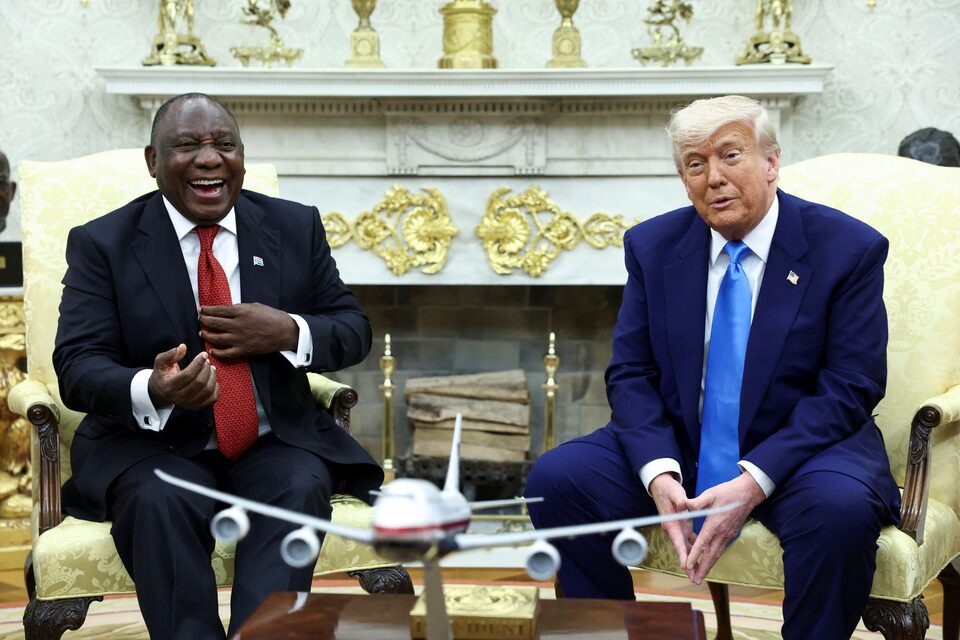
JOHANNESBURG, Nov 4 – South African President Cyril Ramaphosa has said the outcome of the United States midterm elections could create an opportunity to reset relations between Pretoria and Washington, following months of diplomatic and trade tensions under President Donald Trump.
Speaking after casting his vote in Johannesburg’s municipal elections, Ramaphosa described the US election results as a potential turning point in international relations and expressed hope for renewed engagement on trade, investment and geopolitical issues.
“I do think that this is going to introduce a new era in world relations,” Ramaphosa said. “We’re hoping that, on a bilateral basis, there will be a coming together of minds, where we will find a proper path forward on geopolitics as well as on trade matters and investment matters.”
The Democratic Party’s victories in both chambers of Congress in Tuesday’s midterm elections represented a significant setback for Trump’s political agenda. The outcome also coincided with a positive session for South African financial markets, with the rand strengthening by approximately 1% against the US dollar to 16.46 per dollar on Wednesday, making it one of the better-performing currencies tracked by Bloomberg during the session.
Relations between South Africa and the US have deteriorated since Trump returned to the White House in 2025. His administration froze US assistance to South Africa and made allegations that the country’s government was permitting genocide against White Afrikaner farmers, claims that have been disputed.
Trump has also criticised South Africa’s Black economic-empowerment policies, which were introduced to address economic inequalities established under apartheid.
Trade relations have faced further pressure following Washington’s announcement earlier this week that it intends to revoke South Africa’s access to duty-free trade benefits under the African Growth and Opportunity Act (AGOA).
US Trade Representative Ambassador Jamieson Greer said the decision was based on unspecified “concerning and pervasive practices” that, according to the US administration, undermine American trade and investment interests and pose a national security threat.
The proposed exclusion carries implications for South African exporters that have benefited from preferential access to the US market. However, Ramaphosa said AGOA represents only part of the country’s broader commercial relationship with Washington.
“Exclusion from AGOA is indeed a negative for us,” Ramaphosa said in remarks broadcast by Johannesburg-based eNCA. He noted that the agreement accounts for approximately 10% of South Africa’s total exports to the United States, according to government data.
The president added that bilateral trade extends beyond products covered by the preferential trade programme.
“We also have trade dealings with the US on a variety of products, which are outside AGOA,” Ramaphosa said. “Our trade relations with the US continue, and we want it to get even better through bilateral dealings.”
The United States is South Africa’s third-largest trading partner, after China and the European Union. Bilateral trade between the two countries totalled $24.1 billion in 2025, compared with $55.6 billion in trade with China, according to data compiled by Bloomberg.
The figures highlight the scale of South Africa’s commercial exposure to both markets, while underscoring the importance of maintaining access to the US beyond AGOA preferences.
Ramaphosa’s remarks indicate Pretoria’s interest in keeping diplomatic and commercial channels open despite disagreements over trade policy and domestic legislation. Whether the political changes in Washington translate into a shift in the administration’s approach to South Africa remains uncertain.
