
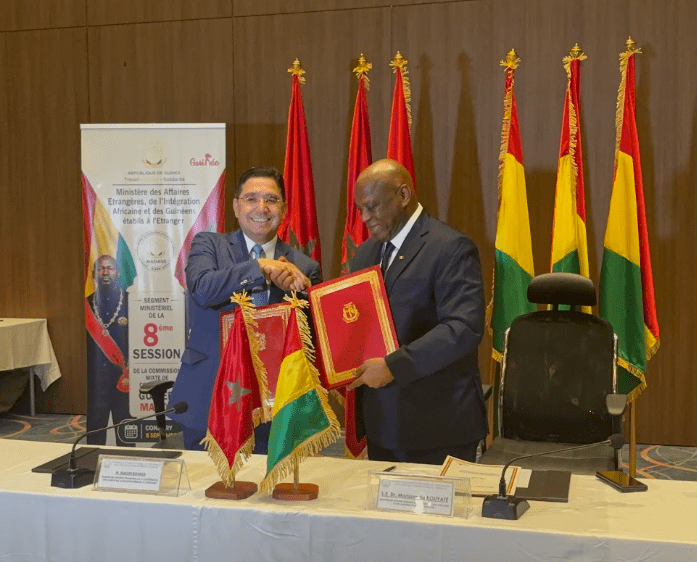
CONAKRY, Sept 9 – Morocco and Guinea have agreed to deepen their economic and development partnership, signing 25 cooperation agreements as both countries seek to expand bilateral investment and strengthen South-South cooperation.
The agreements were concluded on Tuesday during the eighth session of the Morocco-Guinea Joint Cooperation Commission in Conakry, co-chaired by Moroccan Foreign Minister Nasser Bourita and his Guinean counterpart Morissanda Kouyaté.
The new agreements expand the legal framework governing cooperation between the two countries across a broad range of sectors, including finance, customs, agriculture, energy, tourism, air transport, healthcare, justice, ports, housing and urban planning.
The package also covers meteorology and climatology, sports, culture, handicrafts, higher education, scientific research and innovation, academic scholarships and vocational training, reflecting an effort to move bilateral relations beyond traditional diplomatic cooperation toward wider economic and institutional integration.
The two ministers reviewed existing bilateral ties and reaffirmed their intention to raise the relationship to a strategic level, anchored on mutual economic interests, shared prosperity and sustainable development.
Both sides also committed to pursuing what they described as an exemplary model of South-South cooperation, with Morocco offering its development experience and technical expertise to support Guinea’s economic transformation.
Morocco Backs Guinea’s Simandou 2040 Agenda
Bourita welcomed President Mamadi Doumbouya’s Simandou 2040 development programme, signalling Morocco’s interest in supporting Guinea’s longer-term economic development strategy.
Rabat said it is prepared to contribute to the implementation of Simandou 2040 in several priority areas, including strategic infrastructure, security, fisheries, healthcare, industrial and agricultural processing, food security, skills development, water management and energy.
The partnership could provide Guinea with access to Moroccan experience in infrastructure development, industrial processing and human-capital development as Conakry seeks to translate its natural-resource wealth into broader economic growth.
For Morocco, deeper engagement with Guinea also strengthens its economic presence in West Africa and expands opportunities for Moroccan companies and institutions across infrastructure, finance, agriculture, energy and other sectors.
Atlantic Strategy Adds Regional Dimension
Guinea also expressed support for Morocco’s Atlantic-focused initiatives, including the Royal Initiative on the Atlantic African States Process and Rabat’s proposal to facilitate Atlantic Ocean access for landlocked Sahel countries.
The two countries additionally welcomed progress on the African-Atlantic Gas Pipeline, in which Guinea is participating. The project has entered its operational launch phase and is intended to strengthen regional energy connectivity.
The Atlantic initiatives add a broader regional dimension to the bilateral partnership, linking Morocco’s economic engagement with Guinea to wider efforts around infrastructure, energy connectivity and trade integration across West and Atlantic Africa.
Guinea Reaffirms Position on Western Sahara
The meeting also included renewed political support from Guinea for Morocco’s position on Western Sahara.
Kouyaté reiterated Guinea’s backing for the Autonomy Plan under Moroccan sovereignty, describing it as the sole solution to the dispute. Guinea has maintained a Consulate General in Dakhla since January 2020, reinforcing its diplomatic position.
Bourita welcomed and thanked Guinea for its continued support in regional and international forums.
The two governments also highlighted the longstanding relationship between Morocco and Guinea, including ties of friendship, cooperation and solidarity and the mutual respect between King Mohammed VI and President Doumbouya.
Both sides pledged to monitor implementation of the newly signed agreements and continue strengthening bilateral relations.
The breadth of the agreements suggests that Morocco and Guinea are seeking to turn their longstanding political relationship into a more integrated economic partnership, with infrastructure, energy, industrialisation, agriculture and human-capital development emerging as central pillars of the next phase of cooperation.
