
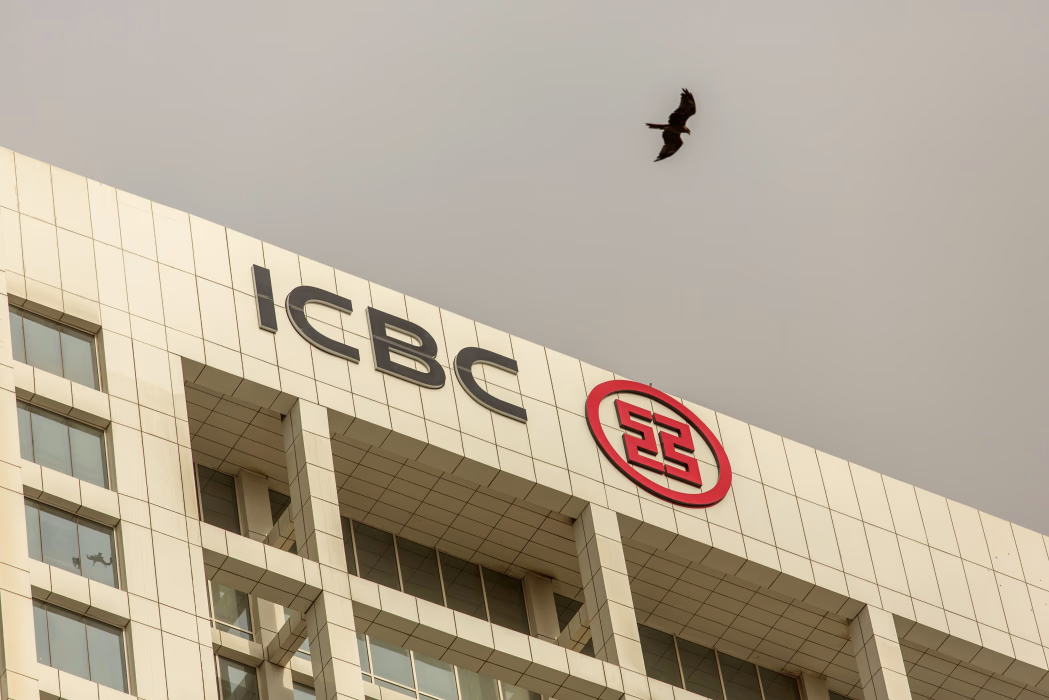
Sept 7 – Industrial and Commercial Bank of China plans to raise up to 100 billion yuan, approximately $15 billion, through a private placement of shares as China’s largest commercial lender strengthens its capital base amid a broader recapitalisation of the country’s financial sector.
According to the bank’s regulatory filing, China’s Ministry of Finance, China National Tobacco Corporation and entities linked to the tobacco company are expected to participate in the share placement. ICBC said the proceeds will be used to replenish its core Tier 1 capital, a key measure of a bank’s capacity to absorb losses while maintaining operations.
The capital increase is relevant to Africa because of ICBC’s significant ownership position in Standard Bank Group and the extensive financial relationship between the Chinese and South African lenders.
ICBC acquired a 20% stake in Standard Bank in 2007 for about $5.5 billion, establishing one of the most significant banking partnerships linking China and Africa. Standard Bank’s latest shareholder information shows ICBC holds 325 million shares, equivalent to 19.7% of the South African banking group. The Government Employees Pension Fund is the second-largest shareholder, with a 14.3% stake.
Standard Bank operates across 20 African countries and describes itself as the continent’s largest lender by assets. Its partnership with ICBC has focused on facilitating business between Chinese companies and African markets, including trade financing, infrastructure funding and cross-border payments.
The relationship has also expanded into renminbi settlement. China recently authorised the two banks to provide renminbi-clearing services across 19 African markets, giving eligible businesses a more direct mechanism for settling transactions using China’s currency.
For African markets, the significance of ICBC’s recapitalisation lies less in the immediate injection of capital itself than in whether a stronger balance sheet ultimately supports the financial channels connecting Chinese capital with African economies.
Core Tier 1 capital is primarily composed of shareholders’ equity and retained earnings. Increasing this capital buffer can strengthen a bank’s ability to absorb losses, comply with regulatory requirements and potentially expand its lending capacity.
A stronger capital position, however, does not automatically translate into greater lending to Africa. The more relevant question for African markets is whether ICBC’s increased financial capacity will support additional trade finance, infrastructure lending and renminbi-denominated transactions through its relationship with Standard Bank.
ICBC’s proposed capital raise forms part of a broader effort by Chinese authorities to reinforce major financial institutions. ICBC and Agricultural Bank of China have announced combined capital-raising plans of about 260 billion yuan, equivalent to roughly $39 billion.
Across China’s wider financial sector, the state-backed recapitalisation programme involving banks and insurers could reach approximately 360 billion yuan, or $53.6 billion.
The measures come as Chinese financial institutions contend with lower interest rates, slower economic growth and weak demand for credit, all of which have placed pressure on profitability. Strengthening capital buffers is intended to enable banks to continue financing businesses while maintaining sufficient protection against potential losses.
For Africa, the development reinforces the importance of the China-Africa banking corridor as trade, infrastructure investment and financial settlement between the two regions continue to expand. Whether ICBC’s stronger capital position leads to increased African financing will depend on lending demand, risk appetite and the investment priorities of the bank and its partners.
