
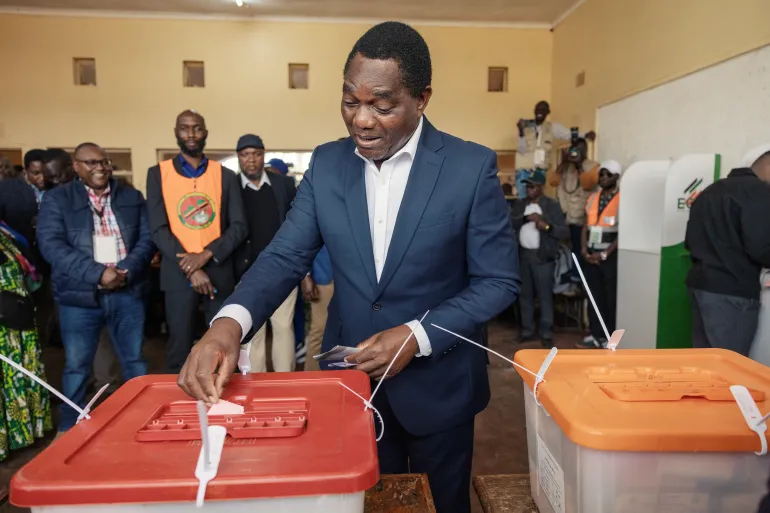
LUSAKA, Aug 18 – Zambia’s President Hakainde Hichilema has won a second term with about 60% of valid votes, according to results released by the country’s electoral commission, giving the president another five years to pursue economic reforms and investment in the copper-rich nation.
Hichilema defeated his main challenger, Brian Mundubile, who secured roughly 38% of the vote. The result allows Hichilema to build on his first-term record, which included a major restructuring of Zambia’s external debt and efforts to restore relationships with international lenders.
The president has pledged to use his second term to accelerate economic expansion, create jobs and widen economic opportunities for households. He has also said the government wants to double the size of Zambia’s economy.
Hichilema took office in 2021 after Zambia had defaulted on its debt the previous year, leaving the country facing one of its most severe economic crises since independence. His administration subsequently reached restructuring agreements with international creditors and sought to improve access to international financing while attracting new investment into the mining sector.
Copper remains central to Zambia’s economic strategy and has also placed the country at the centre of competition between China and the United States over critical minerals. The government has sought to expand investment in the sector as global demand for copper rises because of its importance to electric vehicles, renewable energy systems and other technologies.
The administration has also increased social spending despite the fiscal pressures associated with debt restructuring. Its policies included the introduction of free secondary education, which brought an estimated 2.3 million children back into classrooms, alongside expanded social cash transfers and funding for community projects.
However, the economic recovery has not eliminated concerns over household living standards. Many Zambians continue to cite food prices and the cost of living as major challenges, creating a gap between improvements in macroeconomic conditions and the experience of households.
That disconnect was reflected in Mundubile’s stronger-than-expected performance. While Hichilema secured a clear majority, the opposition’s 38% share of the vote points to continued public dissatisfaction over economic hardship despite progress on debt restructuring and investment.
The election was also marked by tensions surrounding the vote-counting process. Authorities arrested 11 people, including senior opposition figures, during a nighttime raid in which gunfire was exchanged, with Mundubile present at the scene.
The following day, the electoral commission temporarily suspended the counting process after reports of violence against polling officials and the theft of ballot papers.
Mundubile subsequently alleged that he had received information suggesting that results forms from polling stations may have been altered and called for an independent investigation. Hichilema’s camp rejected the allegation and accused the opposition leader of making false claims.
Hichilema now enters his second term with the opportunity to build on the progress made during his first administration, but also faces pressure to translate economic reforms and investment into stronger household incomes and broader improvements in living standards.
For Zambia, the challenge will be to sustain debt and fiscal reforms while using its copper wealth and growing investor interest to generate employment and reduce the economic pressures that remain central to voters’ concerns.
