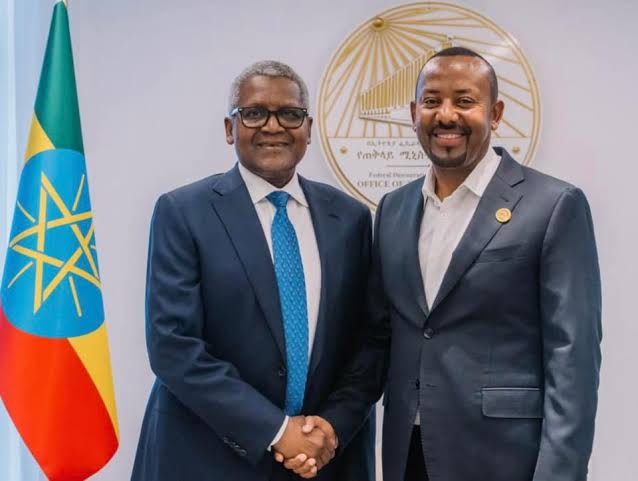
ADDIS, ABABA, Oct 17 – Aliko Dangote, Africa’s richest man, plans to list at least 10% of his Ethiopian fertilizer business on the country’s stock exchange, potentially opening a new investment route into one of the continent’s major planned fertilizer manufacturing projects.
Dangote disclosed the proposal at an investor roadshow in Addis Ababa on October 15, where executives were also presenting a separate share offer linked to the Dangote Petroleum Refinery in Nigeria, according to reporting by Ethiopian Business Review.
The proposed listing concerns a fertiliser manufacturing venture in Gode, southeastern Ethiopia, designed to produce three million tonnes of urea annually. No share price, offering timetable or final transaction structure has been announced.
The proposal represents a potential route for Ethiopian investors to participate in a major industrial venture, while providing the business with another possible channel for accessing capital.
Dangote and Ethiopian Investment Holdings Share Project Ownership
The fertiliser project is being developed through a partnership between Dangote Group and Ethiopian Investment Holdings (EIH), the Ethiopian government’s strategic investment arm.
Under a shareholders’ agreement signed in August 2025, Dangote Group holds a 60% stake in the venture, while EIH owns the remaining 40%.
The original agreement covered the development, construction and operation of the urea manufacturing complex, alongside supporting infrastructure. This included a pipeline intended to transport natural gas from a processing facility serving the Calub and Hilala gas fields.
The partnership was initially announced with an estimated project cost of $2.5 billion. Subsequent plans expanded the investment scope to incorporate additional energy and pipeline infrastructure.
The proposed stock-market listing is a new development in the financing and potential ownership structure of the venture. It does not represent the creation of the project itself, which was already established through the agreement between Dangote Group and EIH.
The precise ownership implications of the proposed offering will depend on its final structure and the proportion of shares made available to investors.
Three Million Tonnes of Planned Urea Capacity
The Gode project is designed to produce three million tonnes of urea annually, positioning it as a significant planned addition to Ethiopia’s industrial and agricultural supply chain.
Urea is a nitrogen-based fertiliser widely used to improve crop growth and agricultural productivity. Natural gas is a key feedstock in conventional urea manufacturing, making the availability and cost of gas important factors in the project’s operating economics.
For Ethiopia, domestic fertiliser production could reduce exposure to imported supplies and provide a more direct link between local natural resources and agricultural demand.
Ethiopian Investment Holdings has identified reducing reliance on imported fertiliser and strengthening regional supply as objectives of the venture. The project could also create opportunities to supply neighbouring markets, depending on production costs, logistics and regional demand.
However, the plant’s stated three-million-tonne annual capacity is a development target, not evidence of current production. Realising the projected benefits will depend on completing construction, securing reliable feedstock supplies and operating the facility competitively.
The associated energy and pipeline infrastructure will therefore be important to the project’s commercial viability.
Proposed Listing Could Broaden Ethiopia’s Investment Market
The proposed offering would bring a substantial industrial venture into Ethiopia’s developing capital market, potentially allowing investors to gain exposure to fertiliser manufacturing through a locally traded security.
For the company, a stock-market listing could diversify its financing options beyond bank borrowing, existing shareholders and international investment. If the offering includes newly issued shares, the proceeds could help fund project development or related infrastructure. If it involves the sale of existing shares, the proceeds would instead go to the selling shareholders.
A combination of the two structures could serve both purposes.
The absence of a disclosed offer price, timetable and final transaction structure means investors cannot yet determine the proposed valuation or the precise financial implications of the transaction.
Further details will also be needed on shareholder rights, eligibility requirements, disclosure obligations and the conditions governing the start of trading.
Ethiopian Fertiliser Listing Differs From Dangote Refinery Offer
The proposed Ethiopian fertiliser listing must be distinguished from the separate Dangote Petroleum Refinery investment presented at the same Addis Ababa roadshow.
The refinery offer uses Ethiopian depository receipts to represent shares held in Nigeria, providing a mechanism for Ethiopian investors to obtain exposure to the Nigerian business through a locally accessible instrument.
The fertiliser proposal, by contrast, concerns an operating venture being developed in Ethiopia and would require its own transaction structure and relevant approvals.
Consequently, restrictions and eligibility conditions attached to the refinery offer, including its qualified-investor requirements, cannot automatically be assumed to apply to the proposed fertiliser listing.
Investors will need a formal announcement setting out the shares available, eligibility criteria, use of proceeds, valuation and expected commencement of trading before the terms of the transaction can be assessed.
For Dangote Group and its Ethiopian partner, the proposal could provide a new avenue for connecting industrial investment with domestic capital. Its eventual significance will depend on the structure of the offer and the project’s progress towards commercial production.