
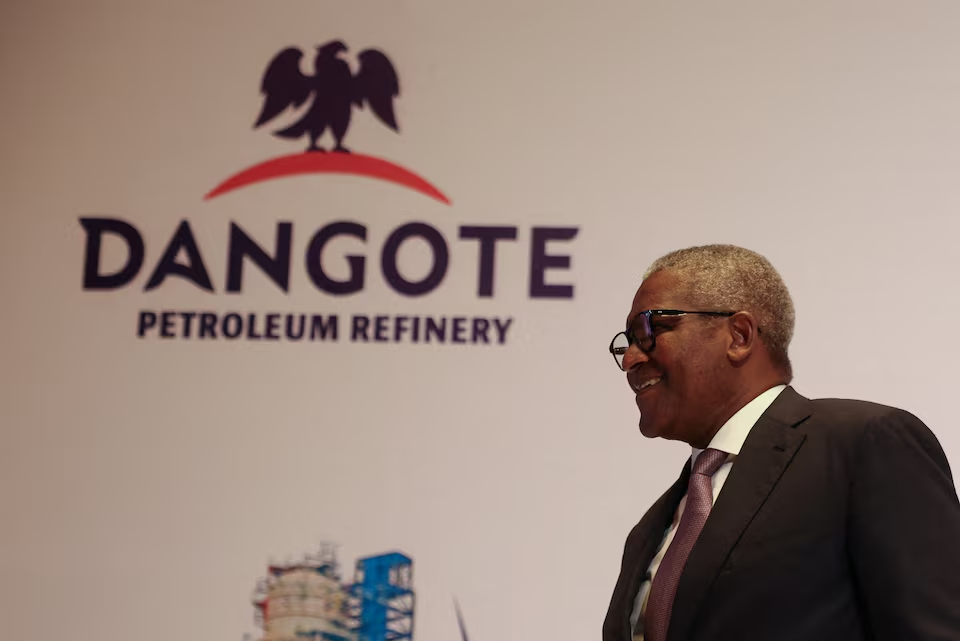
LAGOS, Nov 4 – Aliko Dangote is exploring ways to make shares in Dangote Refinery available through additional African stock exchanges after the company’s initial public offering attracted investor orders worth approximately $4.77 billion, nearly three times the value of its base offer.
Dangote Group has held discussions with several African exchanges since April to develop mechanisms that would allow investors outside Nigeria to trade instruments linked to the refinery’s shares. The initiative is intended to expand participation beyond the company’s primary listing on the Nigerian Exchange and address regulatory barriers that restricted direct access for investors in other African markets.
The IPO involved 4.1 billion ordinary shares offered at ₦525 each, giving the base offer a value of approximately ₦2.15 trillion ($1.6 billion). Investor orders reached approximately ₦6.4 trillion ($4.77 billion), according to people familiar with the offering.
The level of demand represented roughly three times the value of shares initially offered, although applications are still undergoing verification and the final allotment has yet to be determined.
According to Reuters, Dangote Group initiated discussions with African exchanges in April. Edoh Kossi Amenounve, chief executive of the West African regional stock exchange, BRVM, said the talks began at Dangote’s invitation.
The BRVM serves eight West African countries: Benin, Burkina Faso, Côte d’Ivoire, Guinea-Bissau, Mali, Niger, Senegal and Togo.
Amenounve said participating exchanges had encountered difficulties agreeing on a common process because each market operates under its own securities and listing regulations.
“It was not easy to have a kind of consensus on how the IPO can be conducted in all these different markets,” he told Reuters on the sidelines of the Africa Financial Summit in Luanda.
Depositary receipts considered for cross-border access
One of the options under consideration is the use of Global Depositary Receipts (GDRs), financial instruments that represent shares in a company but can be traded on exchanges outside its primary listing market.
Under such an arrangement, investors in other African countries could purchase locally traded instruments representing Dangote Refinery shares without requiring the company to conduct separate primary share offerings in each market.
Amenounve said similar arrangements had been used in Kenya and Botswana.
The Nigerian Exchange has also been working with exchanges in Egypt, Kenya, Botswana and Ethiopia to establish cross-border investment access through depositary receipts and other mechanisms. Some arrangements have been completed, while others remain subject to regulatory approval.
The African Exchanges Linkage Project already provides trading infrastructure connecting participating stock markets. However, the absence of a common regulatory framework remains a significant obstacle to broader cross-border capital market activity.
Companies seeking to raise capital across multiple African markets generally need separate approvals from the securities regulator in each jurisdiction, creating additional compliance requirements and administrative costs.
Amenounve called for greater regulatory cooperation, including mutual recognition of approvals, to reduce duplication and facilitate cross-border offerings.
“If you want to ease this kind of process, maybe it is time to think about harmonisation and mutual recognition,” he said.
Strong IPO demand awaits final allotment
Dangote Refinery’s public offer officially closed on October 27, according to the company’s offer update. Applications are now being verified before regulators approve the final basis of allotment.
The reported ₦6.4 trillion ($4.77 billion) represents investor demand rather than the amount raised by the refinery. Because applications exceeded the available shares, some investors may receive fewer shares than requested, while excess or unsuccessful applications will be subject to refunds following the allotment process.
The base offer comprised 4.1 billion shares, with the refinery retaining the option to issue up to 30% additional shares through an overallotment facility, subject to regulatory approval. The final proceeds will therefore depend on the number of shares allotted and whether the additional allocation is exercised.
Under the indicative timetable, the basis of allotment was expected to be submitted to regulators on November 10, with clearance targeted for November 17. Trading on the Nigerian Exchange is expected to commence later in November, subject to regulatory and operational changes.
The offering was promoted as an opportunity for investors across Africa to acquire an ownership stake in one of the continent’s largest industrial assets. However, the prospectus was not registered as a public offer outside Nigeria, meaning investors in other countries had to comply with their domestic securities regulations or use available approved investment platforms and cross-border arrangements.
Dangote acknowledged the regulatory challenges in October, describing them as a “teething problem.”
“We want to make sure that the African capital markets collaborate with each other,” he told Reuters at the time.
The company subsequently extended the offer period to support initiatives intended to broaden access across the continent, including potential depositary-receipt programmes.
Dangote Refinery’s official offer website said applications were received from 120 countries, with investors from all 54 African countries participating. However, the company has not published an independently verified geographical breakdown showing the number of shares requested or allotted in each country.
IPO proceeds to support refinery expansion
The capital raised through the offering is intended to support the expansion of Dangote Refinery, which currently has processing capacity of approximately 700,000 barrels per day.
Dangote plans to double capacity to 1.4 million barrels per day, a scale that would strengthen the facility’s position in African and international petroleum markets.
Built at an estimated cost of $20 billion, the refinery has already become a significant supplier of petrol, diesel and aviation fuel to customers in Africa and other international markets.
The IPO is also expected to broaden the refinery’s ownership base beyond Dangote Group and institutional investors, giving public-market investors an opportunity to participate in its expansion.
If the proposed cross-border arrangements materialise, investors could gain access to the refinery through their domestic exchanges rather than relying exclusively on the Nigerian market. The initiative could also provide a framework for other large African companies seeking to attract capital from investors across multiple jurisdictions.
