
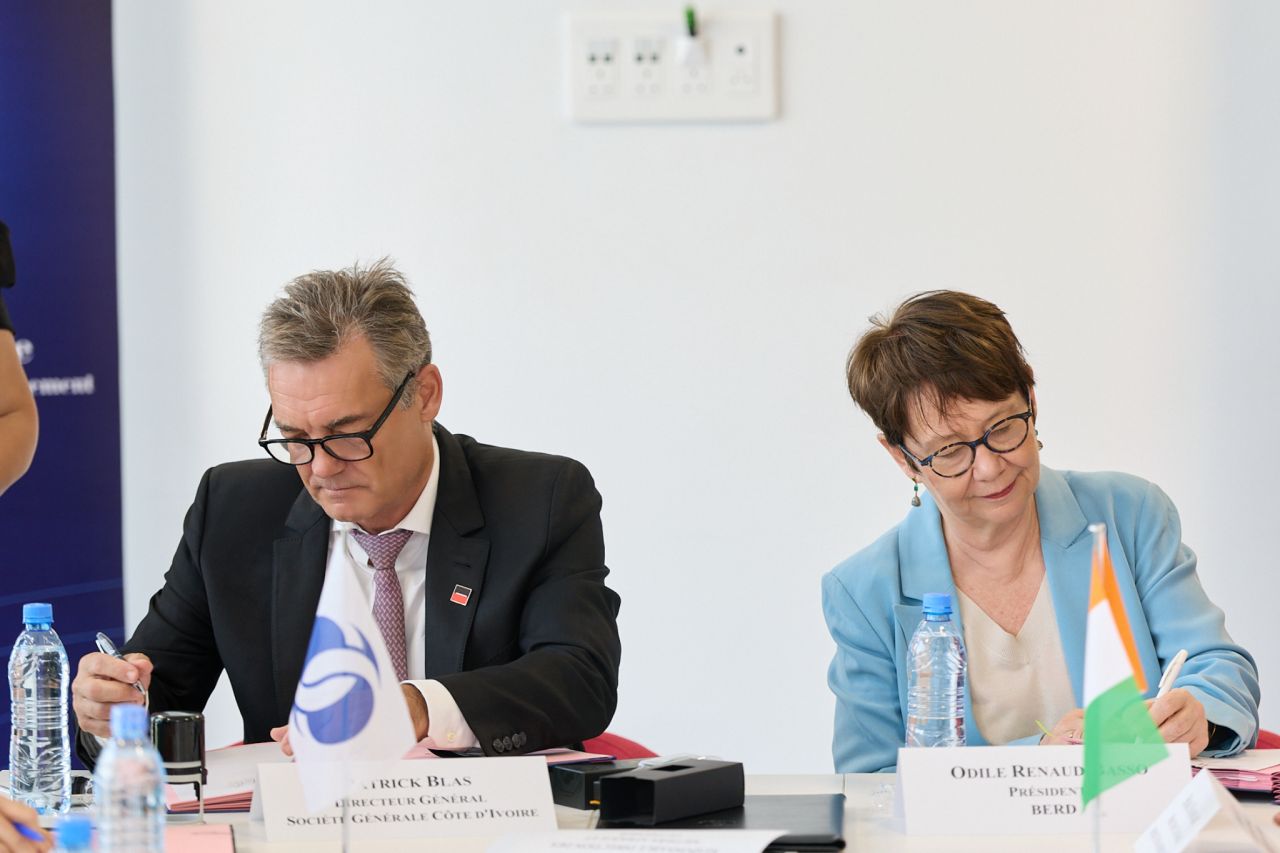
ABIDJAN, Nov 23 – The European Bank for Reconstruction and Development (EBRD) on Monday signed a €250 million financing package with Société Générale Côte d’Ivoire (SGCI), combining credit guarantees, risk-sharing arrangements and trade finance to expand lending to businesses and strengthen private-sector activity in Côte d’Ivoire.
The package is structured around three instruments designed to increase the bank’s capacity to finance companies across different segments of the economy, from micro, small and medium-sized enterprises (MSMEs) to larger businesses requiring longer-term credit.
Its largest component by lending potential is a €100 million Guarantee for Growth (G4G), an EBRD-developed product being deployed in Africa for the first time. The guarantee is designed to release lending capacity on a participating bank’s balance sheet, enabling it to extend additional credit to the real economy.
Through the arrangement, SGCI will be able to provide up to €120 million in new lending to Ivorian businesses, including at least €100 million for MSMEs. The structure is intended to expand access to financing for smaller enterprises, which often face constraints in securing the credit needed to invest, expand operations and support working capital requirements.
The second component is a €100 million risk-sharing facility, the first of its kind in Côte d’Ivoire. It will increase SGCI’s capacity to provide larger loans and extend financing over longer maturities, broadening the range of businesses and projects the bank can support.
The package also includes a €50 million trade line under the EBRD’s Trade Facilitation Programme (TFP). The facility will support eligible import and export transactions while connecting SGCI to the EBRD’s international network of partner banks. This is expected to help Ivorian companies access trade finance and participate more effectively in international markets.
EBRD expands investment activity in Côte d’Ivoire
The agreement reflects the EBRD’s expanding engagement with Côte d’Ivoire following the country’s accession as a shareholder in December 2024 and its recognition as a recipient country in July 2025.
EBRD President Odile Renaud-Basso said the latest transactions brought the Bank’s signed investment in the country to close to €500 million, demonstrating the pace of its activity since beginning operations there in 2025.
She said the partnership was intended to support the priorities of Côte d’Ivoire’s National Development Plan by strengthening domestic businesses and mobilising greater volumes of private investment.
The EBRD’s approach combines direct investment with financial-sector partnerships that can extend credit to businesses through local institutions. In this case, the guarantees and risk-sharing arrangements are designed to expand SGCI’s capacity to lend, while the trade line supports companies engaged in cross-border commerce.
The distinction between the instruments is significant. The G4G guarantee is intended to free up balance-sheet capacity for additional lending, the risk-sharing facility supports larger loans and longer maturities, while the trade line addresses financing needs associated with eligible international transactions.
SGCI positioned to expand business financing
Société Générale Côte d’Ivoire is the country’s largest bank by customer loans, with a network of 88 branches serving approximately 5,000 corporate clients and 560,000 retail customers.
Chief Executive Officer Patrick Blas said the partnership would strengthen the bank’s ability to meet the financing needs of businesses, particularly SMEs, and support their expansion plans.
The arrangement builds on SGCI’s existing role in financing Ivorian companies while adding instruments that could increase its capacity to support a broader range of borrowers.
For smaller businesses, the allocation of at least €100 million in new lending under the G4G arrangement represents a central element of the package. For larger companies, the risk-sharing facility is intended to improve access to financing with longer repayment periods. The trade line provides a separate channel for businesses involved in imports and exports.
The scale of the package also highlights the role of commercial banks in translating development-finance commitments into credit for local businesses. Rather than relying exclusively on direct lending, the EBRD is using guarantees and risk-sharing mechanisms to work through an established domestic financial institution.
The EBRD said it had invested more than €480 million in Côte d’Ivoire to date. The latest agreements add to that activity and place access to business finance, MSME lending and trade facilitation at the centre of its engagement with the country.
