
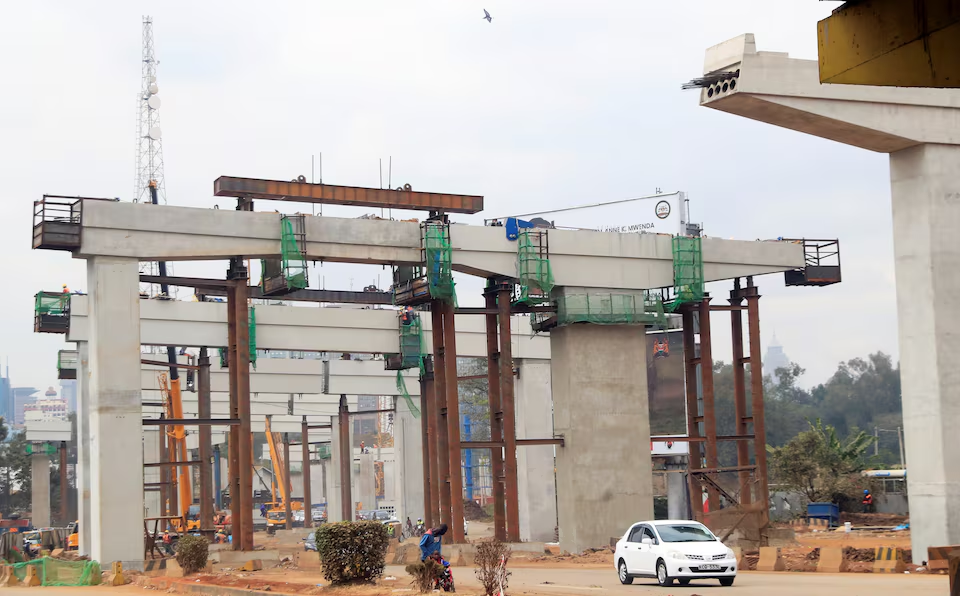
NAIROBI, Aug 19 – Kenya’s construction activity continued to expand in the first half of 2026, with higher cement production and consumption alongside a strong pipeline of building approvals indicating sustained investment across the sector.
Data from the Kenya National Bureau of Statistics (KNBS) showed that cumulative cement production reached 5.54 million metric tonnes between January and June, up from 4.86 million tonnes during the same period in 2025. Cement consumption also increased, reaching 5.46 million tonnes during the first six months of the year.
The figures point to continued demand from housing developments, commercial construction, road projects and public infrastructure programmes. Although monthly activity eased in June, the overall performance remained substantially above the levels recorded during the first half of last year.
Cement production declined to 911,141 tonnes in June from 938,136 tonnes in May, while consumption fell to 893,447 tonnes from 929,328 tonnes over the same period. The monthly decline did not materially alter the broader upward trend recorded during the first half of the year.
Kenya’s cement market had already recorded significant growth in 2025. Production reached 10.44 million tonnes, compared with 8.85 million tonnes in 2024, representing an increase of about 18%. Consumption also rose to 10.28 million tonnes from 8.54 million tonnes a year earlier.
Building approvals provide a second indication of continued construction activity. In Nairobi, the total value of approved building plans reached KSh18.5 billion in May 2026, compared with KSh14.7 billion in February.
Residential developments accounted for the largest share of approved projects. In May, residential approvals were valued at KSh14.7 billion, representing almost 80% of total approved developments, while non-residential projects accounted for KSh3.8 billion.
The value of approved projects has fluctuated throughout 2026. January recorded the highest figure so far at KSh25.7 billion, including KSh8.2 billion in residential projects and KSh17.5 billion in non-residential developments. Approvals fell to KSh14.7 billion in February before increasing to KSh22 billion in March and KSh20.1 billion in April.
The current pipeline remains significant compared with historical levels, suggesting developers continue to commit capital to new projects despite higher construction costs and wider economic uncertainty.
The pattern also reflects the changing composition of construction demand, with residential investment remaining a major driver while commercial and infrastructure projects continue to contribute to activity.
The strength of cement demand and building approvals provides an indication of underlying construction investment in Kenya. If the trend continues through the second half of 2026, the sector could remain an important contributor to economic activity, particularly through housing, infrastructure development and related industries.
