
– Business, Finance, Markets & Economic News
  • Home
  • Economy
  • Business
  • Markets
  • Finance
  • Credit Ratings
  • Policy
  • Tech
– Business, Finance, Markets & Economic News
  • Home
  • Economy
  • Business
  • Markets
  • Finance
  • Credit Ratings
  • Policy
  • Tech
Top News
Kenya Commences Turkana Oil Operations, First Production Expected December 1
Dangote Refinery Raises Nigeria Petrol Supply by 12% as Imports Climb 47% in October
ExxonMobil Approves $4 Billion Angola Oilfield Redevelopment as Block 15 Makes New Discovery
Zimbabwe Revises Lithium Export Tax Formula to Capture More Downstream Value
Gabon Seeks IMF Programme Deal in December 2026 as Eurobonds Rally
African Pension Funds Grow as OECD Highlights Investment Gaps Across Markets
Durban Gateway Terminal Faces License Threat as Shipping Delays Disrupt South African Trade
South Africa Holds Interest Rate at 7.25% as Policymakers Weigh Inflation Risks
Bank of Ghana Cuts Policy Rate by 300 Basis Points to 11% in Monetary Policy Realignment
Senegal President to Implement Revised 2026 Budget by Decree Amid IMF Programme Standoff
Kenya Awards Mrima Hill Critical Minerals Project to US-Backed Frontier Minerals Consortium
Nigeria’s Bank of Industry Earmarks 10% of Financing for Climate Projects
IMF Agrees to Unlock $2.3 Billion for Egypt as Loan Programme Nears Completion
Nigeria’s Central Bank and NNPC Sign Agreement on Oil Revenue Management and Energy Financing
Vitol Selected to Develop New Tanzania-Zambia Fuel Pipeline and Upgrade TAZAMA
SUBSCRIBE
– Business, Finance, Markets & Economic News
Subscribe
– Business, Finance, Markets & Economic News
  • Home
  • Economy
  • Business
  • Markets
  • Finance
  • Credit Ratings
  • Policy
  • Tech
Copyright 2026 - All Right Reserved
Economy

Can South Africa Leverage Global Attention Into Influence?

by Gift Egbeiyon January 27, 2026
written by Gift Egbeiyon January 27, 2026
South Africa
FacebookTwitterLinkedinEmail
227

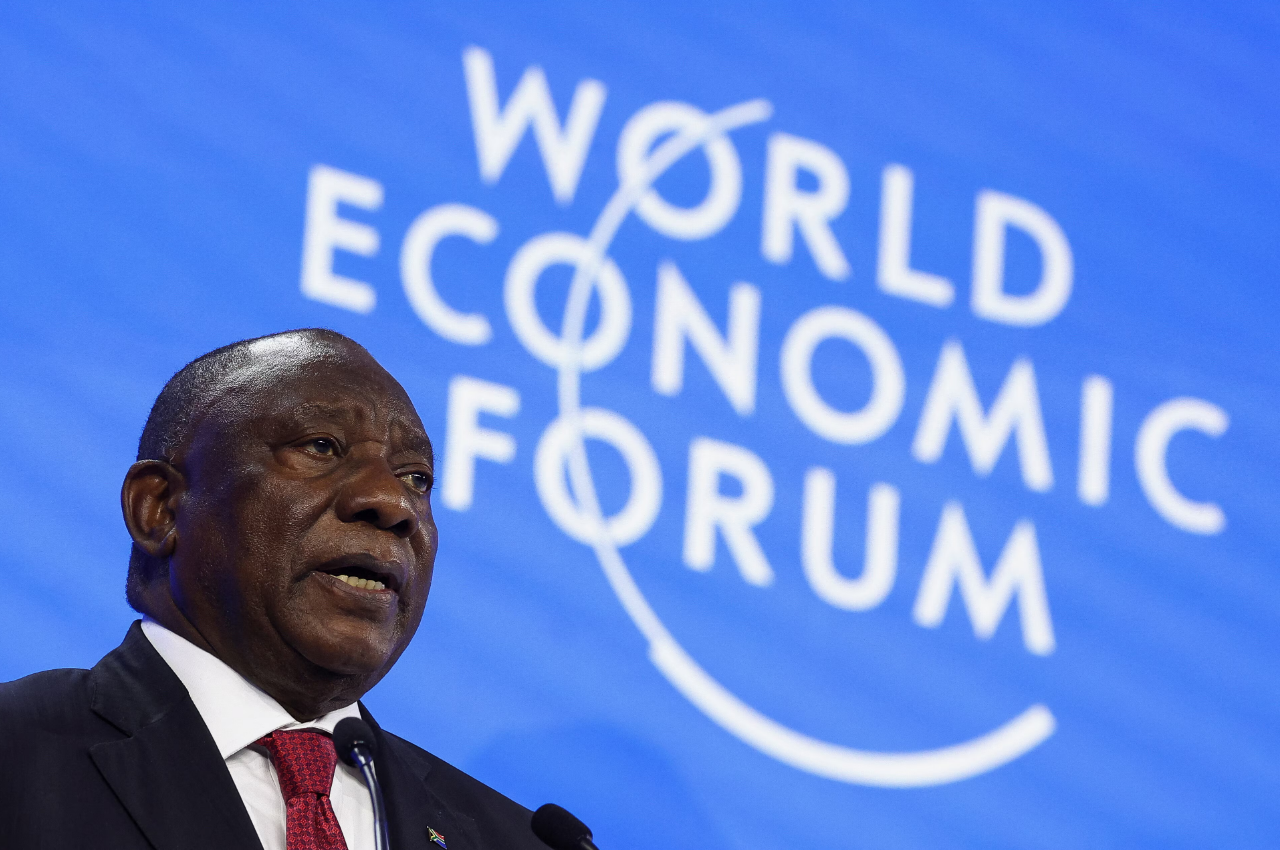
JOHANNESBURG, Jan 27 – The World Economic Forum (WEF) says it will resume hosting its Africa summit in South Africa in April 2027 after a seven-year absence caused by the Covid-19 pandemic when most global events were cancelled. 

The decision follows South Africa’s hosting of the G20 Summit, reinforcing a pattern that is difficult to ignore. Africa’s most industrialised economy is increasingly being entrusted with convening power at a time when global governance is under strain, donor fatigue is rising, and capital is searching for credible growth narratives beyond traditional markets.

Yet hosting prestige forums is not the same as wielding influence. The real test will be whether South Africa can convert visibility into leverage, and symbolism into substance.

From a diplomatic standpoint, the WEF’s move underscores confidence in South Africa’s institutional capacity, infrastructure readiness, and ability to manage complex multilateral engagements. In a fragmented global order, the ability to host neutral, high-level dialogue has become a form of soft power. South Africa is quietly reclaiming this role, positioning itself as a bridge between developed markets, the Global South, and a rapidly reordering multipolar system.

You Might Be Interested In
  • Egypt Inflation Rises to 14.9% in July as Annual Price Pressures Persist

For investors, the implications run deeper. Davos-style meetings are not merely talk shops. They are spaces where capital narratives are shaped, risks are reframed, and long-term allocation decisions begin to take form. Hosting the Special Davos Meeting gives South Africa a rare opportunity to influence how Africa is discussed in rooms that shape sovereign wealth funds, pension capital, multinational boards, and development finance institutions.

The question is whether this opportunity will reset perceptions or simply reinforce existing ones.

Africa’s challenge is not a lack of forums, but a credibility gap between promise and execution. If the 2027 meeting centres on familiar rhetoric without confronting structural constraints such as energy insecurity, logistics bottlenecks, policy uncertainty, and uneven reform momentum, the moment will fade quickly. Global capital may be patient, but it is not sentimental.

South Africa’s opportunity lies in anchoring the conversation around bankable reforms rather than aspirational themes. This means using the Davos platform to highlight regulatory clarity, infrastructure pipelines, blended finance structures, and credible public private partnerships. It also means presenting Africa not as a single story, but as a set of differentiated markets with distinct risk and return profiles.

While the short-term boost to tourism, hospitality, and services will be welcome, it is the least significant outcome. The more enduring prize is reputational. A successful meeting would reinforce South Africa’s standing as Africa’s diplomatic and commercial gateway at a time when competition for that role is intensifying.

There is also a continental dimension. Although hosted in South Africa, the meeting’s legitimacy will depend on whether it advances broader African priorities rather than national branding alone. If the agenda meaningfully addresses industrialisation, employment, trade integration, and sustainable financing, the event could mark a pivot in how Africa engages with global economic governance.

Ultimately, the WEF Special Davos Meeting is not a reward for past performance. It is a test of future relevance. South Africa has been given the spotlight. Whether it can translate global attention into influence, and influence into investment, will determine whether this moment becomes a turning point or just another footnote in Africa’s long engagement with the world economy.

Read Next

  • Gabon Seeks Up to $1.5 Billion in International Borrowing Under Revised 2026 Budget

    July 21, 2026
  • South Africa’s Inflation Expectations Drop Sharply After New 3% Target

    December 12, 2025
  • Gabon Raises $580 Million in 8-Year Eurobond as IMF Programme Talks Advance

    October 15, 2026
  • Uganda MPs Question Heavy Budget Tilt Toward State Industrial Body

    April 16, 2026
  • Namibia Central Bank Raises Repo Rate to 6.75% as Inflation Pressures Build

    June 17, 2026

Newsletter

Subscribe to our newsletter for trusted insights on Africa’s economies, markets, and business.

African Economy Inc. Logo

About Us

We are a business and economic intelligence platform delivering in-depth reporting, analysis, and insights on markets, companies and economic developments across Africa.

Our Company

  • AI Disclosure Policy
  • About
  • Editorial Standard
  • Partnerships
  • Advertise With Us
  • Careers
  • Ownership

News

  • Economy
  • Business
  • Markets
  • Finance
  • Credit Ratings
  • Policy
  • Tech

Useful Links

  • Privacy Policy
  • Terms of Use
  • Closed Captioning Policy
  • Accessibility Statement
  • Personal Information
  • Data Tracking
  • Register New Account

Subscribe Newsletter

Subscribe to our newsletter for trusted insights on Africa’s economies, markets, and business.

©2026 Majons Media Inc. All Rights Reserved.

Facebook Twitter Instagram Linkedin
Manage Consent
To provide the best experiences, we use technologies like cookies to store and/or access device information. Consenting to these technologies will allow us to process data such as browsing behavior or unique IDs on this site. Not consenting or withdrawing consent, may adversely affect certain features and functions.
Functional Always active
The technical storage or access is strictly necessary for the legitimate purpose of enabling the use of a specific service explicitly requested by the subscriber or user, or for the sole purpose of carrying out the transmission of a communication over an electronic communications network.
Preferences
The technical storage or access is necessary for the legitimate purpose of storing preferences that are not requested by the subscriber or user.
Statistics
The technical storage or access that is used exclusively for statistical purposes. The technical storage or access that is used exclusively for anonymous statistical purposes. Without a subpoena, voluntary compliance on the part of your Internet Service Provider, or additional records from a third party, information stored or retrieved for this purpose alone cannot usually be used to identify you.
Marketing
The technical storage or access is required to create user profiles to send advertising, or to track the user on a website or across several websites for similar marketing purposes.
  • Manage options
  • Manage services
  • Manage {vendor_count} vendors
  • Read more about these purposes
View preferences
  • {title}
  • {title}
  • {title}
– Business, Finance, Markets & Economic News
  • Economy
  • Business
  • Markets
  • Banking & Finance
  • Energy
  • Tech
  • Policy
  • African Economy Inc.