
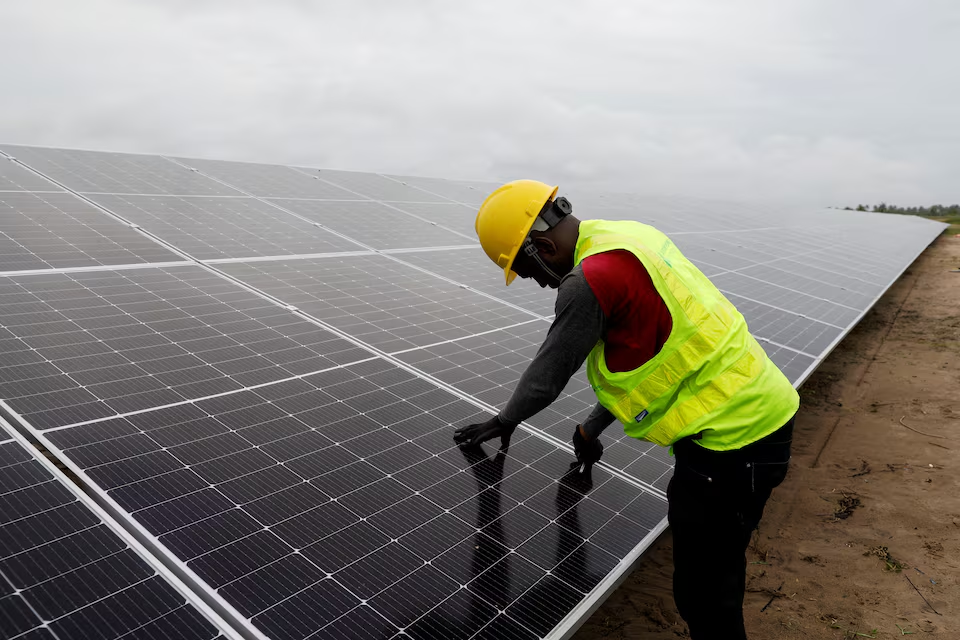
LAGOS, Nov 19 – Nigeria’s Bank of Industry plans to direct at least 10% of its financing interventions towards climate and sustainability-focused projects under its 2025-2027 strategy, as the development finance institution seeks to support cleaner industrial production and reduce operating costs for businesses.
The commitment covers investments in renewable energy, climate-smart agriculture and energy-efficient manufacturing. BOI also intends to mobilise additional funding and partnerships to help businesses adopt sustainable production practices.
Managing Director and Chief Executive Officer Olasupo Olusi disclosed the strategy at the second edition of the bank’s Sustainability Conference in Lagos on Wednesday, November 18, 2026.
The conference, themed “Green, Resilient, Profitable: Redefining Nigerian Businesses for a Sustainable World,” brought together government officials, development finance institutions and private-sector stakeholders to discuss the integration of environmental, social and governance (ESG) standards into business operations.
BOI seeks partnerships to expand climate financing
Olusi said rising energy costs, climate-related disruptions, resource constraints and changing global market expectations were making sustainability increasingly important to the competitiveness and long-term survival of Nigerian businesses.
He noted that manufacturers continued to face high energy costs, dependence on alternative power generation and inefficient production systems. Investments in renewable energy, efficient equipment and cleaner production processes, he said, could reduce operating expenses and improve productivity.
“Businesses must find ways to operate more efficiently, withstand economic and environmental shocks, and remain profitable. These objectives are interconnected, and the ability to achieve them will shape the future of Nigerian industry,” he said.
BOI is working with development partners, including the Deutsche Gesellschaft für Internationale Zusammenarbeit (GIZ) and the Africa Guarantee Fund, to mobilise climate finance, reduce financing barriers and support businesses adopting sustainable practices.
Olusi emphasised that access to funding alone would not be sufficient to drive the transition, calling on businesses to invest in innovation, strengthen governance and integrate sustainability into their commercial strategies.
“Financing is one part of the transition. Businesses must also embrace innovation, strengthen governance, and integrate sustainability into their operations in ways that improve their long-term competitiveness,” he said.
The Federal Ministry of Industry, Trade and Investment also called for stronger green financing and technical support, particularly for small and medium-sized enterprises (SMEs).
Speaking on behalf of the ministry, Permanent Secretary Christopher Isokpunwu described sustainability as a business imperative increasingly influencing access to capital, operational efficiency, market access and competitiveness.
“Simply put, green business is increasingly smart business,” he said.
Isokpunwu said manufacturers investing in renewable energy could reduce operating costs and protect profit margins, while agribusinesses adopting circular production, resource efficiency and waste reduction could strengthen local value chains.
He added that Nigeria’s ambition to build a $1 trillion economy would require industries that are more productive, innovative, resilient and globally competitive.
AFD provides €100 million facility for climate projects
The financing constraints facing businesses were also highlighted by Jackie Amprou, Nigeria Country Manager of Agence Française de Développement (AFD).
Amprou said strong environmental and social performance did not automatically translate into access to capital. He identified project bankability, institutional and technical capacity, and actual or perceived financial risks as obstacles preventing businesses from securing funding for green investments.
“We must move beyond simply rewarding green performance. We must actively finance green transformation,” Amprou said.
AFD’s partnership with BOI under the Transforming Financial Systems for Climate (TFSC) programme is designed to address these constraints through a €100 million non-sovereign credit facility, co-financed by AFD and the Green Climate Fund, alongside a €2.5 million technical assistance grant.
The credit facility supports climate mitigation and adaptation projects, while the technical assistance grant is intended to strengthen BOI’s climate strategy, climate-risk management, environmental and social systems, and capacity to identify and finance eligible investments.
Amprou said the institutional capacity developed through the programme had also helped BOI access a separate $30 million AFD credit facility for Nigeria’s creative industries.
The combination of BOI’s planned climate financing allocation, development partner funding and technical assistance is intended to expand access to capital for businesses investing in more sustainable production systems.
