
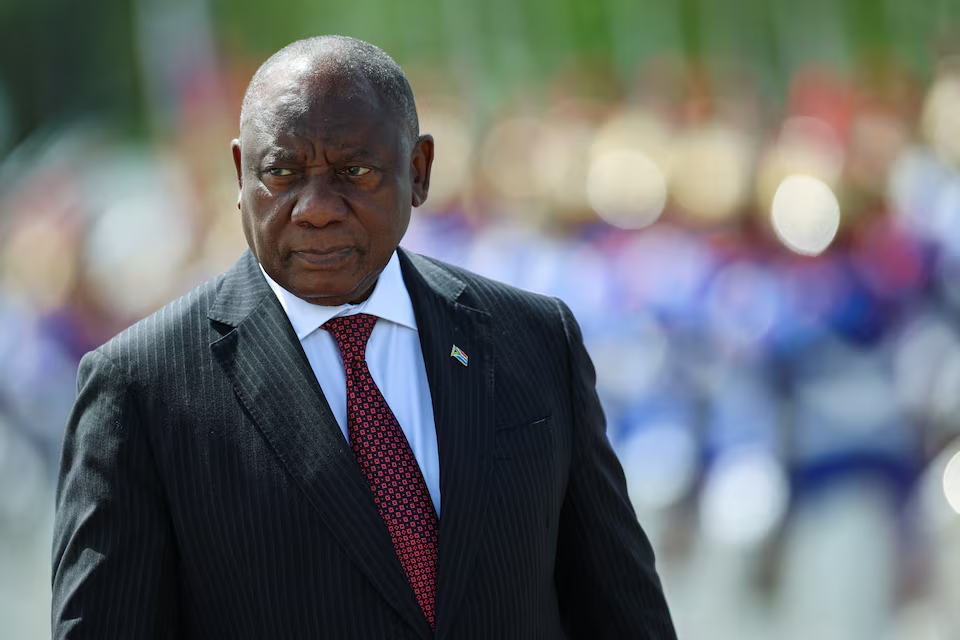
JOHANNESBURG, Nov 21 – South Africa is seeking to attract more capital from the global technology industry, with President Cyril Ramaphosa using an engagement at Stanford University in California to promote the country’s economic reforms, infrastructure programme and improving electricity supply.
Speaking during a fireside chat with members of the university community, Ramaphosa invited Silicon Valley companies and investors to consider opportunities in South Africa, arguing that the country was becoming more receptive to investment as it works to address longstanding constraints on economic activity.
The government is targeting economic growth of 3%, a goal Ramaphosa described as a shared national ambition because of its potential to support job creation. He said cooperation with the private sector remained central to accelerating reforms and improving the operating environment for businesses.
Infrastructure spending forms another major part of the government’s growth strategy. Ramaphosa said South Africa had budgeted R1 trillion (approximately US$74 billion) for infrastructure investment over three years, describing the programme as a mechanism for stimulating wider economic activity and expanding productive capacity.
“We are also looking at infrastructure growth. We have budgeted 1 trillion rand infrastructure investment, for the very first time in South Africa that we’re going to have 1 trillion rand to be invested in three years to ramp up infrastructure, because we see infrastructure as the flywheel that will generate more growth,” he said.
Electricity generation was among the areas where he said progress was becoming visible. Government is also pursuing changes across ports, harbours and the wider logistics system, which remain important to the movement of goods and the performance of the productive economy.
The President acknowledged that funding alone would not guarantee delivery. He called for a more capable public administration, stronger cooperation between government and business, and reductions in bureaucratic obstacles that delay project execution.
The investment appeal also rests on South Africa’s ability to support technology-intensive industries. Ramaphosa identified improved electricity generation as an important consideration for investors, particularly data-centre operators whose businesses require reliable and substantial power supply. He said international technology companies were already establishing data centres in the country, alongside investment by local firms.
He added that the government’s objective extended beyond attracting foreign technology companies. South Africa wants domestic businesses and workers to participate more extensively in the value chains developing around artificial intelligence and other emerging technologies.
Skills development is therefore a central component of the country’s longer-term strategy. Ramaphosa said the Silicon Valley delegation included a significant number of young South Africans to expose them to global technology developments, leading institutions and potential business opportunities. He expects this exposure to support the development of a workforce capable of taking up skilled positions and establishing technology businesses.
The President also linked the skills agenda to changes in the education system, including early childhood development and improvements in education quality. He said the government wanted technological learning to begin at an earlier age, including introducing coding and AI-related skills to young children.
“We are now starting at that level to undo the damage that was done by apartheid, because two things that apartheid did were the dispossession of our people’s assets, as well as Bantu education, or bad education.
“We’re reforming our education and starting the education at a very young age so that children at four years old should be able to code, they should be able to be proficient with technology and now of late with artificial intelligence as well, because that will improve their skill base and that will enable them to be important players in the economic development of our country,” he said.
Beyond infrastructure and human capital, Ramaphosa pointed to the country’s constitutional and institutional framework as part of its investment proposition. He cited the independence of the judiciary, Parliament, the central bank and other democratic institutions as sources of stability and investor certainty. Professionalising the public service, he added, was necessary to strengthen the state’s ability to implement policy and deliver services.
Looking further ahead, the President outlined a more ambitious economic destination than the government’s immediate 3% growth target. He said his vision was for South Africa to achieve annual growth of between 5% and 6%, accompanied by lower poverty and inequality, higher employment and a stronger domestic technology base.
“And where South Africa has an economy that will be growing, let’s say 5% or 6% or so, where the new technologies of the world are well appropriated in South Africa and where South Africa is also generating new technologies,” he said.
The Stanford engagement formed part of a wider presidential mission to Silicon Valley, which Ramaphosa described as an opportunity to deepen South Africa’s understanding of artificial intelligence and develop partnerships capable of supporting economic growth.
The challenge for South Africa will be to translate its investment pitch into sustained capital commitments and measurable improvements in infrastructure, energy reliability, logistics and skills. The government’s stated priorities place these areas at the centre of its effort to make the economy more competitive and expand participation in technology-driven industries.
