
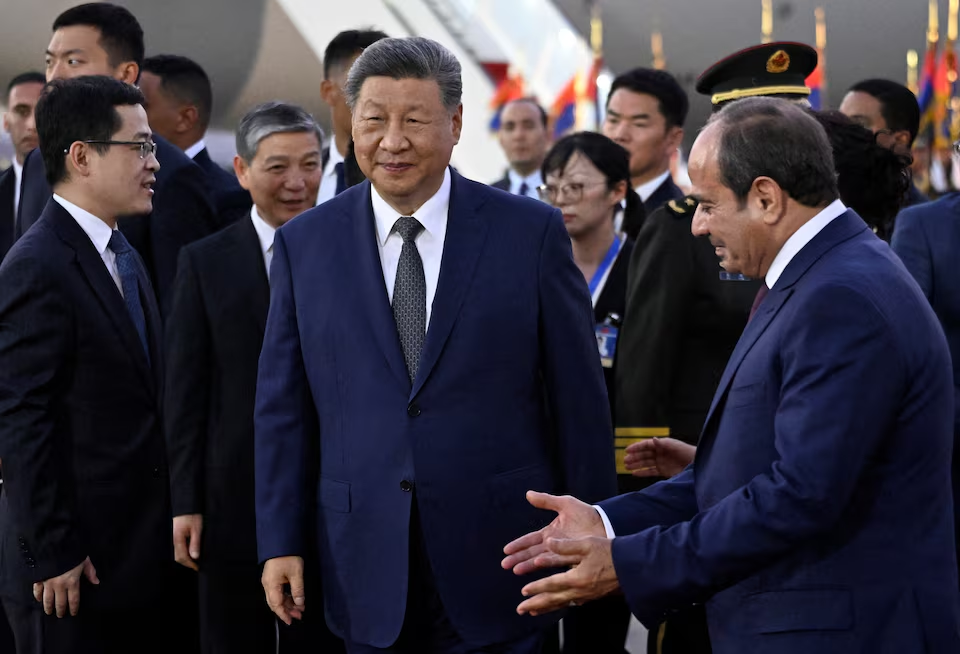
CAIRO, Sept 2 – Chinese President Xi Jinping met Egyptian President Abdel Fattah El-Sisi in Cairo on Wednesday, opening a visit that underscores the deepening economic, investment and strategic relationship between China and Egypt.
Xi, who arrived in the Egyptian capital on Tuesday, was received by El-Sisi at Ittihadiya Palace in an official ceremony. The visit is his first to Egypt in a decade and comes at a time when turmoil across the Middle East is prompting countries in the region to reassess their economic and security relationships.
Egypt has traditionally maintained close ties with the United States and receives about $1.3 billion a year in US military assistance. At the same time, Cairo has steadily expanded its relationship with Beijing, with economic and military cooperation accelerating since 2014, when El-Sisi visited China and the two countries established a strategic partnership.
The widening relationship reflects Egypt’s efforts to diversify its international partnerships while China seeks to strengthen its influence in the Middle East and expand its economic links across Africa.
Ayman Zaineldine, a former Egyptian diplomat, said Egypt was seeking broader relationships with major global powers. “Egypt wants to widen the circle of its relations with major world powers, including China,” he told Reuters. “So the visions converge.”
Trade and investment are central to the relationship. Egypt, home to more than 110 million people and the Suez Canal, represents a major consumer market for Chinese companies while providing Beijing with an important strategic gateway between Asia, Europe and Africa.
Egyptian government data showed that imports from China exceeded $10 billion during the first half of the year, an increase of more than 14% from the same period a year earlier.
Chinese companies have also established a significant presence across Egypt’s infrastructure and industrial economy. Investments have extended from container ports and green hydrogen projects to manufacturing facilities producing iron pipes, vehicle tyres and other industrial products.
China State Construction Engineering Corporation has played a major role in developing the business district of Egypt’s new administrative capital, one of El-Sisi’s flagship infrastructure projects.
H. A. Hellyer, a scholar at the Royal United Services Institute, said Egypt offered Beijing several strategic advantages. “Egypt represents something quite valuable to Beijing – a large domestic market for investment opportunities, and a lot of diplomatic weight in the region, including the Palestine question, as well as connectivity to Africa,” he said.
Military cooperation has also become a more prominent part of the relationship. Last month, Egypt and China conducted the “Eagles of Civilization” military exercises, which included an air combat exercise involving Chinese-made J-16 fighter aircraft and French-made Rafale jets.
The exercises highlighted the expansion of defence ties between the two countries as Egypt continues to maintain its longstanding security partnership with Washington while developing additional military relationships.
For Beijing, Egypt’s geographic position adds to its strategic value. The Suez Canal is one of the world’s most important maritime trade routes, while Egypt’s location gives China access to markets across the Middle East, North Africa and the wider African continent.
The relationship is therefore extending beyond conventional trade into infrastructure, energy, manufacturing, technology and defence. For Egypt, deeper engagement with China provides another source of investment and economic cooperation as the government seeks to attract capital and strengthen its position as a regional commercial hub.
Xi’s visit comes against the backdrop of wider geopolitical shifts in the Middle East, making the China-Egypt relationship increasingly relevant to the region’s economic and strategic landscape. As Cairo continues to diversify its international partnerships, Beijing is positioning itself as an increasingly important economic and diplomatic partner.
