
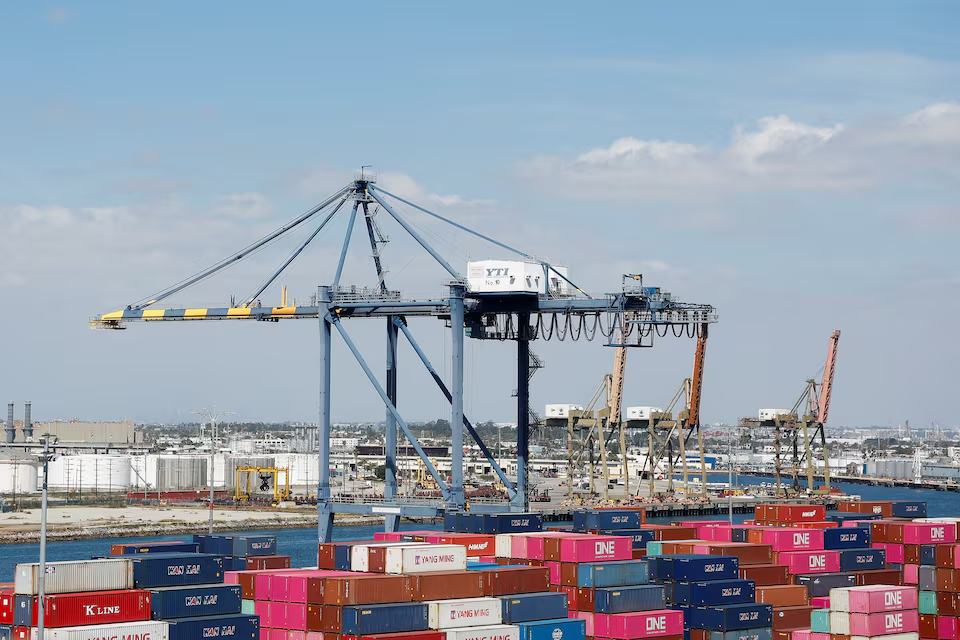
RABAT, July 19 – Morocco’s OCP Group is finalising logistics to resume phosphate fertilizer exports to the United States, following the Trump administration’s decision to temporarily suspend import duties on Moroccan phosphate fertilizers.
According to Stephen Vaden, Deputy Secretary of the United States Department of Agriculture (USDA), shipments could begin arriving in New Orleans as early as the end of this week or next week, once customs classification procedures are completed.
Vaden said OCP’s Chief Executive Officer met with USDA officials this week to finalise the remaining administrative requirements.
According to Vaden, “The last hurdle is working with U.S. Customs and Border Protection to determine exactly how to classify the shipments under the President’s order.”
The resumption follows President Donald Trump’s June 29 proclamation, which suspended certain antidumping and countervailing duties on Moroccan phosphate fertilizer for eight months.
The White House invoked Section 318 of the Tariff Act of 1930, declaring an emergency over concerns about the availability of fertilizer supplies needed to support US agricultural production. The temporary suspension allows Moroccan phosphate fertilizer to enter the United States duty-free throughout the eight-month period.
Unlike quota-based trade measures, the suspension places no limits on shipment volumes.
Vaden said, “That means that if retailers want to place large orders with OCP, they absolutely can do that.”
He added that retailers choosing to secure supplies beyond the current growing season would be making “a smart business decision”, noting that businesses could begin stockpiling fertilizer for future planting seasons while the suspension remains in effect.
The USDA estimates that the policy could reduce phosphate fertilizer costs by as much as 22%, generating approximately $1.82 billion in annual savings for American farmers and benefiting nearly 100,000 producers across 97 million planted acres.
Although fertilizer prices have yet to respond, Vaden said the market impact is expected once shipments begin arriving.
According to him, “Those price effects should begin to filter through when the ships hit New Orleans.”
Market data cited by DTN showed Monoammonium Phosphate (MAP) averaged $954 per tonne, down $1 from the previous month, while Diammonium Phosphate (DAP) averaged $912 per tonne, up $3 over the same period.
Headquartered in Casablanca, OCP is the world’s largest producer of phosphate rock and phosphate-based fertilizers. Morocco controls more than 70% of the world’s known phosphate reserves, while OCP accounts for approximately 31% of the global phosphate market, making it one of the most strategically important suppliers of agricultural nutrients worldwide.
The temporary duty suspension also marks a significant reversal of US trade policy introduced in 2021, when Washington imposed a 19.97% countervailing duty on Moroccan phosphate imports following a complaint from The Mosaic Company, which argued that subsidised imports were harming domestic producers.
The tariff was gradually reduced through subsequent reviews before the US Court of International Trade lowered the duty to 2.11% in December 2025. By March 2026, the US government had withdrawn its appeal.
Meanwhile, scrutiny of the US fertilizer market continues to intensify. The Federal Trade Commission (FTC) is investigating competition in the industry, while the Iowa Corn Growers Association and 16 other state corn organisations have urged the Department of Justice (DOJ) to accelerate its own investigation into alleged anti-competitive practices.
Commenting on the broader investigation, Vaden said, “Announcements and reports of investigations are welcome news, but it will take decisive action to restore free and fair markets.”
He also warned that companies engaging in anti-competitive behaviour should expect increased regulatory scrutiny, adding, “If I’m in one of these other industries and there’s other chicanery afoot, I would not sleep soundly at night.”
The reopening of the US market comes at a time when global fertilizer supply chains remain under pressure from geopolitical disruptions, tighter export controls by major producers and declining domestic phosphate production in the United States, reinforcing Morocco’s strategic importance to global food security.
