
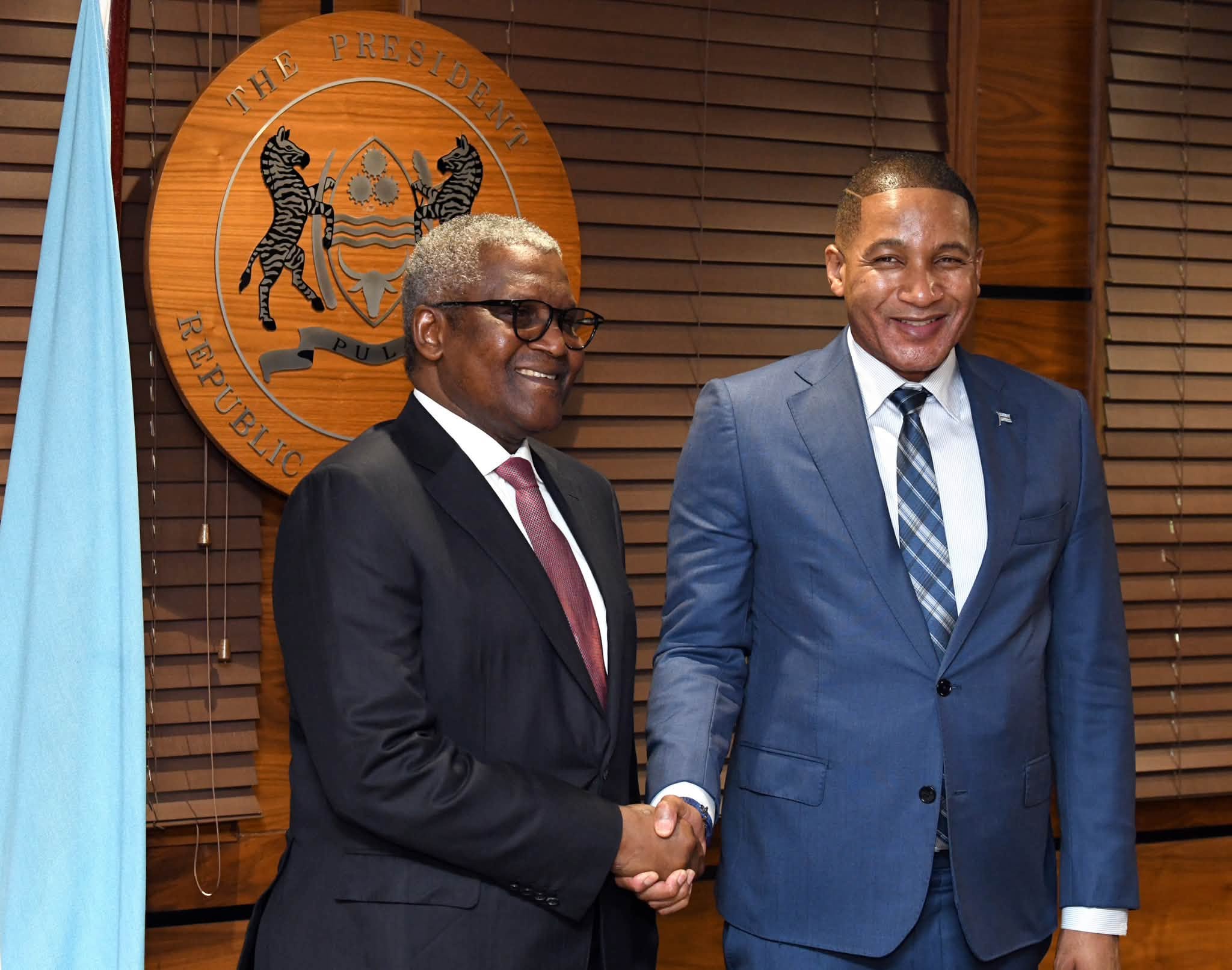
GABORONE, Sept 3 – Africa’s richest man, Aliko Dangote has held discussions with Botswana President Duma Boko in Gaborone on Thursday for talks focused on potential large-scale infrastructure and industrial investments as the southern African country seeks to deepen private-sector participation in its development agenda.
President Boko welcomed Dangote and recalled previous meetings with the businessman in New York and at the African Union Summit in Addis Ababa. He said discussions had continued through direct engagement and with institutions including the Botswana Stock Exchange.
Boko used the meeting to emphasise the need for African countries to rely more heavily on domestic entrepreneurs and investors to drive economic development. He argued that governments across the continent have not done enough to create conditions that allow African businesses and investors to participate more fully in major development projects.
With Africa’s population projected to account for about a quarter of the world’s population by 2050, Boko said the continent must strengthen its productive capacity and reduce dependence on imported goods, including basic consumer products such as detergent.
The Botswana president identified implementation as one of the continent’s biggest development constraints, arguing that governments already have many of the policies and ideas required to promote economic transformation but have struggled to execute them at scale.
He pointed to Dangote Group as an example of large-scale implementation, citing the company’s investments in Ethiopia and Congo-Brazzaville, as well as its refinery expansion in Kenya.
Boko said Botswana was prepared to work with the Dangote Group on major projects and highlighted regional infrastructure as an immediate area of opportunity. Among the projects discussed was the Trans-Kalahari rail line, which he said should begin construction this year.
The proposed railway could create additional demand for construction materials, including cement, while improving regional connectivity and supporting trade. Botswana, Boko said, was prepared to move quickly on opportunities that could generate wider economic activity.
The president also urged Dangote to engage Botswana’s pension funds and other institutional investors, seeking to mobilise domestic capital for major infrastructure projects. He framed the discussions as an opportunity to pursue substantial investments rather than smaller-scale projects.
Boko described Dangote’s visit as the beginning of a “spectacular journey” centred on major investments and said several meetings scheduled during the day were intended to translate the discussions into concrete plans.
The engagement reflects a broader push to strengthen African private-sector participation in infrastructure and industrial development. For Botswana, attracting large African corporate investors could provide additional capital and implementation capacity for projects aimed at improving connectivity, industrial output and employment.
For Dangote Group, deeper engagement with Botswana would extend the conglomerate’s continental expansion strategy and potentially create new opportunities across infrastructure, manufacturing, construction materials and other sectors linked to Africa’s industrialisation.
