

– Business, Finance, Markets & Economic News
  • Home
  • Economy
  • Business
  • Markets
  • Finance
  • Credit Ratings
  • Policy
  • Tech
– Business, Finance, Markets & Economic News
  • Home
  • Economy
  • Business
  • Markets
  • Finance
  • Credit Ratings
  • Policy
  • Tech
Top News
TotalEnergies to Invest $10 Billion in Angola as It Targets Sustained Oil Production
Kenya Set for About $400 Million World Bank Emergency Financing Amid Rising Risks
South Africa Swings to 2.6% Current Account Deficit as Higher Oil Costs Hit Imports
Emerging-Market Private Credit Fundraising Surges to $8.7 Billion in H1 2026
TotalEnergies Makes New Angola Oil Discovery, Expands Exploration Footprint
Egypt’s Annual Urban Consumer Price Inflation Eases to 14.5% in August, Stats Agency Says
Senegal to Put 109 Oil and Gas Blocks on Market as Dakar Seeks New Energy Investors
Angola Moves to Open $18.6 Billion Domestic Bond Market to Foreign Investors
India’s Lohum Begins Lithium Mining in Zimbabwe With First Overseas Shipment
Africa’s Deposits Rise 12% to $156.30 billion as Payment Activity Accelerates, Standard Bank says
Morocco and Guinea Sign 25 Agreements to Deepen Strategic Economic Partnership
Africa50 Targets $20 Billion Infrastructure Portfolio as Funding Gap Widens
Senegal Rejects Restructuring, Plans Debt Reprofiling Under $2.2 Billion IMF Deal
Africa’s Private Credit Market Set for Further Growth as Financing Gap Widens
Mauritius Explores Etihad Partnership as Island Seeks to Expand Aviation Network
SUBSCRIBE
– Business, Finance, Markets & Economic News
Subscribe
– Business, Finance, Markets & Economic News
  • Home
  • Economy
  • Business
  • Markets
  • Finance
  • Credit Ratings
  • Policy
  • Tech
Copyright 2026 - All Right Reserved
Home » Insights » How Africa Powers the Global Green Economy but Misses the Profits
Insights

How Africa Powers the Global Green Economy but Misses the Profits

by Oluebube Elechi March 16, 2026
written by Oluebube Elechi March 16, 2026
FacebookTwitterLinkedinEmail
176

JOHANNESBERG, Mar 16 – Africa has become a central supplier of the minerals used in electric vehicles, renewable power systems and battery storage technologies. Yet most of the economic value linked to those resources is generated outside the continent.

Critical minerals such as cobalt, lithium, manganese and graphite are essential inputs for lithium‑ion batteries, wind turbines and solar infrastructure. Demand for these materials is rising as governments and companies accelerate the shift toward low‑carbon energy systems.

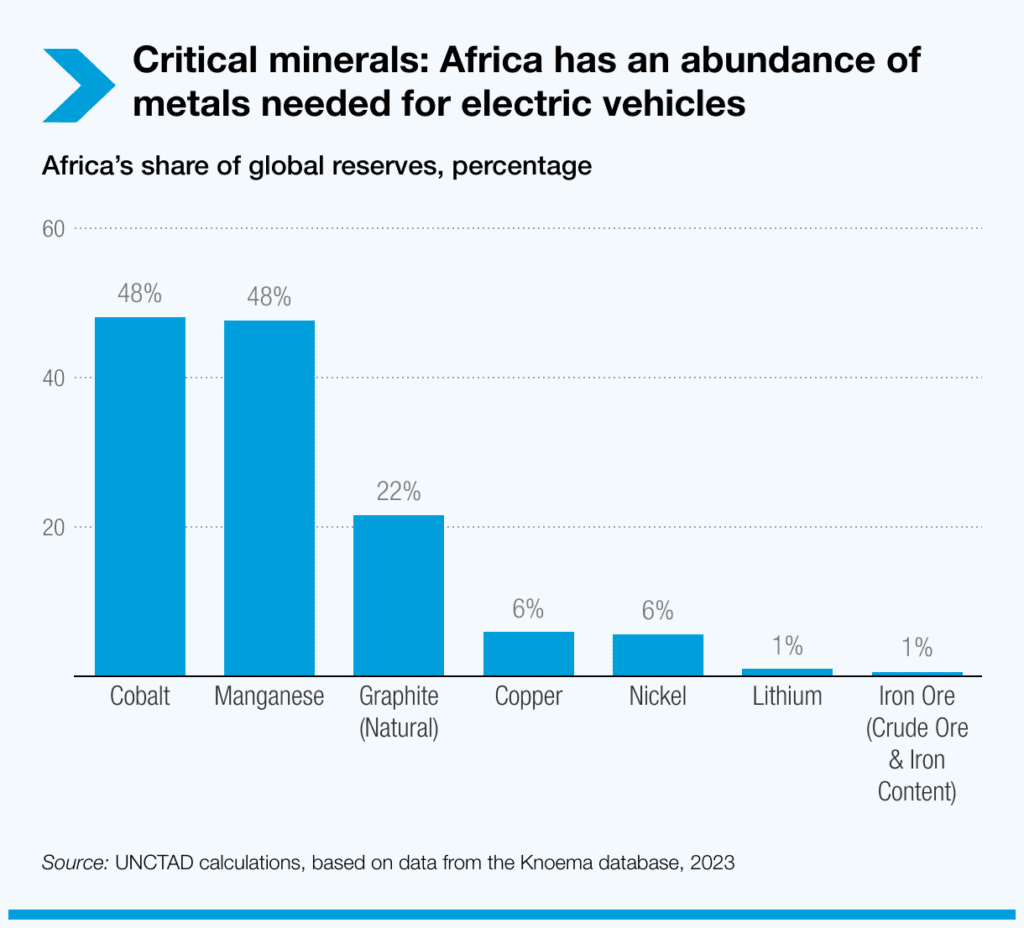
According to the United Nations Conference on Trade and Development, Africa holds a large share of these resources. The continent accounts for about 47% of global cobalt reserves and nearly half of the world’s manganese reserves. These minerals play a key role in battery production and energy storage technologies that support renewable electricity networks.

However, most of the value associated with the industry is created outside the region.
You Might Be Interested In
  • Africa Attracts Over $20 Billion in Investment as Ethiopia and Kenya Drive FDI Surge

The imbalance is evident in the Democratic Republic of Congo, which produces more than 70% of global cobalt supply. Much of the metal mined in the country is exported in raw or semi‑processed form to refineries and battery manufacturers in Asia, Europe and North America.

Processing, battery cell production and electric vehicle manufacturing remain concentrated in those regions. As a result, African producers capture only a limited share of the broader industrial value chain.

The gap reflects the structure of global mineral supply networks, where extraction often occurs in resource‑rich countries while higher value manufacturing is located in major industrial economies.

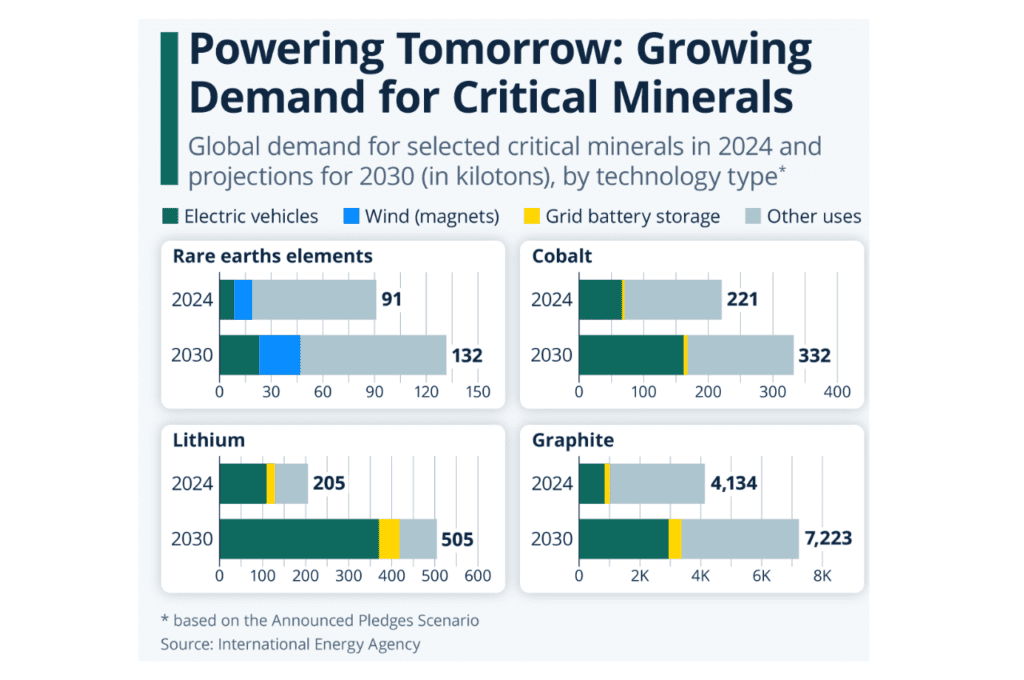
Demand for these materials is expected to increase sharply in the coming decades. Analysis from the International Energy Agency shows that the global energy transition could significantly increase demand for battery metals by 2040 as electric vehicle adoption and renewable energy deployment expand.

The imbalance is visible in the Democratic Republic of Congo, the world’s largest cobalt producer. The country supplies more than 70% of global cobalt output, according to data cited by S&P Global. Most of that production is exported as raw or semi processed material before it is refined and used in battery manufacturing abroad.
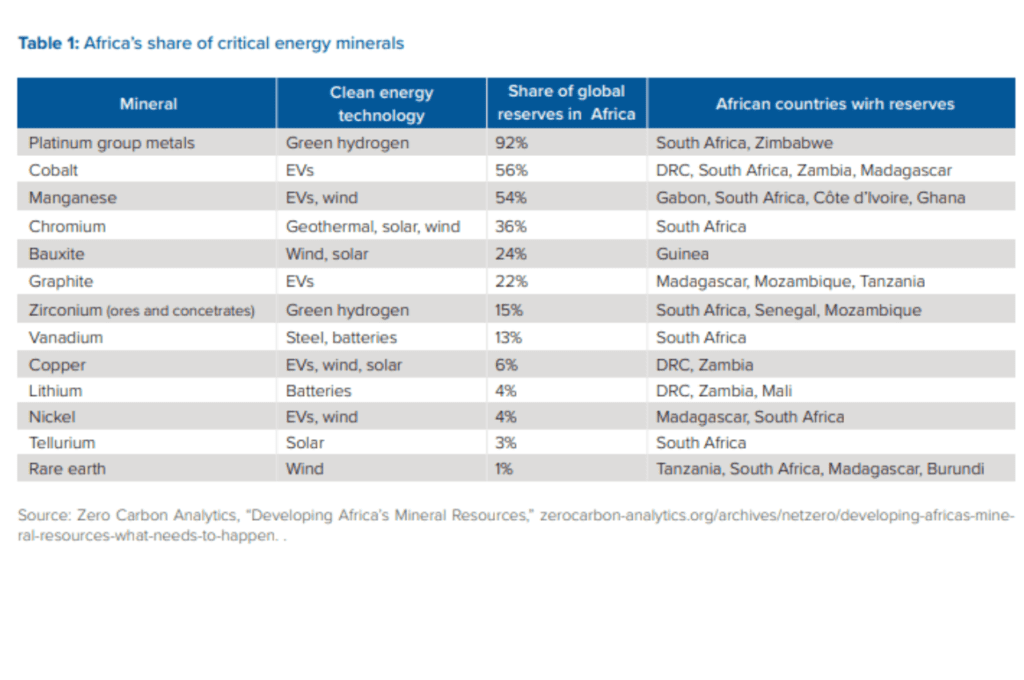
Analysts estimate that African countries capture only around 10 percent of the total value generated across the critical minerals supply chain, according to research cited by DevelopmentAid. Higher value activities such as refining, battery production and advanced materials manufacturing remain concentrated in other regions.

Demand for these resources is expected to increase as governments and companies accelerate the shift toward low carbon energy systems. Projections cited by researchers drawing on analysis from the International Energy Agency suggest demand for lithium could increase fivefold between 2025 and 2040, while demand for minerals such as graphite and nickel could double.

The rising demand has intensified geopolitical competition for access to mineral supplies. Governments in the United States, China and the European Union have increased engagement with African producers as they seek to secure supply chains for battery metals and other strategic resources.
However, processing capacity remains heavily concentrated outside Africa. In several battery metal markets, Chinese companies control a large share of global refining infrastructure even when the raw materials originate in African mines.

Some African governments have begun introducing policies aimed at retaining more value locally. The government of Zimbabwe has restricted exports of unprocessed lithium ore in an effort to encourage investment in domestic processing facilities.

Analysts say capturing more value from critical minerals will require investment in energy infrastructure, industrial capacity and skills development across the continent.

For Africa, the growing global demand for battery metals presents both an opportunity to expand exports and a longer term challenge of building the industries that transform those resources into higher value products.

Read Next

  • S&P Upgrades Nigeria’s Sovereign Rating to B on Stronger Economic Outlook

    May 16, 2026
  • Bank of Tanzania Invests in Africa Finance Corporation to Boost Infrastructure Financing

    March 18, 2026
  • Senegal Eurobonds Recover as IMF Reaches $2.2 Billion Loan Deal with Government

    September 2, 2026
  • IMF to Resume Senegal Talks as Country Moves Toward New Lending Programme

    August 18, 2026
  • Petra Diamonds Begins Job Cuts and Restructuring at South Africa’s Finsch Mine

    June 1, 2026

Newsletter

Subscribe to our newsletter for trusted insights on Africa’s economies, markets, and business.

African Economy Inc. Logo

About Us

We are a business and economic intelligence platform delivering in-depth reporting, analysis, and insights on markets, companies and economic developments across Africa.

Our Company

  • AEI Intelligence
  • About
  • Editorial Standard
  • Partnerships
  • Advertise With Us
  • Careers
  • Ownership

News

  • Economy
  • Business
  • Markets
  • Finance
  • Credit Ratings
  • Policy
  • Tech

Useful Links

  • Privacy Policy
  • Terms of Use
  • Closed Captioning Policy
  • Accessibility Statement
  • Personal Information
  • Data Tracking
  • Register New Account

Subscribe Newsletter

Subscribe to our newsletter for trusted insights on Africa’s economies, markets, and business.

©2026 Majons Media Inc. All Rights Reserved.

Facebook Twitter Instagram Linkedin
Manage Consent
To provide the best experiences, we use technologies like cookies to store and/or access device information. Consenting to these technologies will allow us to process data such as browsing behavior or unique IDs on this site. Not consenting or withdrawing consent, may adversely affect certain features and functions.
Functional Always active
The technical storage or access is strictly necessary for the legitimate purpose of enabling the use of a specific service explicitly requested by the subscriber or user, or for the sole purpose of carrying out the transmission of a communication over an electronic communications network.
Preferences
The technical storage or access is necessary for the legitimate purpose of storing preferences that are not requested by the subscriber or user.
Statistics
The technical storage or access that is used exclusively for statistical purposes. The technical storage or access that is used exclusively for anonymous statistical purposes. Without a subpoena, voluntary compliance on the part of your Internet Service Provider, or additional records from a third party, information stored or retrieved for this purpose alone cannot usually be used to identify you.
Marketing
The technical storage or access is required to create user profiles to send advertising, or to track the user on a website or across several websites for similar marketing purposes.
  • Manage options
  • Manage services
  • Manage {vendor_count} vendors
  • Read more about these purposes
View preferences
  • {title}
  • {title}
  • {title}
– Business, Finance, Markets & Economic News
  • Economy
  • Business
  • Markets
  • Banking & Finance
  • Energy
  • Tech
  • Policy