
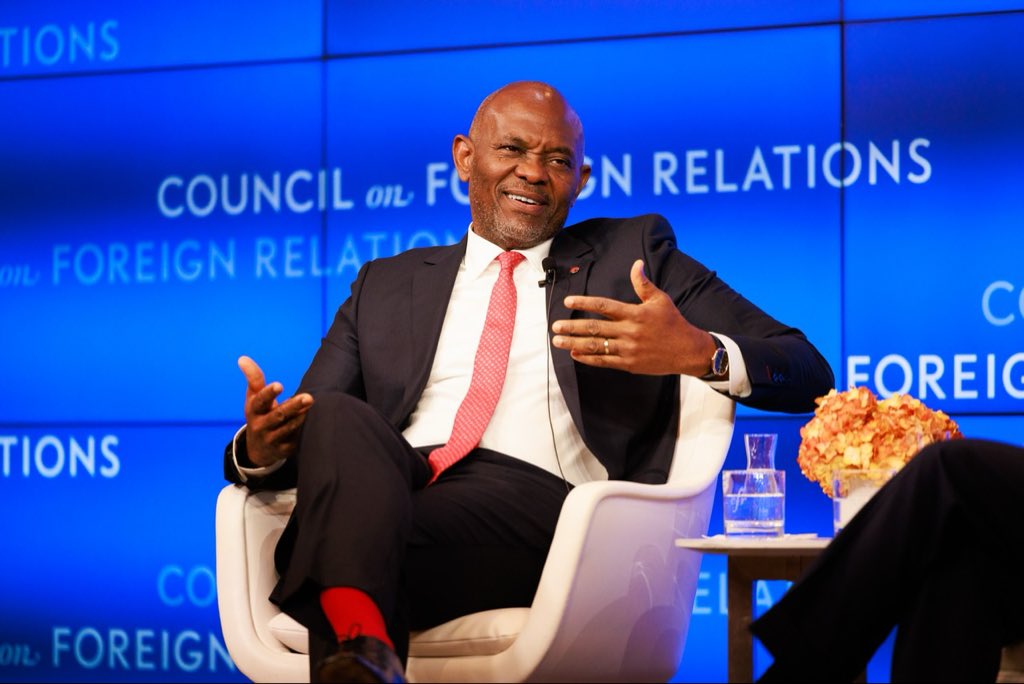
NEW YORK, Sept 24 – Nigerian investor and philanthropist Tony Elumelu has called for a rethink of how development finance institutions assess and deploy capital in Africa, arguing that an excessive focus on credit ratings can constrain financing for the continent’s infrastructure and businesses.
Elumelu made the remarks during the Darryl G. Behrman Lecture on Africa Policy at the Council on Foreign Relations in New York on September 22. The discussion, moderated by CFR President Michael Froman, examined Africa’s role in the global economy, entrepreneurship, private-sector growth, energy security and U.S.-Africa relations.
Elumelu said the scale of Africa’s infrastructure deficit requires significant capital and questioned whether development finance institutions are deploying their resources sufficiently to fulfil their catalytic mandate.
“The type of capital we need in Africa to fix our urgent infrastructure deficit is significant. It’s huge,” Elumelu said.
He argued that development institutions should not necessarily be required to maintain the same risk profile as conventional commercial lenders when their mandate is to support development.
“You don’t have to have junk credits, but if you have AA, BA, B, it’s not bad because you have a developmental catalytic aspiration, ambition, or commitment,” he said.
Challenging a Ratings-Driven Model
Elumelu said an emphasis on preserving highly rated balance sheets can influence development institutions to favour safer assets instead of deploying capital toward businesses and infrastructure projects that carry greater but potentially manageable risks.
“The money goes back to the U.S. Treasury. It’s not helping to develop the continent that they should be helping,” he said.
His argument comes amid broader discussions over how international capital can better support infrastructure, energy and private-sector development across African economies. Elumelu has also called for greater use of trade, investment and private-sector partnerships in Africa’s economic transformation.
Local Financial Institutions and African Risk
Elumelu pointed to Nigeria’s banking-sector consolidation as an example of how stronger locally anchored financial institutions can expand access to capital.
He recalled a period when Nigeria’s banking industry was highly fragmented and individual banks had limited capacity to raise substantial capital. Consolidation subsequently strengthened the balance sheets of larger institutions and enabled them to increase lending to businesses.
According to Elumelu, African financial institutions can have an advantage in assessing local businesses because they understand the markets, operating environments and risks in which those companies function.
He contrasted this with international development capital that may rely more heavily on conventional credit assessments when evaluating African businesses and infrastructure projects.
Private Capital and the Development Finance Gap
Elumelu also pointed to the evolution of major African companies as evidence that private-sector capital can become an increasingly important source of investment.
Referring to a conversation with Aliko Dangote, he said Dangote Group had more than $7 billion in free cash at the time of their discussion, highlighting the transformation of businesses that previously required significant external capital into potential sources of capital themselves.
For Elumelu, the example underscores the potential role of development institutions in taking greater risks at earlier stages of the investment cycle, allowing businesses and projects to reach a scale at which commercial and institutional investors can participate.
“That’s why some of us look at private capital,” Elumelu said. “Because the development banks, they have trillions, but it’s not being spent appropriately.”
From Development Finance to Private Investment
Elumelu’s argument centres on the catalytic role of development finance rather than simply the preservation of institutional balance sheets.
Under his proposed approach, development institutions would use their capital and risk-bearing capacity to help finance businesses and infrastructure projects that can generate wider economic benefits and eventually attract commercial investment.
The remarks formed part of Elumelu’s wider argument for a more investment-led approach to Africa’s economic development, with greater emphasis on entrepreneurship, trade, domestic capital and private-sector participation.
