
– Business, Finance, Markets & Economic News
  • Home
  • Economy
  • Business
  • Markets
  • Finance
  • Credit Ratings
  • Policy
  • Tech
– Business, Finance, Markets & Economic News
  • Home
  • Economy
  • Business
  • Markets
  • Finance
  • Credit Ratings
  • Policy
  • Tech
Top News
Nigeria, DP World Sign $7 Billion Ogun Port and Special Economic Zone Deal
Senegal Debt Restructuring Seen Having Limited Impact on Regional Banks, S&P Says
Nigeria’s Tony Elumelu Calls for Development Finance Overhaul to Unlock More Capital for Africa
Dangote and Ethiopia Unveil $160 Million Petroleum Pipeline Linking Djibouti and Ethiopia
Nigeria, US Sign Framework to Deepen Investment in $700 Billion Mining Sector
Ghana Central Bank Targets Reserve Rebuild as Gold Exports Decline
Zambia Inflation Falls to 6.1% in September as Rate Cut Outlook Builds
Ghana’s Cocoa Production Rises 27.7% to 771,000 Tons in 2025/26 Season
Uganda’s Public Debt Rises 14.8% to $37.1 Billion as Domestic Borrowing Increases
Access Bank Wins Approval to Transfer Kenya Operations Into National Bank of Kenya
Bank Al-Maghrib Holds Key Rate at 2.25% as Morocco Cuts 2026 Growth Forecast
South Africa Central Bank Raises Policy Rate to 7.25% as Inflation Pressures Return
Ghana’s COCOBOD Seeks $1.4 Billion From Domestic Investors to Finance Cocoa Purchases
South Africa’s Headline Inflation Edges Up to 4.4% in August, Below Forecast
TotalEnergies and AMNI Take Final Investment Decision on Nigeria’s Ima Gas Field
SUBSCRIBE
– Business, Finance, Markets & Economic News
Subscribe
– Business, Finance, Markets & Economic News
  • Home
  • Economy
  • Business
  • Markets
  • Finance
  • Credit Ratings
  • Policy
  • Tech
Copyright 2026 - All Right Reserved
Home » Finance » Senegal Debt Restructuring Seen Having Limited Impact on Regional Banks, S&P Says
Finance

Senegal Debt Restructuring Seen Having Limited Impact on Regional Banks, S&P Says

by Emmanuel Ebube September 24, 2026
written by Emmanuel Ebube September 24, 2026
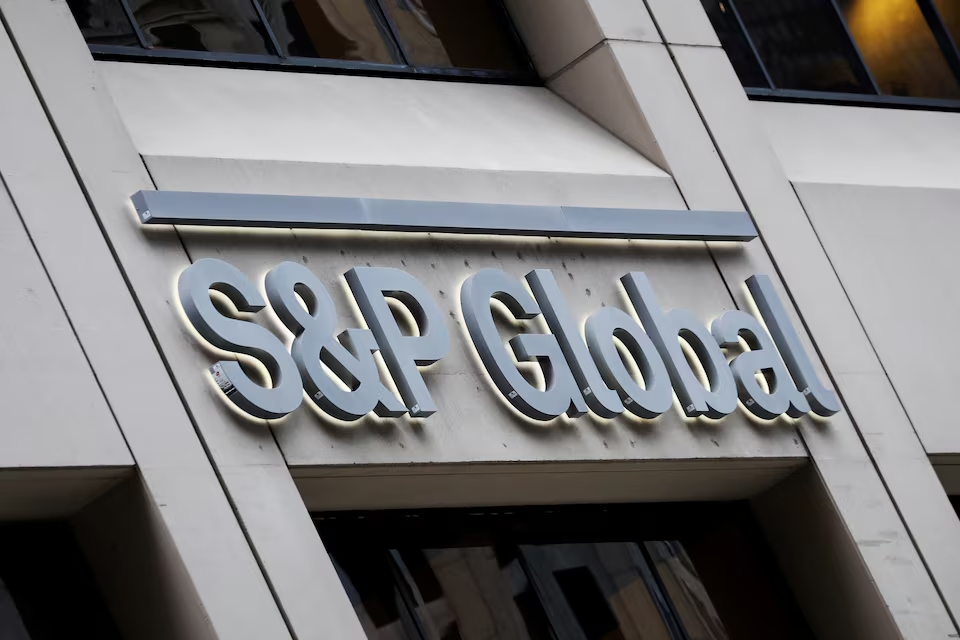
The S&P Global logo is displayed on its offices in the financial district in New York City, U.S., December 13, 2018. REUTERS/Brendan McDermid
FacebookTwitterLinkedinEmail
6

DAKAR, Sept 24 – Senegal’s planned restructuring of its foreign-currency debt is unlikely to create significant losses for major commercial banks in sub-Saharan Africa because of their limited exposure to the country’s international debt, S&P Global Ratings said.

However, the ratings agency warned that Senegal’s substantial stock of domestic debt leaves open the possibility of a broader restructuring that could increase credit costs for some regional lenders.

Senegal’s government announced earlier this month that it intends to seek a debt treatment as part of efforts to restore debt sustainability and secure a new $2.2 billion IMF programme. The IMF has confirmed a staff-level agreement for a 36-month Extended Credit Facility arrangement, subject to further approvals and financing assurances.

The planned treatment is expected to exclude obligations denominated in the regional CFA franc, according to the government’s approach outlined in the source material. That would leave foreign-currency creditors potentially exposed to changes in principal, interest or repayment terms.

You Might Be Interested In
  • WIOCC Group has secured a $300 million investment from AFC and Vision Invest

S&P said banks including Ecobank Transnational, FirstBank of Nigeria and United Bank for Africa have exposure to Senegalese sovereign debt, but their holdings are concentrated in local-currency obligations and represent a relatively small portion of their balance sheets.

“Senegal’s plan to restructure foreign-currency denominated debt won’t hurt rated banks in Sub-Saharan Africa,” S&P said in its note. “That’s because the banks are only exposed to local-currency debt and have limited exposure to Senegal sovereign debt.”

Domestic Debt Remains the Key Banking Risk

The more significant concern for regional lenders would arise if Senegal eventually extends its debt treatment to domestic obligations.

S&P estimates Senegalese local-currency government debt represents approximately 1.5% to 3% of the total assets of the affected banks.

Under a scenario involving a 30% reduction in principal, S&P estimates that credit losses at the affected banks would increase by between 1 and 3 percentage points, while pretax profit would decline by an average of 22%.

Even under a more severe scenario involving a 70% principal haircut, S&P said the banks would be able to absorb the resulting losses through earnings and remain above regulatory capital requirements. Pretax profit would nevertheless fall by an average of approximately 50%.

The assessment comes as Senegal works to establish the terms of its debt treatment. The IMF’s September agreement with the government identified debt sustainability and improved public debt management as key elements of the proposed programme.

Senegal has indicated that it intends to use an enhanced version of the G20 Common Framework for the restructuring, although the government has provided limited detail on how its proposed approach would differ from the existing mechanism.

The IMF says the Common Framework can accommodate different forms of debt treatment, including deeper restructuring where debt is unsustainable and repayment reprofiling where the primary challenge is liquidity.

For regional banks, the immediate exposure therefore remains concentrated in Senegal’s domestic debt market, while the eventual scope and terms of the government’s broader debt treatment will determine whether additional pressure emerges on bank earnings and capital.

Read Next

  • BRICS Countries Explore Linking Fast Payment Systems and Central Bank Digital Currencies

    August 11, 2026
  • NNPC Halts Operations at State Refineries After Reviews Expose Heavy Value Losses

    February 5, 2026
  • Dangote and Ethiopia Unveil $160 Million Petroleum Pipeline Linking Djibouti and Ethiopia

    September 24, 2026
  • Equinor Sees Stronger Case for Tanzania LNG Project as Hormuz Disruption Reshapes Gas Markets

    August 26, 2026
  • Nigeria Set First Tax Rules for Cryptocurrency, Introduces 1.5% Stamp Duty

    August 4, 2026

Newsletter

Subscribe to our newsletter for trusted insights on Africa’s economies, markets, and business.

African Economy Inc. Logo

About Us

We are a business and economic intelligence platform delivering in-depth reporting, analysis, and insights on markets, companies and economic developments across Africa.

Our Company

  • AEI Intelligence
  • About
  • Editorial Standard
  • Partnerships
  • Advertise With Us
  • Careers
  • Ownership

News

  • Economy
  • Business
  • Markets
  • Finance
  • Credit Ratings
  • Policy
  • Tech

Useful Links

  • Privacy Policy
  • Terms of Use
  • Closed Captioning Policy
  • Accessibility Statement
  • Personal Information
  • Data Tracking
  • Register New Account

Subscribe Newsletter

Subscribe to our newsletter for trusted insights on Africa’s economies, markets, and business.

©2026 Majons Media Inc. All Rights Reserved.

Facebook Twitter Instagram Linkedin
Manage Consent
To provide the best experiences, we use technologies like cookies to store and/or access device information. Consenting to these technologies will allow us to process data such as browsing behavior or unique IDs on this site. Not consenting or withdrawing consent, may adversely affect certain features and functions.
Functional Always active
The technical storage or access is strictly necessary for the legitimate purpose of enabling the use of a specific service explicitly requested by the subscriber or user, or for the sole purpose of carrying out the transmission of a communication over an electronic communications network.
Preferences
The technical storage or access is necessary for the legitimate purpose of storing preferences that are not requested by the subscriber or user.
Statistics
The technical storage or access that is used exclusively for statistical purposes. The technical storage or access that is used exclusively for anonymous statistical purposes. Without a subpoena, voluntary compliance on the part of your Internet Service Provider, or additional records from a third party, information stored or retrieved for this purpose alone cannot usually be used to identify you.
Marketing
The technical storage or access is required to create user profiles to send advertising, or to track the user on a website or across several websites for similar marketing purposes.
  • Manage options
  • Manage services
  • Manage {vendor_count} vendors
  • Read more about these purposes
View preferences
  • {title}
  • {title}
  • {title}
– Business, Finance, Markets & Economic News
  • Economy
  • Business
  • Markets
  • Banking & Finance
  • Energy
  • Tech
  • Policy