
RABAT, Aug 23 – Morocco’s economic relationship with Spain has expanded into a broader strategic partnership, with bilateral trade reaching an estimated €22.757 billion in 2025 and Rabat playing an increasingly important role in European supply chains, logistics and regional security.
Data highlighted by Spanish news agency EFE show that Spain remains Morocco’s largest trading partner for both exports and imports, despite a moderation in the pace of bilateral trade growth in recent years. Trade expanded rapidly over the past decade before growth became more measured from 2018, while Spanish exports to Morocco declined by 4.1% in 2025, largely because of lower fuel sales.
Trade has continued to grow in 2026. In the first half of the year, Spanish exports to Morocco increased 3.5% to €6.4205 billion, representing 3.2% of Spain’s total exports. Imports from Morocco rose 4.1% to €5.7955 billion, equivalent to 2.5% of Spain’s total imports.
The figures underline the scale of the commercial relationship, but Morocco’s importance to Spain extends beyond merchandise trade. The two countries are closely linked through logistics, manufacturing, migration and security cooperation, giving Rabat strategic relevance well beyond the value of goods exchanged across the Strait of Gibraltar.
That leverage became particularly visible during periods of diplomatic tension. The 2021 crisis between Madrid and Rabat, triggered after Spain allowed Polisario Front leader Brahim Ghali to receive medical treatment in Spain, demonstrated the potential consequences of strained bilateral relations. Madrid subsequently moved to repair ties and placed greater emphasis on Morocco’s role as a strategic partner.
Spain’s policy shift included support for Morocco’s autonomy proposal for Western Sahara as the basis of what Madrid described as a serious and credible political solution. The reset in relations was reinforced by Spanish Prime Minister Pedro Sánchez’s visit to Rabat in 2022, when both sides sought to establish a new framework for bilateral cooperation.
Migration and border management have since remained central to the relationship. Recent mass crossings into Ceuta have again brought Morocco’s role in managing migration flows into focus, while also highlighting the economic and security interdependence surrounding Spain’s North African enclaves.
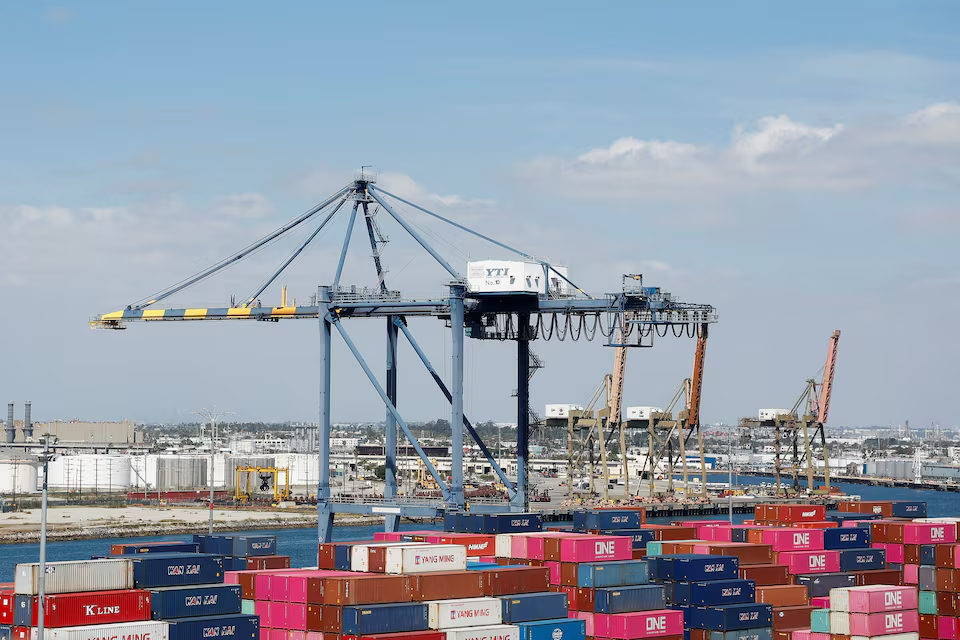
Morocco’s influence is also evident in logistics. The Tanger Med port has developed into a major Mediterranean shipping and transshipment hub, connecting European and African markets with global supply chains. Its expansion has increased Morocco’s importance as a logistics gateway while creating greater competitive pressure for some Spanish ports seeking to maintain their position in Mediterranean trade.
The relationship is similarly evolving in manufacturing.
Morocco has developed a significant industrial base, particularly in automotive manufacturing, by combining its proximity to Europe with industrial zones, infrastructure, investment incentives and access to African markets. International manufacturers and suppliers have increasingly integrated Moroccan facilities into cross-border production networks.
This development means the economic relationship cannot be viewed simply as European investment flowing into Morocco. Spanish and other European companies also benefit from Morocco’s proximity to European consumers, competitive production environment, established logistics infrastructure and access to markets across Africa.
Morocco’s automotive sector has become its largest export industry, reflecting the country’s broader strategy of moving beyond traditional trade and developing higher-value manufacturing capabilities. The expanding supplier ecosystem is helping deepen local industrial capacity while connecting Moroccan production to international supply chains.
The broader strategic picture is therefore one of growing interdependence. Spain benefits from Morocco’s role as a nearby manufacturing and logistics platform, while Morocco uses its relationship with Spain and the wider European market to attract investment, develop industrial capabilities and strengthen its position as a gateway between Europe and Africa.
For Spain, this makes Morocco more than a major trading partner. For Morocco, the relationship provides access to one of Europe’s most important markets while reinforcing its ambitions to become a regional production, logistics and investment hub.
As trade, manufacturing and logistics links deepen, disruptions to the relationship could carry costs for both sides. Morocco’s expanding economic infrastructure and its position between two continents mean its strategic importance to Spain and the wider European economy is increasingly tied not only to what it exports, but to the supply chains and commercial networks it helps connect.
