
– Business, Finance, Markets & Economic News
  • Home
  • Economy
  • Business
  • Markets
  • Finance
  • Credit Ratings
  • Policy
  • Tech
– Business, Finance, Markets & Economic News
  • Home
  • Economy
  • Business
  • Markets
  • Finance
  • Credit Ratings
  • Policy
  • Tech
Top News
Zambia-Tanzania $1.2 Billion Power Interconnector Expected to Start Operations in 2029
Developing Countries’ External Debt Hits Record $9.4 Trillion in 2025, World Bank Warns
AngloGold Ashanti to Invest $900 Million in Gold Mine Expansions Across Africa and Brazil
AfDB Arranges $1.2 Billion Financing for Tanzania’s Tabora–Kigoma Standard Gauge Railway
Caledonia Mining Secures $150 Million Bridge Facility for Zimbabwe’s Bilboes Gold Project
AfDB President Calls for New African Financial Architecture to Accelerate Private-Sector Growth
US and Egypt Sign $125 Million Agreement to Expand Private-Sector Opportunities
Ethiopia Becomes Africa’s Fifth-Largest Economy After GDP Rebasing to $210.7 Billion
CANEX WKND 2026: Afreximbank Pushes Financing and Market Access for Africa’s Creative Industries
World Bank’s IFC Says Africa Needs Deeper Financial Markets to Mobilize Private Capital at Scale
Dangote Explores Cross-Border Share Trading as Refinery IPO Attracts $4.77 Billion in Orders
OPay Suspends $304 Million US IPO Following Chinese Regulatory Inquiry
Egypt Raises $500 Million Through International Bond Market Reopening
Ramaphosa Sees Opportunity to Reset South Africa-US Relations After Midterm Elections
Ghana Inflation Rises for Third Consecutive Month to 5.5% in October 2026
SUBSCRIBE
– Business, Finance, Markets & Economic News
Subscribe
– Business, Finance, Markets & Economic News
  • Home
  • Economy
  • Business
  • Markets
  • Finance
  • Credit Ratings
  • Policy
  • Tech
Copyright 2026 - All Right Reserved
Home » Economy » World Bank Flags Growing Trade-Off Between Debt Payments and Social Spending in Africa
Economy

World Bank Flags Growing Trade-Off Between Debt Payments and Social Spending in Africa

by Oluebube Elechi October 12, 2026
written by Oluebube Elechi October 12, 2026
World Bank
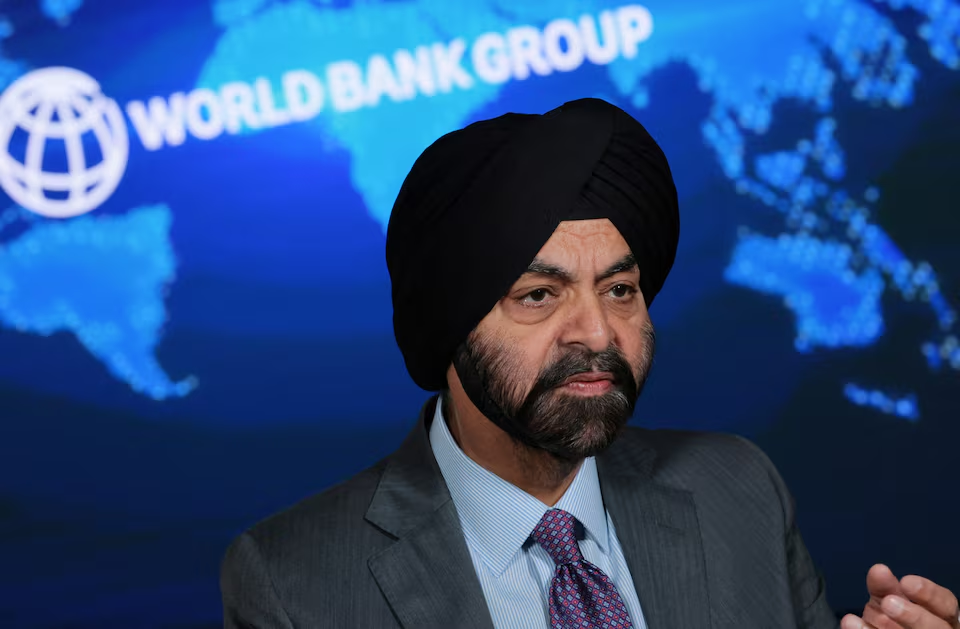
World Bank Group President Ajay Banga sits for an interview with Reuters at the World Bank in Washington, D.C., U.S., April 10, 2026. REUTERS/Jonathan Ernst
FacebookTwitterLinkedinEmail
46

LAGOS, Oct 12 – Sub-Saharan African governments are spending a growing share of their resources servicing public debt, leaving less money available for healthcare, education and infrastructure, according to the World Bank’s October 2026 Africa Economic Update.

The report found that interest payments on public debt exceed government spending on health or education in nearly four-fifths of countries across the region, highlighting how borrowing costs are constraining public investment and the delivery of essential services.

Between 2023 and 2026, interest payments averaged between 2.9% and 3.2% of gross domestic product (GDP) across sub-Saharan Africa, placing sustained pressure on government budgets even as fiscal deficits are projected to narrow.

Fiscal Deficits Narrow, but Spending Remains Constrained

The World Bank projects the region’s overall fiscal deficit will decline from 5.6% of GDP in 2020 to 3.5% in 2026, before narrowing further to an average of 3.1% in 2027 and 2028.

You Might Be Interested In
  • Nigeria Cuts Benchmark Rate to 23% in Biggest Reduction in Almost Two Decades

The primary deficit, which excludes interest payments, has also improved, falling from 3.1% of GDP in 2020 to a projected 0.5% in 2025. The report expects government fiscal balances to approach equilibrium by 2028.

However, improving headline fiscal indicators do not necessarily translate into greater spending capacity. Debt interest continues to absorb resources that could otherwise finance public services and long-term development.

The report stated: “In nearly four-fifths of the countries in the region, interest payments exceed public spending on health and/or education.”

Government revenue is projected to increase by 2.6 percentage points of GDP between 2024 and 2026, compared with a projected 2.3-percentage-point rise in total expenditure.

Of that expenditure increase, only 0.4 percentage point is expected to come from non-interest spending. This limits the extent to which governments can expand services and investment despite stronger revenue collection.

Domestic Borrowing Changes the Debt Profile

The World Bank’s assessment suggests that sub-Saharan Africa’s debt challenge increasingly centres on the cost of servicing existing obligations, rather than simply the volume of additional borrowing.

The median general government gross debt ratio reached 57% of GDP in 2025, nearly twice the 29% recorded in 2012. Although the ratio has eased from a peak of 60% in 2023, the regional average conceals substantial differences in countries’ fiscal positions and debt structures.

Domestic borrowing has become the dominant source of government financing since 2021, accounting for more than half of total public debt.

While local debt markets provide governments with an alternative to external financing, domestic borrowing often comes with higher interest rates and shorter maturities than concessional external loans. These conditions can increase debt-servicing expenses and expose governments to more frequent refinancing requirements. As a result, governments can face pressure on public finances even when their debt ratios stabilize or decline.

Debt Service Threatens Long-Term Development

The consequences extend beyond annual budget management. When interest payments absorb a growing share of public revenue, governments have less flexibility to finance transport infrastructure, electricity systems, schools, hospitals and social protection.

The World Bank warned that this trade-off could weaken economic performance over time.

“Crowding out productive expenditure can slow capital accumulation, weaken productivity growth, and hinder poverty reduction,” the report stated.

The findings highlight a central fiscal challenge for African economies: improving debt sustainability requires more than controlling borrowing. Governments must also manage financing costs, strengthen revenue mobilisation and improve the composition and maturity of public debt.

For countries seeking to accelerate economic transformation, the balance between meeting existing debt obligations and financing future growth remains a critical policy concern.

Read Next

  • Morocco Plans $2 Billion Budget Boost to Cushion Impact of Middle East Conflict

    May 15, 2026
  • Afreximbank Signs $190 Million Financing Package for Zimbabwe’s CBZ Bank

    July 31, 2026
  • Rwanda’s Central Bank Raises Key Interest Rate to 8.75% as Inflation Accelerates

    August 27, 2026
  • Nigeria, Sweden Push Investment-Ready Projects in Energy, Digital Economy

    February 26, 2026
  • Ghana Inflation Falls to 3.3% as Rate Cut Expectations Rise

    March 4, 2026

Newsletter

Subscribe to our newsletter for trusted insights on Africa’s economies, markets, and business.

African Economy Inc. Logo

About Us

We are a business and economic intelligence platform delivering in-depth reporting, analysis, and insights on markets, companies and economic developments across Africa.

Our Company

  • AEI Intelligence
  • About
  • Editorial Standard
  • Partnerships
  • Advertise With Us
  • Careers
  • Ownership

News

  • Economy
  • Business
  • Markets
  • Finance
  • Credit Ratings
  • Policy
  • Tech

Useful Links

  • Privacy Policy
  • Terms of Use
  • Closed Captioning Policy
  • Accessibility Statement
  • Personal Information
  • Data Tracking
  • Register New Account

Subscribe Newsletter

Subscribe to our newsletter for trusted insights on Africa’s economies, markets, and business.

©2026 Majons Media Inc. All Rights Reserved.

Facebook Twitter Instagram Linkedin
Manage Consent
To provide the best experiences, we use technologies like cookies to store and/or access device information. Consenting to these technologies will allow us to process data such as browsing behavior or unique IDs on this site. Not consenting or withdrawing consent, may adversely affect certain features and functions.
Functional Always active
The technical storage or access is strictly necessary for the legitimate purpose of enabling the use of a specific service explicitly requested by the subscriber or user, or for the sole purpose of carrying out the transmission of a communication over an electronic communications network.
Preferences
The technical storage or access is necessary for the legitimate purpose of storing preferences that are not requested by the subscriber or user.
Statistics
The technical storage or access that is used exclusively for statistical purposes. The technical storage or access that is used exclusively for anonymous statistical purposes. Without a subpoena, voluntary compliance on the part of your Internet Service Provider, or additional records from a third party, information stored or retrieved for this purpose alone cannot usually be used to identify you.
Marketing
The technical storage or access is required to create user profiles to send advertising, or to track the user on a website or across several websites for similar marketing purposes.
  • Manage options
  • Manage services
  • Manage {vendor_count} vendors
  • Read more about these purposes
View preferences
  • {title}
  • {title}
  • {title}
– Business, Finance, Markets & Economic News
  • Economy
  • Business
  • Markets
  • Banking & Finance
  • Energy
  • Tech
  • Policy
  • African Economy Inc.