
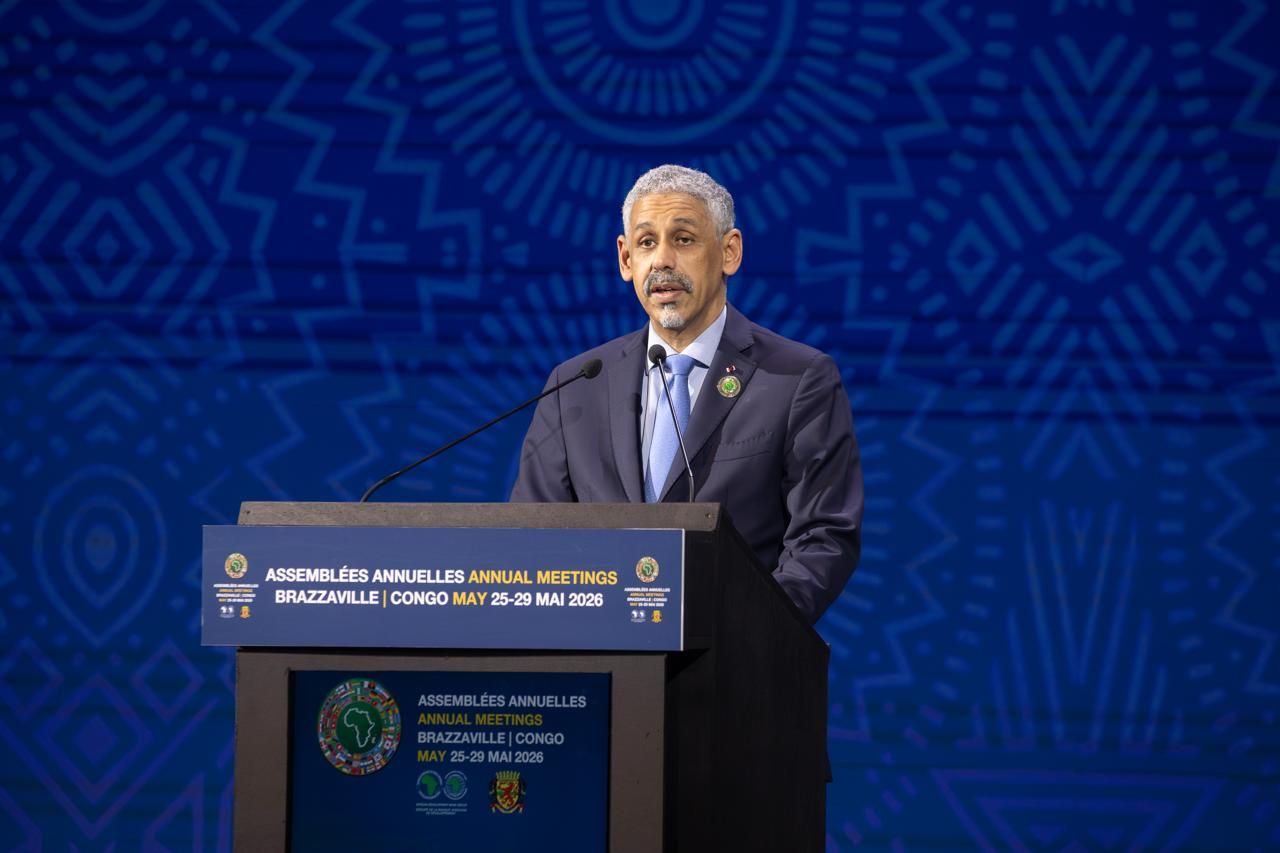
BRAZZAVILLE, June 1 – On the banks of the Congo River, in a conference Centre that offers panoramic views of the world’s second-largest river by discharge, more than 4,000 delegates gathered last week for the 61st Annual Meetings of the African Development Bank Group. The setting was deliberate. The Congo River alone holds enough hydroelectric potential to power much of sub-Saharan Africa. It remains largely unharnessed.
That tension between Africa’s vast endowments and its chronic failure to mobilize them sat at the heart of every session, every policy dialogue, every side conversation in Brazzaville. The theme of the 2026 African Economic Outlook, released at the meetings, stated it plainly: ‘Mobilizing Africa’s Development Financing at Scale in a Fragmented World.’
The numbers are staggering. Africa requires more than $1.3 trillion annually to meet the United Nations Sustainable Development Goals. It faces a $184–$221 billion annual infrastructure financing need, a $213 billion climate financing gap, and a $402 billion yearly requirement to fast-track structural transformation. Against a backdrop of declining official development assistance, rising borrowing costs, and a world fragmenting into competing economic blocs, the question the AfDB posed in Brazzaville was deceptively simple: where does that money come from?
The answer, the Bank argues, is hiding in plain sight.
“The issue is not only about a lack of resources but also about effectively deploying capital.” 2026 African Economic Outlook, African Development Bank
Growth Without Transformation
Africa’s macroeconomic headline, on the surface, reads well. The continent’s economies are projected to grow at 4.2% in 2026, moderating from 4.4% in 2025, before rebounding to 4.4 percent in 2027. Twenty-two countries are projected to grow above 5%. East Africa leads, with growth forecast at 5.8 percent, driven by Ethiopia and Kenya. The continent remains among the world’s fastest-growing regions.
But growth and transformation are not the same thing. Inflation continent-wide is projected to remain elevated at 10.4 percent in 2026, eroding real incomes and constraining consumer demand in precisely the economies that need domestic demand to drive structural change. Around 40 percent of African countries remain in debt distress or face a high risk of becoming so. Fiscal space is tightening almost everywhere.
Southern Africa tells the starkest story: growth is expected to remain subdued at just 2.1 percent, weighed down by weaker mining output and the structural drag of South Africa’s electricity and logistics crises. In West Africa, growth moderates from 4.6 to 4.4 percent, with Nigeria’s macroeconomic reform programme injecting both uncertainty and cautious optimism into the regional outlook.
The Architecture of a Gap
Understanding why the gap is $1.3 trillion requires understanding how it was constructed. Three structural failures compound each other.
The first is weak domestic resource mobilisation. Africa’s tax-to-GDP ratio averages around 16 percent compared to 34 percent in OECD countries. Illicit financial flows alone cost Africa an estimated $88.6 billion annually more than the total official development assistance the continent receives.
The second is shallow financial intermediation. Africa’s pension funds and sovereign wealth assets total an estimated $4 trillion. The vast majority is invested outside Africa, often in markets with lower risk-adjusted returns than available domestically. The AfDB’s new New African Financial Architecture for Development (NAFAD) framework, endorsed by the African Union in February 2026, targets precisely this misalignment.
The third is the external financing environment. ODA is declining. Eurobond markets have become prohibitively expensive for many sovereigns. Multilateral lending remains too slow and too small to fill the breach. The geopolitical fragmentation that defines the current moment means that Africa’s traditional financing architecture is being dismantled without a clear replacement.
Africa faces an annual development financing gap of $1.3 trillion. With appropriate reforms, the AfDB estimates the continent could unlock up to $1.43 trillion annually through stronger tax systems, deeper capital markets, improved governance, and greater private sector participation.
The $299 Billion Efficiency Dividend
The most striking claim to emerge from Brazzaville is that African governments could save $299 billion annually simply through more efficient public investment without raising a single additional dollar in revenue or borrowing. The AfDB’s analysis points to procurement inefficiencies, cost overruns on infrastructure projects, and the misallocation of capital towards politically motivated projects over economically productive ones.
This represents a reallocation that, if realized, would be larger than the total foreign direct investment Africa received in 2024. The Bank’s argument is that governance reform strengthening public financial management, improving project selection, and reducing corruption in capital expenditure is itself a form of development financing.
Combine the efficiency dividend with improved revenue mobilisation, deeper capital markets, expanded public-private partnerships, diaspora financing, and better natural capital accounting, and the AfDB arrives at its headline figure: Africa could unlock up to $1.43 trillion annually. More than enough to close the gap. The logic is coherent. The politics are considerably harder.
The Political Economy of Self-Financing
Every reform the AfDB prescribes runs directly into the political economy of the states it is prescribing to. Stronger tax systems require institutional capacity that decades of structural adjustment have often weakened, and political will that is difficult to sustain when revenue collection hits powerful constituencies. Deeper capital markets require regulatory frameworks and investor protections that take years to build and are frequently undermined by policy reversals.
New African Financial Architecture for Development (NAFAD) for all its elegance as a framework requires pension fund managers and sovereign wealth funds to accept lower short-term liquidity in exchange for long-term developmental impact. That is a hard sell to fiduciaries. What Brazzaville represented was less a solution than a reframing: the old story of Africa as perpetual aid recipient is no longer viable. The new story is of a continent that can finance its own future if it builds the institutions and political structures to make that possible.
What Institutional Investors Should Watch
For fund managers, DFIs, and sovereign wealth funds with African exposure, the Brazzaville meetings generated four signals worth tracking closely.
First, the NAFAD framework. If African pension funds and SWFs begin rotating even a fraction of their assets into domestic infrastructure vehicles, it will reshape the capital markets of the continent’s largest economies. The framework has AU political backing; operationalisation remains to be built.
Second, the trade finance gap. The AfDB warned that Africa’s trade finance shortfall could widen to $86.6 billion by 2027, driven by geopolitical tensions tightening global credit. For trade-exposed economies and export-oriented investments, this is a direct risk to operating margins.
Third, the debt restructuring pipeline. With 40 percent of African countries in or near debt distress, and the G20’s Common Framework moving slowly, the terms of sovereign restructurings — particularly the role of Chinese creditors — will define fiscal space for a generation.
Fourth, the IMF anchor. Countries maintaining programme relationships with the IMF are demonstrating superior macroeconomic stability. The June 2026 Article IV missions across multiple African sovereigns will signal which governments have the institutional credibility to execute the financing reforms Brazzaville called for.
A Continent Betting on Itself
The Congo River flows past the Kintele Conference Centre at 41,000 cubic metres per second. If fully harnessed, it could generate 100,000 megawatts of electricity enough to dramatically alter energy economics across central and southern Africa. Almost none of it has been developed.
The AfDB’s $1.43 trillion argument is, in a sense, the same story told in financial terms. The resources exist. The potential is documented. The frameworks are being designed. What remains is the hardest part: building the institutions, the political will, and the investor confidence to turn potential into capital, and capital into transformation.
Brazzaville did not solve that problem. But it named it with unusual clarity, at a moment when Africa can no longer afford to wait for the world to solve it for them.
