
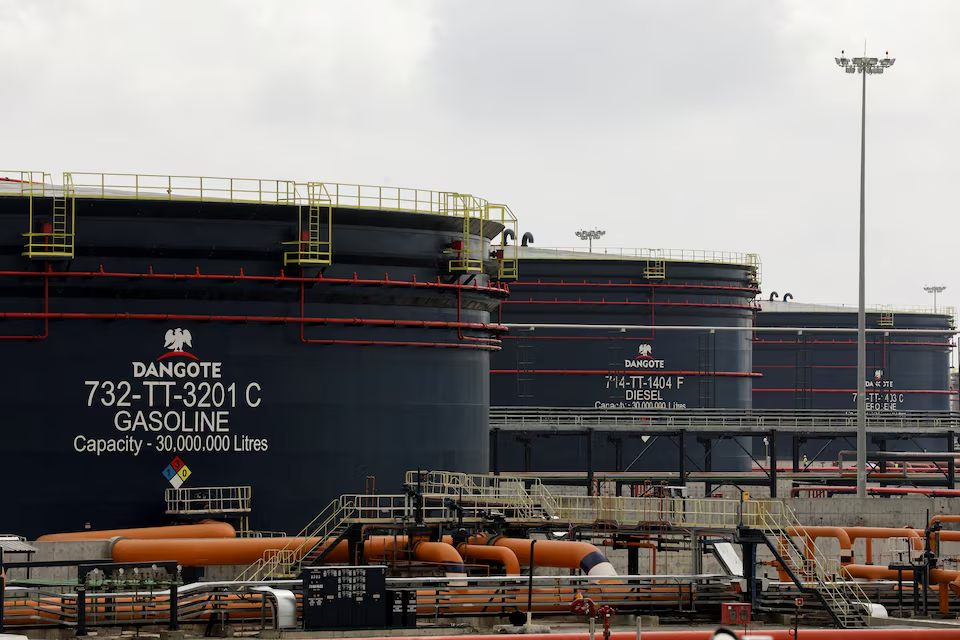
LAGOS, July 15 – Dangote Petroleum Refinery has replaced its naira-denominated pricing model for petroleum products with a dollar-linked pricing framework, marking a significant shift in Nigeria’s downstream oil market and raising fresh concerns about the future of the country’s naira-for-crude initiative.
The refinery announced that all previously issued naira-denominated invoices for petrol, diesel and aviation fuel were void with immediate effect. Under the new pricing structure, products will be benchmarked to the US dollar, with petrol priced at $0.779 per litre, diesel at $1.087 per litre, and aviation fuel at $0.942 per litre.
The company attributed the decision to what it described as an unsustainable currency mismatch between dollar-denominated crude oil purchases and naira-denominated fuel sales.
The pricing shift represents a major development for Nigeria’s energy sector, as it effectively links domestic fuel prices more directly to movements in the naira exchange rate.
What naira-for-crude was actually supposed to do
The Nigerian Government’s naira-for-crude initiative, launched October 1, 2024, let domestic refiners buy Nigerian crude oil in naira rather than dollars, a deliberate policy design meant to reduce the country’s structural dollar demand, ease pressure on reserves, and give local refiners like Dangote a genuine cost advantage over importing refined products from Europe or the Gulf.
Dangote adopted naira-denominated product sales on the back of the scheme, and for close to two years, that arrangement functioned as one of the more visible proof points that Nigeria’s refining buildout was delivering on its central promise: domestic production insulated from the currency swings that had made fuel imports a chronic drain on the naira.
The mechanism that broke it is almost too clean an illustration of why single-currency policy interventions are fragile in a market with competing incentives on both sides.
Industry sources say NNPC Limited, the state oil company supplying Dangote’s crude under the arrangement has been delivering fewer naira-denominated cargoes and more dollar-denominated ones in recent months, while a large share of Dangote’s refined-product sales continued to be settled in naira.
That left the refinery paying an increasing share of its input costs in dollars while collecting revenue in a depreciating local currency, a mismatch that, if left unaddressed, would have eaten directly into margins on a business that has already sunk more than $19 billion into its Lekki complex. Dangote’s response was rational from a corporate-finance perspective and consequential from a policy one: rather than absorb the mismatch, it passed the currency exposure downstream, onto the roughly 4,000-plus fuel marketers who buy from its gantries and, ultimately, onto Nigerian consumers.
Why the timing compounds the problem
This landed at an unusually inconvenient moment for Nigeria’s broader currency narrative. AEI’s own analysis of first-half 2026 currency performance found the naira was Africa’s second-best-performing currency, appreciating 3.36% against the dollar on the back of improved FX liquidity, stronger portfolio inflows, and market confidence in the CBN’s ongoing reform push, one of the few genuinely structural, reform-driven currency stories on the continent this year, as distinct from commodity-windfall gains elsewhere.
Petrol prices in naira terms had also been falling: four consecutive ex-depot price cuts through early July had pushed pump-adjacent pricing down to around N1,075 per litre, a visible, consumer-facing sign that the reform program was delivering tangible relief.
The dollar-pricing switch puts both of those trends at risk simultaneously. At the prevailing official rate, the new $0.779-per-litre petrol benchmark works out to roughly N1,075.61 essentially where naira pricing already sat. But that equivalence holds only as long as the exchange rate does.
Any further naira depreciation now feeds automatically and immediately into domestic fuel prices, reopening precisely the imported-inflation channel that four months of naira-pricing stability, and the underlying currency-reform story CBN has been building market credibility around, had begun to close off.
Independent marketers who now need to source dollars directly to buy from Dangote’s gantries face the same exposure, with smaller operators least able to absorb FX-access friction likely to be squeezed hardest, a dynamic with direct implications for retail fuel availability and pricing consistency nationwide.
The deeper signal: what this says about Dangote’s own risk posture
Dangote’s decision to break from naira pricing is happening at the exact moment the group is trying to finance a second, even larger refinery project in Kenya, a facility now confirmed to cost up to $17 billion, more than double Lekki’s original build cost, with financing explicitly planned to include an IPO alongside internal cash flow and bond issuance.
A company preparing to raise capital from international investors for a $17 billion greenfield project has every incentive to demonstrate disciplined currency-risk management at its existing flagship asset, rather than continuing to absorb an FX mismatch that a prospectus would have to disclose as a material risk factor.
Read this way, the dollar-pricing shift is not simply a defensive reaction to NNPCL’s cargo mix, it is Dangote actively de-risking its balance sheet ahead of a fundraising process where international capital will be pricing Nigerian currency exposure far more conservatively than the domestic naira-for-crude framework was designed to allow for.
That is a rational corporate move. It is also a quiet vote of no confidence, from the single entity with the deepest operational visibility into Nigeria’s crude-to-product value chain, in the durability of naira-denominated arrangements as a long-term hedge against the country’s dollar liquidity constraints.
Dangote Refinery CEO David Bird has maintained publicly that the refinery pays international benchmark prices for crude “regardless” of the naira-for-crude policy’s original intent, a statement that, read alongside this week’s pricing shift, suggests the naira-denominated side of the arrangement was functioning more as a Nigerian government talking point than as the refinery’s actual operating reality.
What this means for the naira-for-crude policy itself
For the Nigerian Government, the practical question is now whether naira-for-crude survives this in any meaningful form. The policy’s entire premise was that domestic refiners transacting in naira would reduce national dollar demand; if the country’s largest and most strategically important refiner is now settling both its crude purchases (increasingly) and its product sales (as of this week) predominantly in dollars, the policy has been hollowed out at its most important participant even if it remains nominally in place for smaller refiners.
NNPCL’s own shift toward dollar-denominated crude cargoes suggests the state oil company itself may be finding the naira leg of the arrangement difficult to sustain, a signal worth more scrutiny than it has so far received, since NNPCL’s willingness to supply naira-priced crude was the entire mechanism the policy depended on.
What institutional actors should watch
For the CBN and Nigeria’s economic team, the immediate task is managing the optics and substance of a currency-reform narrative that has, until this week, been one of the more credible structural stories on the continent, this development is a live test of whether that credibility was built on genuine market-structure improvement or on a fuel-pricing arrangement that has now partially unwound. Continued naira strength would blunt the inflationary impact of dollar-denominated fuel pricing; renewed depreciation would compound it directly and visibly at the pump, in a way ordinary Nigerians will register faster than any FX-liquidity statistic.
For investors evaluating Dangote’s Kenya refinery and its planned IPO, this week’s move should be read as a data point on management’s currency-risk discipline arguably a positive signal for prospective bondholders and IPO investors, even as it creates near-term political and consumer friction in Nigeria. The two audiences want different things from the same decision, and Dangote appears to have chosen the one with the deeper pockets.
For downstream marketers and, by extension, Nigerian consumers, the shift reopens a direct channel between naira volatility and fuel prices that four months of naira-denominated stability had temporarily closed, a reminder that domestic refining capacity, on its own, does not eliminate a country’s exposure to currency risk if the refinery itself remains structurally dependent on dollar-priced crude inputs. Nigeria solved the logistics half of its fuel-security problem when Dangote’s refinery came online. This week made clear it has not yet solved the currency half.