
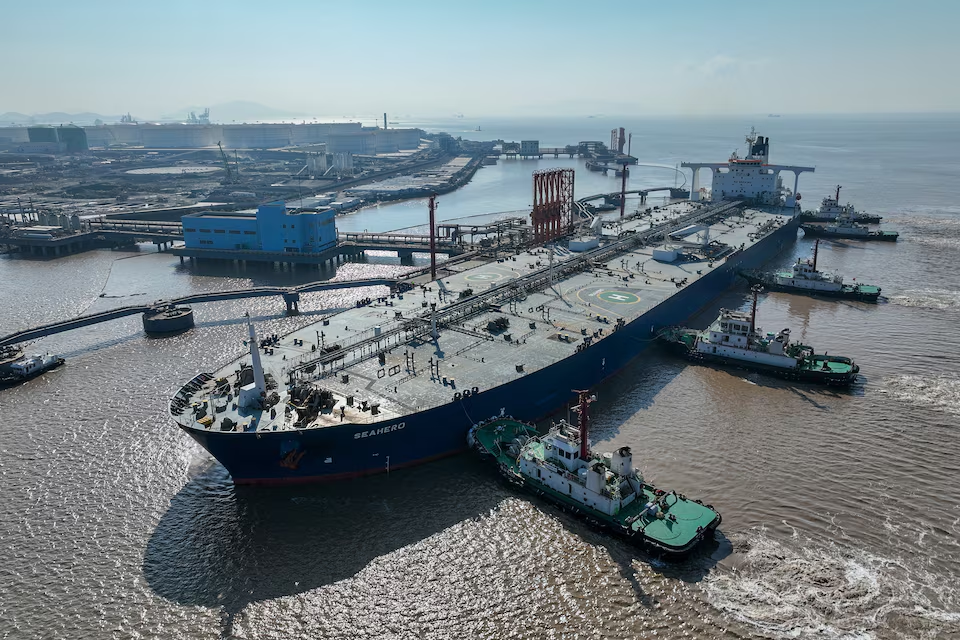
LUANDA, Nov 12 – Asian refiners are increasing purchases of Atlantic Basin crude as tanker freight rates fall sharply from last month’s record levels, improving the competitiveness of West African, Angolan and Brazilian grades, according to traders, shipbrokers and analysts.
Unipec, the trading arm of China’s Sinopec, bought several African crude cargoes last week, while Unipec and South Korea’s SK Energy have provisionally chartered vessels at substantially lower rates to load West African grades in December.
Unipec, a major buyer of West African and Brazilian crude, purchased two cargoes of Congolese Djeno crude at discounts of approximately $22 per barrel to dated Brent on a free-on-board basis, two traders familiar with the West African market said.
The Chinese trader has also provisionally chartered two Suezmax tankers to transport West African crude to Asia at worldscale rates of 475 and 410 for late November to early December loadings. It also chartered a very large crude carrier (VLCC) on the same route at W500 for an early December loading, according to ship brokerages.
SK Energy has similarly provisionally chartered a Suezmax tanker to load crude in Gabon for delivery to Ulsan, South Korea, in December at W380.
Worldscale is an industry benchmark used to calculate tanker freight charges. Sinopec did not immediately respond to a request for comment, while SK Energy declined to comment.
“Softer long-haul VLCC freight rates are making west of Suez grades more attractive,” analysts at consultancy Energy Aspects said in a November 9 note.
The analysts added that elevated premiums for Russia’s ESPO crude could also support Chinese demand for heavier Angolan grades.
Freight market reverses after record surge
The decline follows a sharp increase in tanker costs last month, when freight rates across vessel categories reached record levels. Middle Eastern producers increased exports, requiring more ships to conduct ship-to-ship transfers outside the Strait of Hormuz to avoid attacks linked to the US war on Iran.
Demand for tankers was also supported by Chinese independent refiners switching to non-sanctioned crude after a US blockade cut off Iranian exports. Their efforts to use remaining crude import quotas before year-end added further pressure on vessel availability.
The resulting increase in shipping costs led Asian refiners to hold back purchases in recent weeks, weighing on spot prices. Freight rates subsequently eased as more vessels became available after completing earlier oil deliveries.
The cost of delivering African and Brazilian crude to China has fallen by approximately $5 to $10 per barrel compared with last month, according to a trader who closely tracks the transactions.
Baltic Exchange data showed that freight rates for VLCCs, excluding loadings inside the Strait of Hormuz, as well as Suezmax and Aframax tankers, had declined by around 50% from their peaks last month.
“The recent freight correction has been driven by improving vessel availability following October’s exceptional market tightness,” Wanying Zhang, shipping analyst at Vortexa, said.
“The number of laden mainstream VLCCs and Suezmaxes in East Asia has increased by approximately 15% since early September, suggesting a growing pool of vessels that could become available as they complete discharge operations.”
Angolan and Brazilian grades become more competitive
Lower freight costs have also improved the economics of buying Angolan and Brazilian crude for delivery to China in the coming months.
A Chinese independent refiner in eastern Shandong province separately purchased 1 million barrels of Angolan Plutonio crude for delivery in late December or early January at a premium of approximately $15 per barrel to ICE Brent, according to two traders.
That compares with premiums above $20 per barrel for Angolan grades two weeks earlier.
Brazilian Tupi crude was last traded at a premium of $7 to $8 per barrel to December dated Brent for January arrival, another trader said. Transactions last month had carried premiums closer to $20 per barrel.
Last month, offers for Brazilian crude exceeded $20 per barrel above benchmark prices, while West African crude offers rose above $40 per barrel, traders said.
Asian buyers are also continuing to transport US West Texas Intermediate (WTI) crude using Aframax tankers, which typically carry between 500,000 and 700,000 barrels. Traders said freight rates for VLCCs remain relatively elevated despite their decline from last month’s peaks, making smaller vessels a continuing option for some US crude shipments.
Although WTI prices have fallen, Abu Dhabi’s Murban crude remained approximately $2 per barrel cheaper, according to one trader.
The decline in freight rates is therefore reshaping delivered-cost comparisons across the Atlantic Basin, giving Asian refiners greater access to African and Brazilian grades after last month’s shipping cost surge constrained purchases.
