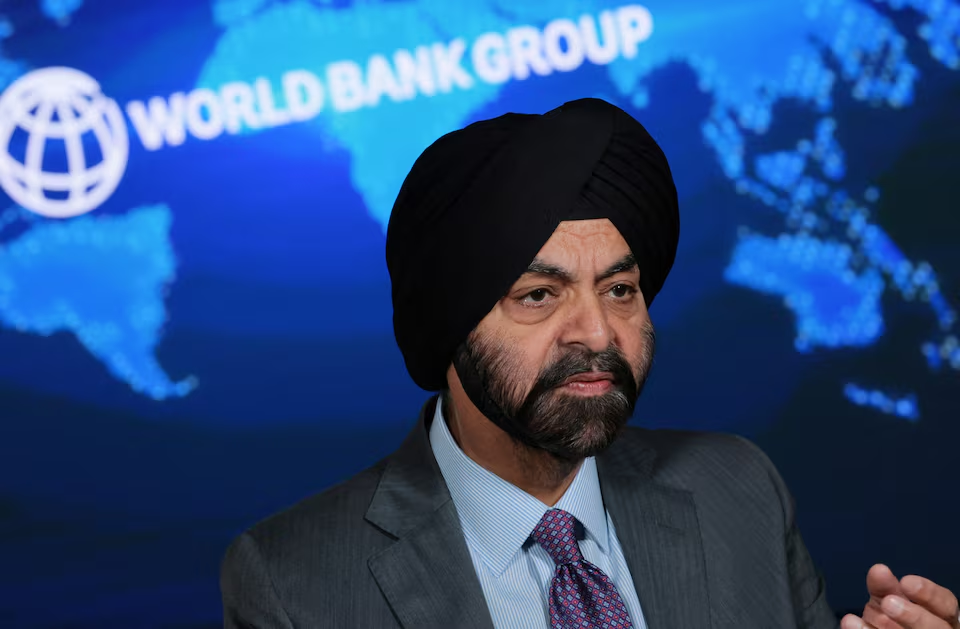
LAGOS, Oct 12 – Sub-Saharan African governments are spending a growing share of their resources servicing public debt, leaving less money available for healthcare, education and infrastructure, according to the World Bank’s October 2026 Africa Economic Update.
The report found that interest payments on public debt exceed government spending on health or education in nearly four-fifths of countries across the region, highlighting how borrowing costs are constraining public investment and the delivery of essential services.
Between 2023 and 2026, interest payments averaged between 2.9% and 3.2% of gross domestic product (GDP) across sub-Saharan Africa, placing sustained pressure on government budgets even as fiscal deficits are projected to narrow.
Fiscal Deficits Narrow, but Spending Remains Constrained
The World Bank projects the region’s overall fiscal deficit will decline from 5.6% of GDP in 2020 to 3.5% in 2026, before narrowing further to an average of 3.1% in 2027 and 2028.
The primary deficit, which excludes interest payments, has also improved, falling from 3.1% of GDP in 2020 to a projected 0.5% in 2025. The report expects government fiscal balances to approach equilibrium by 2028.
However, improving headline fiscal indicators do not necessarily translate into greater spending capacity. Debt interest continues to absorb resources that could otherwise finance public services and long-term development.
The report stated: “In nearly four-fifths of the countries in the region, interest payments exceed public spending on health and/or education.”
Government revenue is projected to increase by 2.6 percentage points of GDP between 2024 and 2026, compared with a projected 2.3-percentage-point rise in total expenditure.
Of that expenditure increase, only 0.4 percentage point is expected to come from non-interest spending. This limits the extent to which governments can expand services and investment despite stronger revenue collection.
Domestic Borrowing Changes the Debt Profile
The World Bank’s assessment suggests that sub-Saharan Africa’s debt challenge increasingly centres on the cost of servicing existing obligations, rather than simply the volume of additional borrowing.
The median general government gross debt ratio reached 57% of GDP in 2025, nearly twice the 29% recorded in 2012. Although the ratio has eased from a peak of 60% in 2023, the regional average conceals substantial differences in countries’ fiscal positions and debt structures.
Domestic borrowing has become the dominant source of government financing since 2021, accounting for more than half of total public debt.
While local debt markets provide governments with an alternative to external financing, domestic borrowing often comes with higher interest rates and shorter maturities than concessional external loans. These conditions can increase debt-servicing expenses and expose governments to more frequent refinancing requirements. As a result, governments can face pressure on public finances even when their debt ratios stabilize or decline.
Debt Service Threatens Long-Term Development
The consequences extend beyond annual budget management. When interest payments absorb a growing share of public revenue, governments have less flexibility to finance transport infrastructure, electricity systems, schools, hospitals and social protection.
The World Bank warned that this trade-off could weaken economic performance over time.
“Crowding out productive expenditure can slow capital accumulation, weaken productivity growth, and hinder poverty reduction,” the report stated.
The findings highlight a central fiscal challenge for African economies: improving debt sustainability requires more than controlling borrowing. Governments must also manage financing costs, strengthen revenue mobilisation and improve the composition and maturity of public debt.
For countries seeking to accelerate economic transformation, the balance between meeting existing debt obligations and financing future growth remains a critical policy concern.