
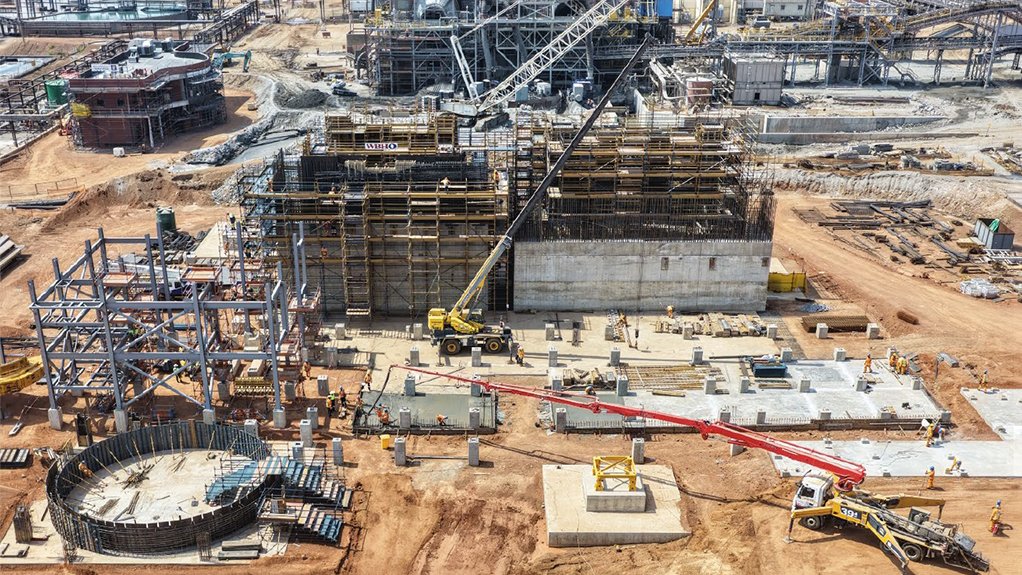
LUSAKA, Nov 10 – Barrick Mining’s $2 billion expansion of its Lumwana copper mine in Zambia is progressing towards completion, with construction of a new copper mill expected to be completed in the fourth quarter of 2026, as the company advances plans to double production at the operation.
The New York and Toronto-listed gold and copper producer said on Monday, November 9, that it had invested $795 million in the project to date, while total expected capital expenditure remains on target at $2 billion.
First copper from the expanded operation is expected by the end of the first quarter of 2028. The expansion is designed to increase annual copper production to 240,000 tonnes from the current 117,000 tonnes, significantly increasing Lumwana’s contribution to Zambia’s copper industry.
Construction progress includes the procurement of all major long-lead equipment, with the mill shells and trunnions, primary crusher and tailings thickener already delivered to the site.
The third level of the primary crusher is nearly complete, while work on the tailings storage facility is expected to begin in the fourth quarter of 2026. The final mill wall lifts are also scheduled for completion during the same period.
At the expanded production level, Lumwana is expected to have a life-of-mine of 30 years, providing a long-term production base for Barrick’s copper business.
Barrick reports $5.07 billion in third-quarter revenue
The project update accompanied Barrick’s third-quarter 2026 results, which showed revenue rising 22% year on year to $5.07 billion, supported by production of 816,000 ounces of gold and 50,000 tonnes of copper.
Earnings before interest, taxes, depreciation and amortisation (EBITDA) increased 13% to $3.22 billion, while attributable adjusted EBITDA rose 22% to $2.47 billion. Operating cash flow reached $2.49 billion, including attributable operating cash flow of $1.80 billion and attributable free cash flow of $640 million.
Net earnings for the quarter were $1.32 billion, compared with $1.30 billion in the corresponding period of 2025. Adjusted net earnings increased to $1.35 billion from $980 million.
Net earnings per share rose 5% to $0.80, while adjusted net earnings per share increased 41% to $0.82 compared with the third quarter of 2025.
“We remain on track to achieve our full-year production guidance,” Barrick president and CEO Mark Hill stated in a release to Mining Weekly.
The company maintained its 2026 production guidance of 2.90 million to 3.25 million ounces of gold and 190,000 to 220,000 tonnes of copper.
Its guidance is based on an assumed oil price of $70 per barrel. Barrick estimates that every $10-per-barrel change in oil prices affects costs associated with diesel consumption by approximately $12 per ounce across its gold operations and $0.04 per pound across its copper operations.
Higher operating costs weigh on gold and copper margins
Barrick reported higher production costs across both commodities during the quarter, reflecting lower processed grades, elevated diesel prices and other operating pressures.
Gold cost of sales increased to $1,950 per ounce from $1,562 per ounce in the third quarter of 2025. Total cash costs rose to $1,386 per ounce from $1,137 per ounce, while all-in sustaining costs (AISC) increased to $1,911 per ounce from $1,538 per ounce.
The increases were primarily attributed to lower grades processed, higher royalties associated with stronger realised gold prices, elevated diesel costs and increased sustaining capital expenditure.
Copper cost of sales rose to $3.65 per pound, while C1 cash costs reached $2.76 per pound and AISC increased to $4.52 per pound. Barrick attributed the higher costs to diesel prices and local currency appreciation, particularly its impact on labour expenses.
Despite the cost increases, the company maintained its full-year production outlook.
Barrick also reduced its total attributable capital expenditure guidance from the previous range of $3.8 billion to $4.2 billion, reflecting lower anticipated spending at the Reko Diq copper-gold project in Pakistan, one of the world’s largest undeveloped deposits of its kind.
Barrick owns 50% of Reko Diq, while three federal state-owned enterprises collectively hold 25%. The remaining 25% is held by the government of Balochistan, comprising a 15% fully funded interest and a 10% free-carried interest.
