
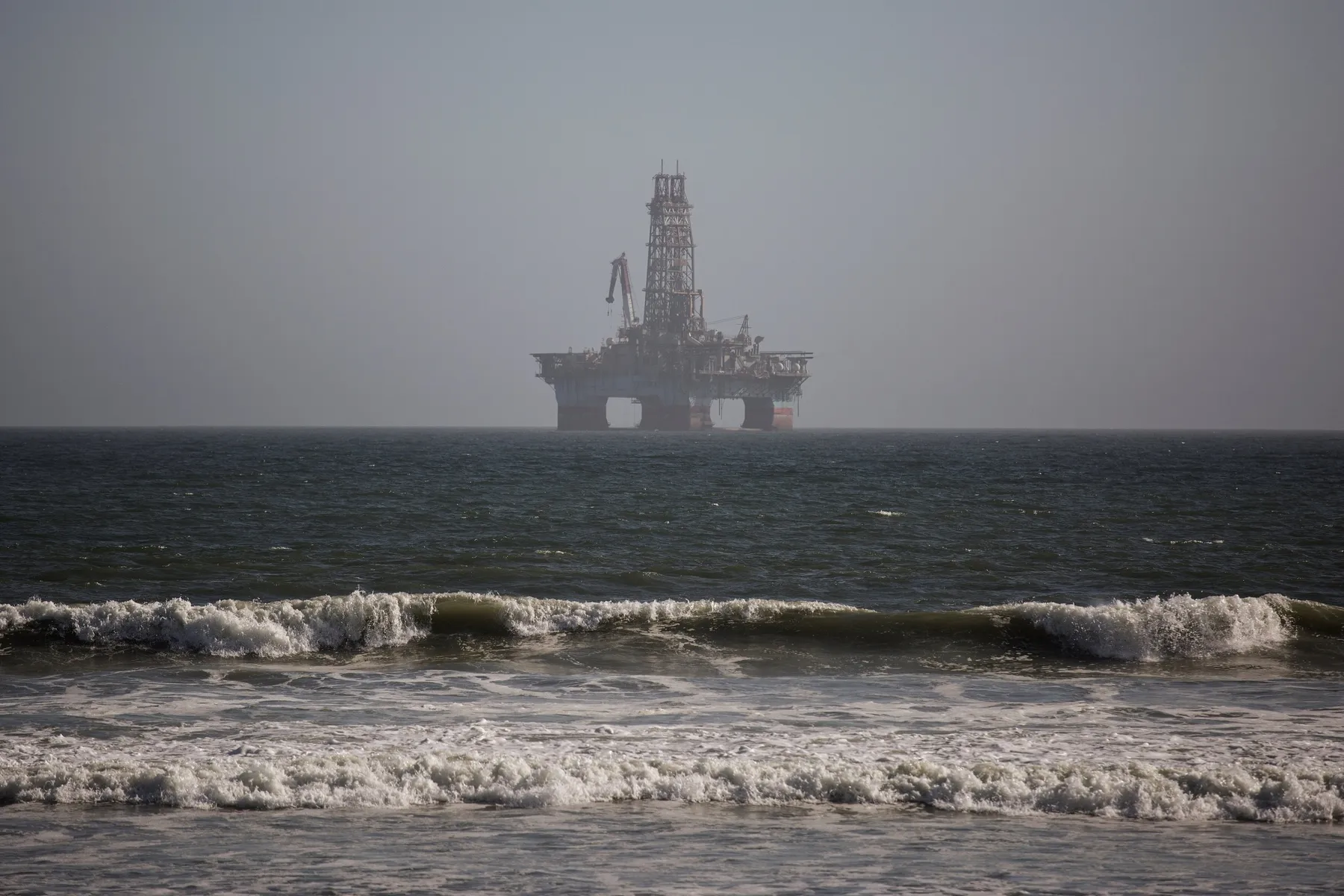
WINDHOEK, August, 2 – The Orange Basin, one of the world’s most promising offshore petroleum provinces, has become a key test of how African governments balance energy development with environmental concerns, as Namibia and South Africa pursue sharply different approaches to unlocking their offshore hydrocarbon resources.
The basin, which stretches across the maritime boundary of both countries, has attracted billions of dollars in planned investment following a series of major discoveries, positioning Namibia as one of the world’s leading frontier oil exploration markets. South Africa, however, has yet to achieve a comparable commercial breakthrough.
Recent developments have underscored the widening policy and regulatory divide between the two neighbours.
According to a Reuters report, on 9 June, Shell announced a new offshore discovery in Petroleum Exploration Licence 39 in Namibia, describing it as delivering its “most promising subsurface results to date.” The licence has hosted several successful exploration wells since 2022, including the landmark Graff-1X discovery that established Namibia as a major emerging oil province.
Just days earlier, environmental organisations and fishing communities appeared before a court in Cape Town seeking to overturn a permit granted to TGS to conduct offshore seismic surveys in South Africa’s section of the Orange Basin.
According to environmental organisation Green Connection, community groups and environmental advocates have initiated at least four court cases and numerous appeals against offshore oil and gas projects and proposed onshore liquefied natural gas developments since 2021.
South Africa’s Petroleum Agency South Africa (PASA) estimates that these legal challenges have delayed as many as 10 exploration wells expected to be drilled before 2030.
The growing regulatory uncertainty has become a concern for international energy companies evaluating investments in the country.
Speaking during the company’s October results presentation, TotalEnergies Chief Executive Patrick Pouyanné said: “We cannot explore, we cannot spend money in a geography if we have to face courts permanently and the permitting becomes really too complex.”
The Orange Basin was formed millions of years ago when South America separated from Africa and is named after the Orange River, which flows into the Atlantic Ocean along the border between Namibia and South Africa.
Although roughly two-thirds of the basin lies within South African waters, the country’s regulatory framework allows multiple administrative appeals and judicial reviews of environmental approvals, contributing to significantly longer permitting timelines than elsewhere on the continent.
According to the Offshore Petroleum Association of South Africa (OPASA), offshore exploration permits can take up to five years to obtain in South Africa, compared with three to nine months in many other African jurisdictions.
OPASA spokesperson Niall Kramer warned that “A similar route of long delays threatens to frustrate South Africa should there be any discoveries.”
TotalEnergies, which has secured exploration acreage along South Africa’s west coast, had planned to drill its first exploration well this year, although the project timeline has become increasingly uncertain amid ongoing legal proceedings.
Attention is now focused on a forthcoming ruling by South Africa’s Constitutional Court, which could reshape the country’s permitting process for offshore exploration.
The case, originally filed in 2021, centres on a challenge by environmental groups against a Shell-led seismic survey off the country’s tourism-dependent Wild Coast.
Environmental lawyer Ricky Stone said the judgment could have far-reaching implications for future energy developments.
According to Stone, “This judgment will be one of the most significant precedents in South African environmental and constitutional law in a generation, whatever the Constitutional Court decides.”
Despite regulatory challenges, South Africa continues to pursue offshore energy development. Mineral and Petroleum Resources Minister Gwede Mantashe has consistently supported oil and gas exploration and has backed industry calls for specialised courts to handle energy-related disputes more efficiently.
The country’s offshore potential includes the Ibhubesi gas field, estimated to contain around 540 billion cubic feet of natural gas and 4.3 million barrels of condensate.
However, exploration success has remained limited. Eco Atlantic Oil & Gas drilled the Gazania-1 well in 2022, discovering light oil-associated gases but not sufficient volumes to justify commercial development.
Reflecting on the experience, Eco Atlantic Chief Executive Gil Holzman said: “We drilled and nothing happened.” He added, “We are living proof that one can actually drill in the basin, leave the surface untouched, and it had zero negative impact on the local communities, zero impact at all on the environment.”
Environmental groups remain unconvinced. Outside the Cape Town court where the TGS case was heard, Stanley Young, a small-scale fisherman from Port Nolloth, argued that offshore petroleum development poses unacceptable risks to coastal livelihoods.
According to Young, “The ocean provides for us for generations and we must protect it. If oil and gas comes in here, it will destroy our livelihoods completely.”
As Namibia advances towards its target of producing first oil by 2030, led by TotalEnergies’ Venus project, which is expected to initially produce around 150,000 barrels per day, the contrasting experiences of the two neighbouring countries are increasingly highlighting the complex trade-offs between attracting investment, safeguarding the environment and securing long-term economic development.
