
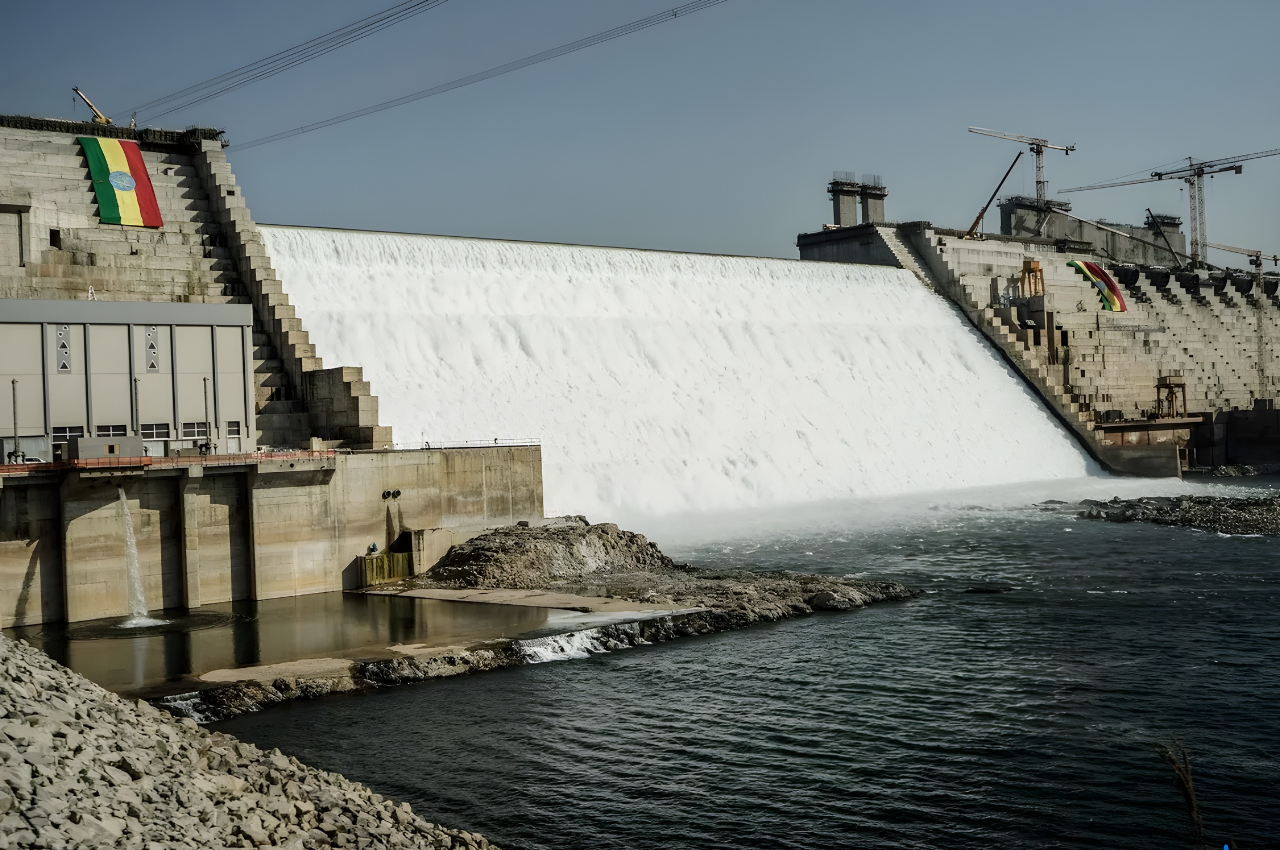
ADDIS ABABA, Feb 23 – President Donald Trump has re-entered the debate surrounding Ethiopia’s Grand Ethiopian Renaissance Dam (GERD), signaling renewed U.S. engagement in one of Africa’s most consequential infrastructure and geopolitical disputes.
His remarks come as Ethiopia accelerates efforts to consolidate its economic and strategic influence across the Horn of Africa
The remarks signal a revival of Washington’s engagement in a dispute that centres on water flows from the Blue Nile and the operational rules governing Africa’s largest hydropower project.
The dam, inaugurated in September 2025 and located near Ethiopia’s border with Sudan, is central to Addis Ababa’s industrialization strategy and long-term energy security planning, with a generation capacity of 5,150 megawatts aimed at expanding electricity access, supporting industrial growth, and enabling regional energy trade.
Following the dam’s launch, Africa’s second-most populous country has rolled out a series of ambitious economic and infrastructural initiatives.
These include plans to secure access to strategic Red Sea ports, the construction of the continent’s largest airport, the launch of a major natural gas programme, and the world’s largest single-site urea fertiliser plant.
The government is also overhauling policies across multiple sectors, liberalising the economy to attract foreign investment after decades of restrictions. Observers note that these moves are not only about economics; they signal Ethiopia’s intent to consolidate influence in the Horn, potentially shifting regional power dynamics.
Analysts suggest that these strategic ambitions make the country a focal point for external actors such as the United States.
Professor Adam Kamil, a Horn of Africa and Ethio-Arab relations specialist, said recent high-level visits, including that of Faisal bin Farhan Al Saud, Saudi Arabia’s foreign minister, and Recep Tayyip Erdoğan, president of Turkey, signal growing diplomatic engagement with Addis Ababa.
He said the visits reflect what he described as Ethiopia’s increasing confidence in regional peacemaking at a moment when traditional Western powers have been retreating from active mediation in the Horn.
“Given the depth of the historical relationship between Ethiopia and the United States, it is inconceivable that Washington would tolerate serious instability in Ethiopia. The Horn of Africa cannot absorb another shock if Ethiopia falters. The region is already under significant strain,” he told AfricanEconomy.
Hydropolitics scholar and veteran negotiator Yacob Arsano (PhD) emphasised Ethiopia’s longstanding strategic partnership with the United States in regional security, pointing to Addis Ababa’s active role in countering Al-Shabaab in Somalia. “This is precisely the kind of engagement Washington endorses and continues to back in its foreign policy,” he said.
Ethiopia and the United States share deep economic ties. In 2024, bilateral trade reached $1.48 billion, with Washington holding a $551 million surplus. The continent’s largest carrier, Ethiopian Airlines also stands as Boeing’s top African partner, which Boeing itself fuels the US economy with $97 Billion annually through operations, related spending, and an expansive supply chain, underpinning around 1.4 million direct and indirect jobs nationwide.
In his latest comments on the dam, Trump struck a more measured tone than in October 2020, when he said Egypt “will end up blowing up that dam” if no agreement were reached. He said the United States was ready to resume mediation between Egypt and Ethiopia to resolve the Nile dispute “once and for all”, describing the issue as a priority.
He called for fair negotiations and cautioned against unilateral control of the river’s resources, warning of the risks of escalation if talks collapse.
“No country in the region should unilaterally control the Nile’s precious resources and disadvantage its neighbours in the process,” he said. Separately, at the World Economic Forum in Davos, Trump said he would seek to convene a meeting between the leaders of Egypt and Ethiopia to advance an agreement on the dam.
“There is already agreement among Nile Basin countries through frameworks such as the Nile Basin Initiative and the Cooperative Framework Agreement (CFA) that Egypt needs to take into account, as these instruments are designed to benefit all riparian states,” Arsano said.
He added that a departure from these established frameworks could complicate Ethiopia’s relations with its partners and weaken its diplomatic standing.
Arsano also criticised what he called the implicit undertones of Trump’s recent remarks, saying it was “strictly inappropriate” to suggest pressure or threats, or to imply that water resources should be restricted to downstream countries.
“Diplomacy cannot be grounded in force or misinformation. The Nile is a shared lifeline, and such hints risk undermining regional trust and cooperation,” he said.
Cairo advocates the 1929 Nile Waters Agreement as a legal safeguard for its historical water rights, which allocated most of the river’s flow to Egypt and Sudan and granted Egypt effective veto power over upstream projects. Ethiopia, which contributes roughly 80–85 percent of the Nile’s waters, was not a party to the treaty and rejects it as a colonial-era imposition that undermines its sovereignty.
Addis Ababa maintains it has the right to develop the Blue Nile for industrialisation, energy security, and national development, and has instead pursued more equitable frameworks, such as the CFA and the Nile Basin Initiative, designed to balance the interests of all riparian states.
Following President Trump’s latest remarks on the GERD, the Ethiopian government issued a measured response, choosing to address the issue cautiously for the time being. Analysts note that Addis Ababa appears to understand president Trump’s increasingly interventionist posture.
“The consequences could be far-reaching if Ethiopia were to respond aggressively, given the United States’ current approach,” said Getachew Tekelemariam, an African development expert.
He said Ethiopia has little to fear following the inauguration of its largest dam but cautioned against local instability and the strategic implications of its future use.
“Ethiopia should deepen its engagement in both regional and multilateral institutions with a carefully crafted diplomatic strategy. Think tanks must be equipped with the resources to position the country on the continental and global stage,” he told African Economy Inc. “Right now, we lack this.”
Tekelemariam added that analysing Washington solely through the lens of the current administration risks misreading its long-term posture.
He said US policy is shaped by a continuum of political experience and institutional influence, noting that many leaders rise through years of ideological formation, legislative roles and congressional engagement before reaching the executive branch. “Ethiopia should trap this network to find the right answer,” he said.
The Horn of Africa, a critical hub for international trade, is heating up like never before. Two years ago, Prime Minister Abiy Ahmed (PhD) openly flagged Ethiopia’s ambition for Red Sea access, calling it an existential issue and urging the country to begin discussions about securing a maritime foothold.
That push has sparked concerns among observers about a potential clash with Eritrea. On top of that, Israel recognising Somaliland is stirring the pot even more.
Meanwhile, rivalry between Gulf powers, particularly the United Arab Emirates and Saudi Arabia, is reshaping political and economic engagements across the region, as both nations compete for allies and infrastructure projects in countries ranging from Sudan to Djibouti.
Egypt is taking deliberate steps to counter Ethiopia’s expanding ambitions in the Horn. Cairo has not only upgraded key port facilities but also secured operational agreements for strategic hubs in Eritrea, including the port of Asab, and in Djibouti, at the Doraleh Multi‑Purpose Port.
At the same time, Egypt has deepened military and political coordination with both countries, sending a clear signal that the Red Sea’s governance remains the prerogative of littoral states, a move that directly challenges Ethiopia’s push for a maritime foothold.
“They plan to turn port access into a bargaining chip, aiming to trap Ethiopia through pricing,” Kamil said. He added that Cairo is allegedly stirring local instability through media campaigns and conspiracies to weaken federal defence, urging Ethiopia to maintain national stability. “Once this is secured, the country is strong enough to make its ambitions a reality,” he added.
