
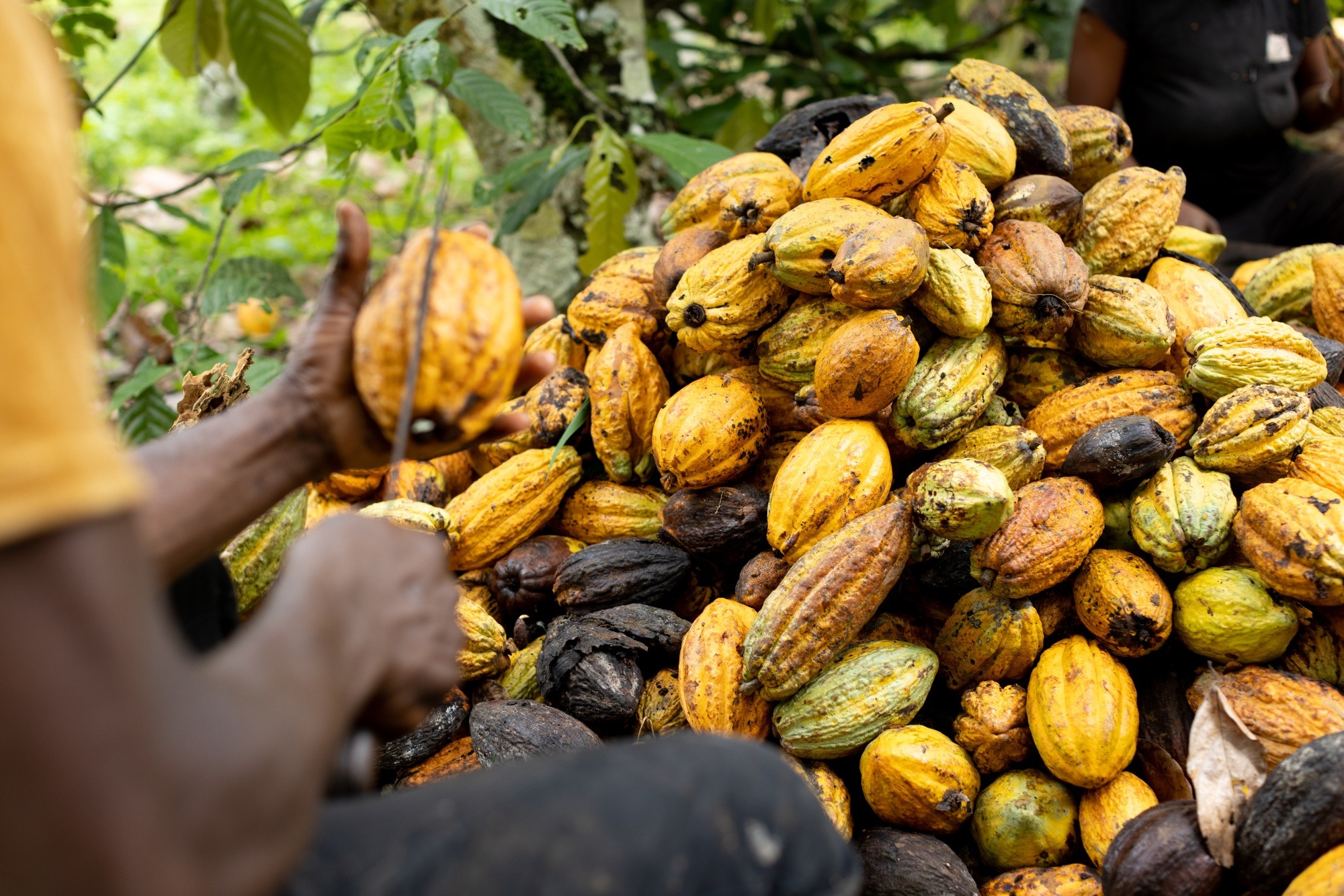
ABIDJAN, Aug. 21 – Ivory Coast cocoa producers and exporters are preparing for new European Union rules aimed at preventing products linked to deforestation from entering the European market, although industry players warn the new system could cause delays when the next cocoa season begins.
The EU’s anti-deforestation regulation requires companies importing commodities including cocoa to demonstrate that their products are not associated with deforestation. The rules are scheduled to take effect at the end of December, increasing pressure on major cocoa-producing countries to strengthen traceability across their supply chains.
Yves Brahima Kone, head of Ivory Coast’s Coffee and Cocoa Council, said the country’s digital identification system for cocoa farmers will support compliance from the beginning of the 2026/27 season on September 1.
“We are ready to prove that our cocoa is traceable and certified … The producer card is up and running and meets all the expectations of chocolate consumers,” Kone said, adding that the system had undergone two years of testing.
Introduced in 2019, the producer cards function as electronic identification and payment tools designed to trace cocoa from farms through to export ports, establish its origin and facilitate access to the government-guaranteed producer price.
Kone said the system could also expand financial inclusion by giving more than one million small-scale cocoa farmers access to banking services. The regulator estimates that Ivory Coast has between 1.2 million and 1.3 million cocoa farmers.
Industry Raises Supply Chain Concerns
Despite the regulator’s confidence in the system, cocoa industry participants are concerned about potential bottlenecks as the new season begins.
According to industry sources, farmers who have not received their identification cards or have lost them could face difficulties selling their cocoa. Participants have also pointed to shortages of terminals required to process the cards, potentially slowing transactions at the start of the season.
The broader challenge is establishing whether the digital system can reliably prevent cocoa produced illegally inside protected areas from entering the formal supply chain.
Ivory Coast estimates that cocoa cultivated in protected forests and national parks accounts for about 15% of national production. Exporters and European environmental organisations put the proportion considerably higher, at around 30%.
Industry participants also said illegally produced cocoa can still reach the ports of Abidjan and San Pedro, where it may be mixed with legally produced beans. One difficulty is that the output of individual farmers can be estimated but is not necessarily measured with sufficient precision to establish the exact volume produced on each farm.
A European export company executive in Abidjan warned that the implementation could prove difficult despite the potential benefits of the system.
“We know the benefits of the card, but make no mistake: there will be a lot of problems, and it’s going to be chaos this season. The new European regulation on deforestation is too complex and difficult to implement on the ground,” the executive said.
Another European exporter also warned that the new requirements could affect the wider cocoa supply chain, saying, “There will be delays in purchasing, in exports, and throughout the entire supply chain. That’s undeniable.”
The competing assessments highlight the challenge facing Ivory Coast as it prepares to align one of the world’s largest cocoa supply chains with stricter environmental traceability requirements.
For European buyers, compliance will become increasingly important as the EU rules take effect. For Ivory Coast, the immediate challenge is ensuring that farmers, cooperatives, exporters and port operators can use the new identification infrastructure at scale without disrupting the flow of cocoa.
The effectiveness of the system in tracing beans back to their farms will also determine whether Ivory Coast can provide European buyers with the documentation required under the new rules while addressing concerns over cocoa production in protected areas.
