
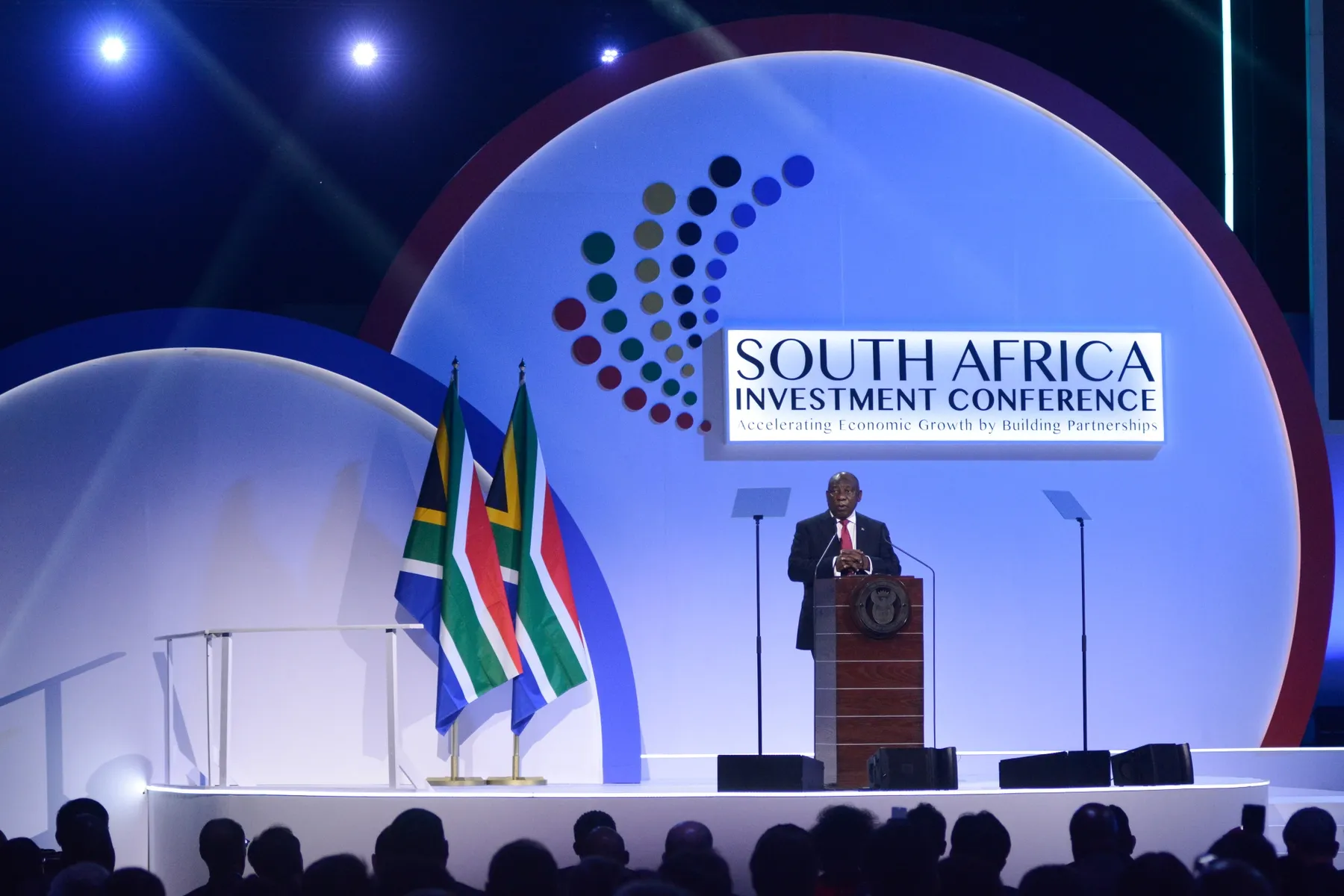
JOHANNESBURG, April 22 – South Africa secured record investment commitments at its latest conference, but official data shows a persistent gap between pledges and actual economic delivery.
The sixth South Africa Investment Conference, held on March 31, 2026, at the Sandton Convention Centre in Johannesburg. attracted 81 confirmed projects worth 889.8 billion rand ($54 billion). The event forms part of a broader government drive to mobilize 3 trillion rand ($182 billion) in investment by 2030.
However, figures from the presidency and the Department of Trade, Industry and Competition reveal that of the roughly 1.5 trillion rand pledged since the initiative began in 2018, only 634 billion rand — just under 42% — had been realised by March 2026.
This conversion rate falls well below global benchmarks, where between 60% and 80% of announced foreign direct investment typically materializes, according to studies by McKinsey & Company.
Despite these challenges, new investments continue to flow. Vivo Energy, a subsidiary of Vitol, is investing around $130 million to expand fuel storage capacity in Durban, strengthening supply resilience amid global energy disruptions.
Much of the pledged capital is coming from domestic firms. Of the 415 billion rand in company-led commitments, about two-thirds originate from South African businesses, including major investments from Sasol, MTN Group and the V&A Waterfront development company.
Still, structural challenges continue to weigh on investment conversion. Economic growth has remained subdued at around 1% to 2% annually, while unemployment remains above 30%. Longstanding issues such as policy uncertainty, infrastructure constraints and the legacy of corruption have dampened investor confidence.
Capital formation also remains below optimal levels. Gross fixed capital formation has hovered around 15%, significantly below the 20% to 25% range typically associated with sustained growth in emerging markets, according to benchmarks from the World Bank and the IMF.
The latest investment commitments span sectors including tourism, real estate, green energy, chemicals and digital infrastructure, with ICT and the digital economy attracting the largest share.
While the scale of pledged investment signals strong interest in South Africa’s economy, the key challenge remains execution turning commitments into tangible projects that drive growth, jobs and long-term economic transformation.
