
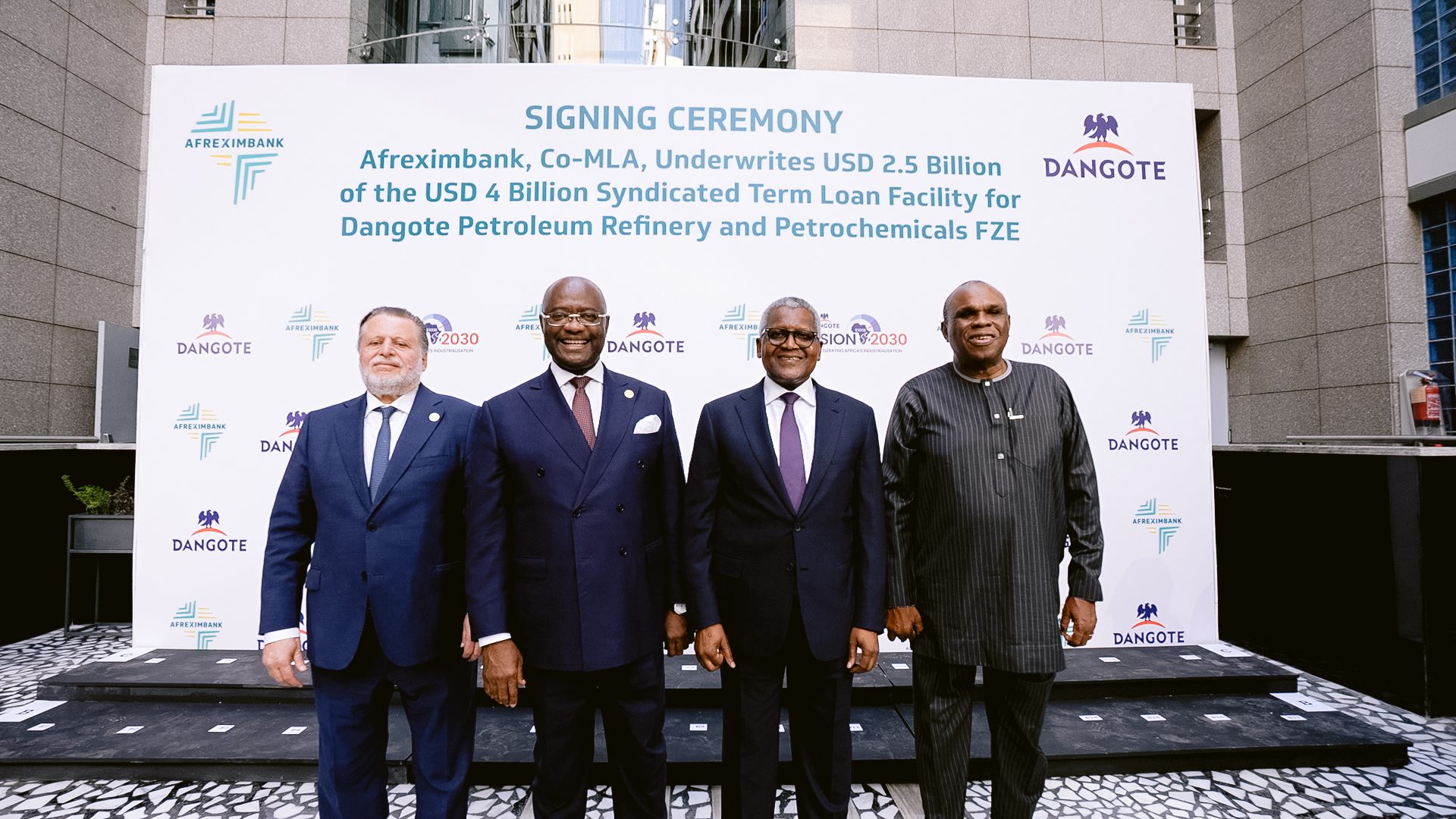
CAIRO, Mar 31 – The African Export-Import Bank (Afreximbank) has underwritten $2.5 billion of a $4 billion senior syndicated term loan for Dangote Petroleum Refinery and Petrochemicals FZE, marking one of the most significant financing deals in Africa’s industrial sector.
The five-year facility, arranged alongside Access Bank as co-mandated lead arranger, is designed to consolidate existing debt, optimise capital structure, and align financing with the refinery’s operational scale and long-term growth trajectory.
The transaction strengthens the financial position of the Dangote Refinery, Africa’s largest refining and petrochemical complex with a capacity of 650,000 barrels per day. It also reinforces the plant’s role as a strategic supplier of refined petroleum products across Africa and global markets.
Afreximbank’s $2.5 billion commitment represents the largest share in the syndicate, underlining its leadership in mobilising capital for Africa’s industrialisation agenda. The bank has played a central role in supporting the refinery since operations began, including a $1 billion working capital facility and advisory support for the Naira-for-Crude initiative, which enables transactions in local currency and reduces reliance on foreign exchange.
Speaking on the development, George Elombi emphasised the broader significance of the investment, noting that Afreximbank has deployed approximately $15 billion into the Dangote Group since 2015. He framed the financing as part of a larger strategy to build resilient African industrial capacity and reduce dependence on external systems.
The deal highlights the growing importance of African-led capital in funding large-scale infrastructure and industrial projects. By strengthening domestic refining capacity, the Dangote Refinery is expected to play a pivotal role in improving energy security, reducing fuel imports, and accelerating intra-African trade in refined petroleum products.
Aliko Dangote described the financing as a critical step in reinforcing the refinery’s balance sheet and positioning it for its next phase of growth, as it scales operations to meet both domestic and regional demand.
The syndicated loan attracted strong participation from a consortium of African and international financial institutions, reflecting sustained investor confidence in the refinery as a transformative industrial asset.
Beyond its immediate financial impact, the transaction signals a broader shift toward financing models anchored in African institutions and capital pools. As the continent pushes toward industrialisation and value addition, projects of this scale are increasingly seen as foundational to long-term economic resilience and self-sufficiency.
