
– Business, Finance, Markets & Economic News
  • Home
  • Economy
  • Business
  • Markets
  • Finance
  • Credit Ratings
  • Policy
  • Tech
– Business, Finance, Markets & Economic News
  • Home
  • Economy
  • Business
  • Markets
  • Finance
  • Credit Ratings
  • Policy
  • Tech
Top News
Barrick Mining Executive Meets Mali Prime Minister as Company Seeks to Rebuild Ties
Guinea Approves $1 Billion Sovereign Wealth Fund Backed by Simandou Mining Revenues
Dangote Refinery’s $48 Billion Valuation Set to Make It Africa’s Largest Listed Company
Amsons Begins $250 Million Cement Investment in Kenya as Bamburi Expands Capacity
AfDB and EBRD Deepen African Partnership to Mobilize Capital for Businesses and Energy
Afreximbank to Advise on $1.5 Billion Financing for Nigeria’s Proposed Ibom LNG Project
IMF Calls for Clearer Debt Targets and Stronger Fiscal Rules in South Africa
Ramaphosa Wins Court Challenge Over Parliamentary Panel’s Farmgate Findings
Mozambique Expects IMF Decision on New Financing Programme by Mid-December
Nigeria’s Tinubu Seeks Approval to Cut 2026 Budget to $48 billion, Keeps Deficit Unchanged
DR Congo Secures $965 Million in Mining and Private-Sector Financing
Dangote Refinery Sets December 1 Listing on Nigerian Exchange After SEC Approval
Gold Fields Plans $7.5 Billion Investment to Extend Ghana’s Tarkwa Mine Operations
Nigeria’s Central Bank Holds Key Interest Rate at 23% After September Cut
Botswana Economy Set to Return to Growth as IMF Flags Diamond Demand and Fiscal Risks
SUBSCRIBE
– Business, Finance, Markets & Economic News
Subscribe
– Business, Finance, Markets & Economic News
  • Home
  • Economy
  • Business
  • Markets
  • Finance
  • Credit Ratings
  • Policy
  • Tech
Copyright 2026 - All Right Reserved
Mining

Guinea Approves $1 Billion Sovereign Wealth Fund Backed by Simandou Mining Revenues

by Oluebube Elechi November 26, 2026
written by Oluebube Elechi November 26, 2026
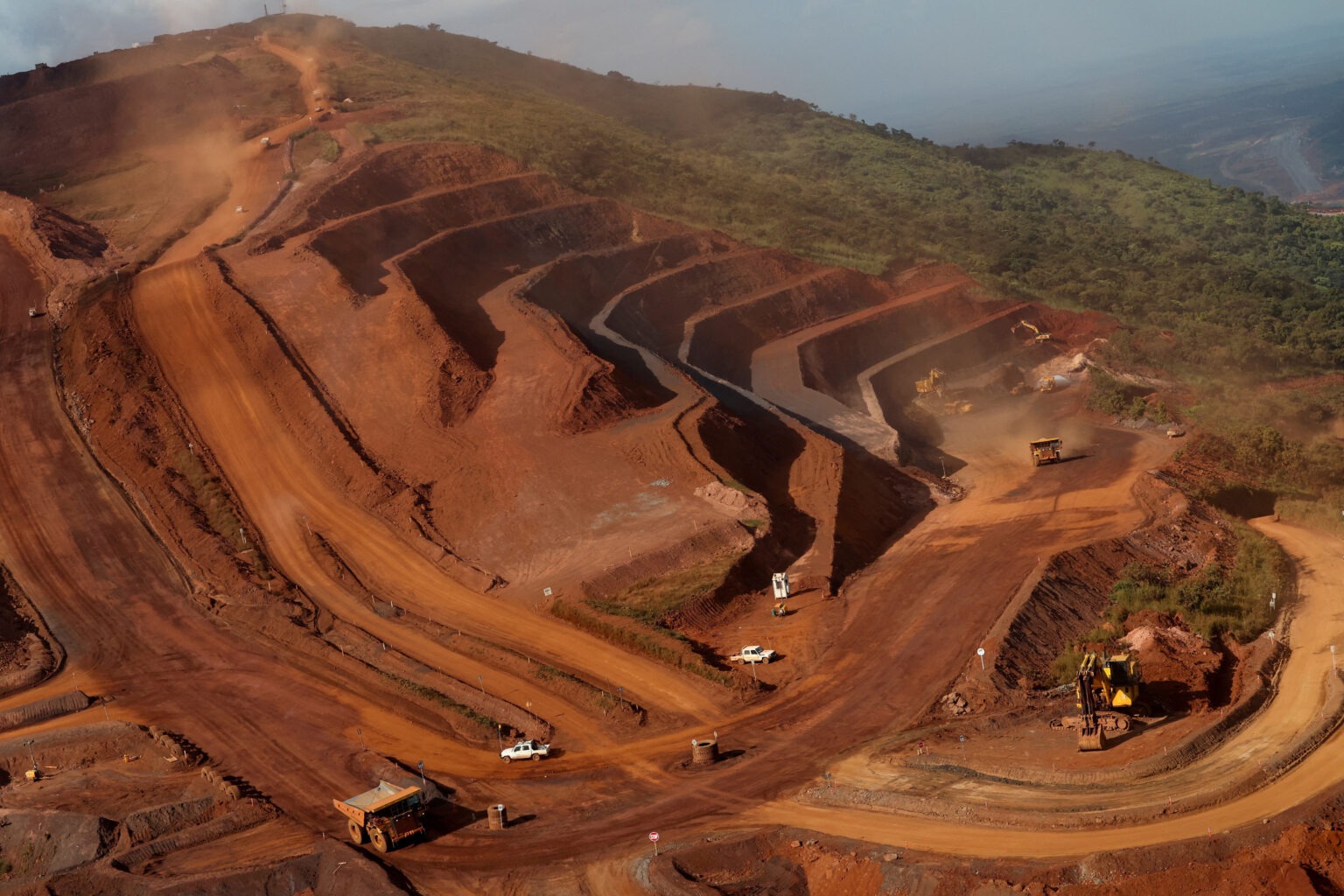
Mining vehicles operate at the blocks three and four of the Simandou mine, one of the largest high-grade iron ore deposits, run by Rio Tinto and partners' joint venture, SimFer, in the Nzerekore Region, Guinea November 4, 2025. Image Credit: REUTERS
FacebookTwitterLinkedinEmail
3

CONAKRY, Nov 26 – Guinea has approved legislation establishing a $1 billion sovereign wealth fund that will channel part of the country’s mining revenues into long-term investments, economic stabilization and savings for future generations, as the government prepares to capture greater value from its expanding extractive sector.

The National Assembly adopted the law establishing the Fonds Souverain de la République de Guinée (FSG) on November 25, with 121 votes in favour, none against and two abstentions out of 123 ballots cast.

Wholly owned by the Guinean state, the fund is expected to mobilise an initial endowment of $1 billion over a maximum period of five years. Its principal funding sources will include allocations from the Simandou iron ore project and revenues from future mining developments that begin commercial operations after the legislation takes effect.

Under the funding framework, 30% of fiscal and non-fiscal revenues generated by Simandou will be allocated to the fund, alongside 5% of revenues from qualifying extractive projects entering the exploitation phase after the law’s enactment.

You Might Be Interested In
  • IRH Agrees £352.8 million Deal to Acquire Kenmare Resources, Operator of Mozambique’s Moma Mine

The initiative forms part of the government’s broader Simandou 2040 development programme, which seeks to convert the country’s mineral wealth into longer-term economic capacity and investment.

Three mandates for mining revenues

The FSG will operate through three investment vehicles covering economic stabilisation, domestic development and intergenerational savings.

The stabilisation vehicle will build financial reserves to help protect public finances against external shocks, particularly fluctuations in international commodity prices. The mechanism is intended to reduce the exposure of government revenues and expenditure to volatility in the mining sector.

A separate development investment vehicle will co-invest with private-sector and institutional partners in commercially viable projects across infrastructure, energy, industry and other productive sectors. The mandate places emphasis on investments capable of generating employment and supporting domestic economic activity.

The third vehicle will manage long-term financial assets, preserving part of the country’s natural resource wealth for future generations rather than allowing the proceeds of finite mineral resources to be consumed entirely through current expenditure.

The structure is designed to give the fund distinct responsibilities while linking resource revenue management to broader economic objectives.

Governance and investment oversight

Although fully state-owned, the fund is designed to operate with institutional autonomy and governance arrangements aligned with international sovereign wealth fund standards.

Its oversight will be handled by a nine-member board of directors, including seven independent directors. Investment decisions are expected to be guided by financial performance, economic objectives and risk-management considerations.

The framework also draws on the Santiago Principles, the internationally recognised set of voluntary standards for sovereign wealth funds. These principles cover governance, accountability, transparency and investment practices.

The law provides for regular public reporting on the fund’s investments, performance and management, with the aim of strengthening oversight and public confidence in how mineral revenues are deployed.

Simandou places resource management at the centre of development strategy

The fund’s establishment comes as Guinea prepares to expand the economic contribution of its mining industry, particularly through the Simandou iron ore project.

By earmarking a share of Simandou revenues and contributions from future extractive projects, the government is seeking to establish a mechanism through which mining income can support investment beyond the life of individual projects.

The approach also reflects a broader policy challenge for resource-rich economies: converting commodity revenues into productive assets while maintaining fiscal stability during periods of price volatility.

The legislation marks an important institutional step, but the fund’s impact will depend on its operationalisation, the pace at which its initial capital is mobilised and the quality of its investment and governance decisions.

For Guinea, the central test will be whether the FSG can translate rising extractive revenues into durable economic assets, stronger domestic productive capacity and financial reserves that extend the benefits of mineral wealth beyond the current generation.

Read Next

  • Brazil’s Petrobras Buys Stake in Namibia Offshore Oil Block in Africa Expansion Push

    February 7, 2026
  • Nigeria Collects $19.9 Billion in Taxes as Digital Systems Expand

    August 12, 2026
  • Bank of Africa, Italy’s SACE Partner to Expand Financing for Strategic Projects Across Africa

    July 27, 2026
  • Nigerian Tycoon Tony Elumelu to Retire as UBA Chairman as Emmanuel Nnorom Takes Over in August 2026

    July 6, 2026
  • Finance Minister Says Nigeria Has Moved Past Worst Phase of Economic Reforms

    July 7, 2026

Newsletter

Subscribe to our newsletter for trusted insights on Africa’s economies, markets, and business.

African Economy Inc. Logo

About Us

We are a business and economic intelligence platform delivering in-depth reporting, analysis, and insights on markets, companies and economic developments across Africa.

Our Company

  • AI Disclosure Policy
  • About
  • Editorial Standard
  • Partnerships
  • Advertise With Us
  • Careers
  • Ownership

News

  • Economy
  • Business
  • Markets
  • Finance
  • Credit Ratings
  • Policy
  • Tech

Useful Links

  • Privacy Policy
  • Terms of Use
  • Closed Captioning Policy
  • Accessibility Statement
  • Personal Information
  • Data Tracking
  • Register New Account

Subscribe Newsletter

Subscribe to our newsletter for trusted insights on Africa’s economies, markets, and business.

©2026 Majons Media Inc. All Rights Reserved.

Facebook Twitter Instagram Linkedin
Manage Consent
To provide the best experiences, we use technologies like cookies to store and/or access device information. Consenting to these technologies will allow us to process data such as browsing behavior or unique IDs on this site. Not consenting or withdrawing consent, may adversely affect certain features and functions.
Functional Always active
The technical storage or access is strictly necessary for the legitimate purpose of enabling the use of a specific service explicitly requested by the subscriber or user, or for the sole purpose of carrying out the transmission of a communication over an electronic communications network.
Preferences
The technical storage or access is necessary for the legitimate purpose of storing preferences that are not requested by the subscriber or user.
Statistics
The technical storage or access that is used exclusively for statistical purposes. The technical storage or access that is used exclusively for anonymous statistical purposes. Without a subpoena, voluntary compliance on the part of your Internet Service Provider, or additional records from a third party, information stored or retrieved for this purpose alone cannot usually be used to identify you.
Marketing
The technical storage or access is required to create user profiles to send advertising, or to track the user on a website or across several websites for similar marketing purposes.
  • Manage options
  • Manage services
  • Manage {vendor_count} vendors
  • Read more about these purposes
View preferences
  • {title}
  • {title}
  • {title}
– Business, Finance, Markets & Economic News
  • Economy
  • Business
  • Markets
  • Banking & Finance
  • Energy
  • Tech
  • Policy
  • African Economy Inc.