
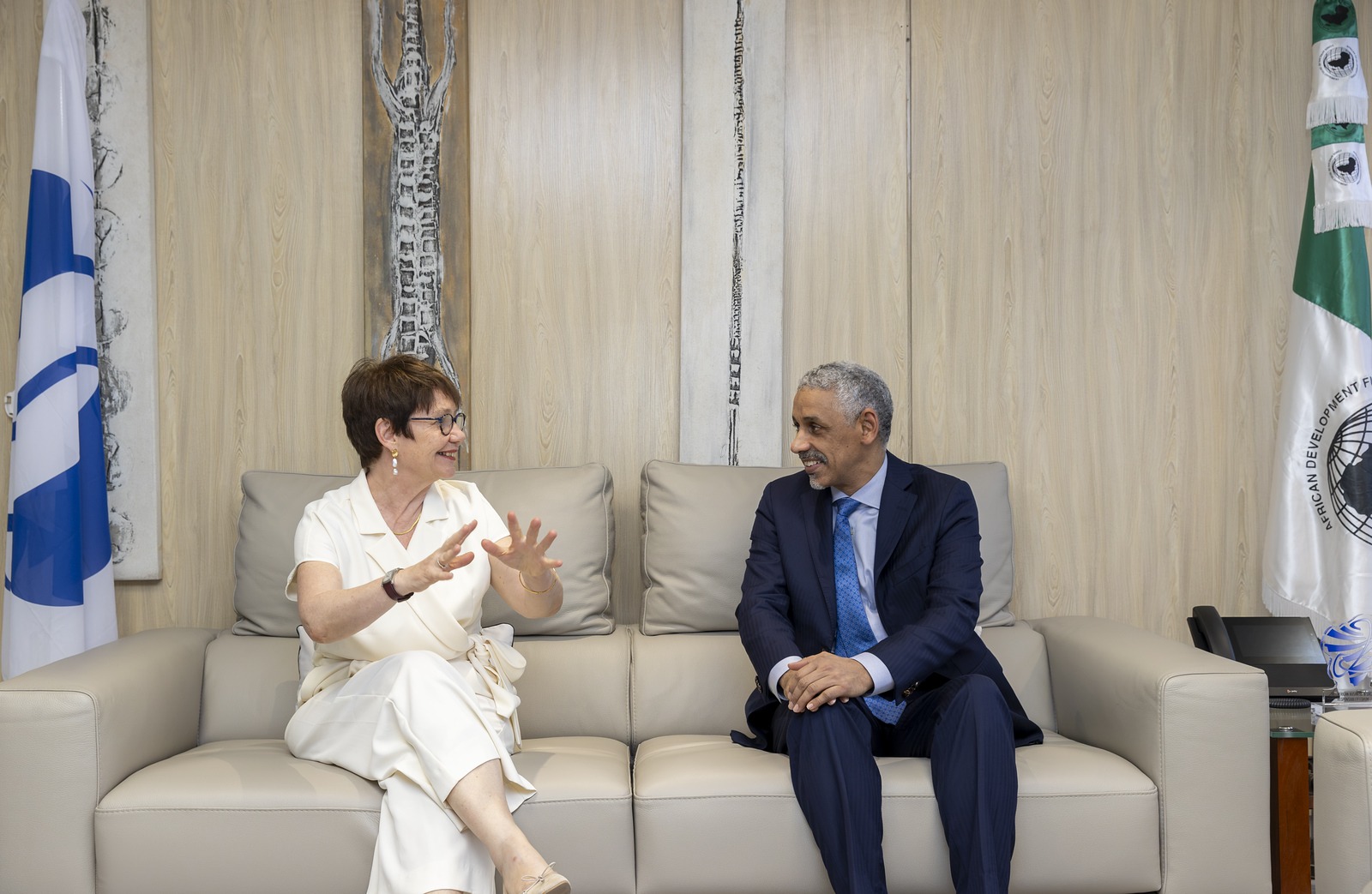
ABIDJAN, Nov 25 – The African Development Bank Group and the European Bank for Reconstruction and Development are expanding cooperation across Africa, targeting financing gaps for small and medium-sized enterprises, energy infrastructure and the mobilisation of domestic savings for productive investment.
The two institutions outlined their priorities on November 24 in Abidjan, where AfDB President Sidi Ould Tah and EBRD President Odile Renaud-Basso met a day after the European lender opened its country office in Côte d’Ivoire.
Their discussions focused on combining the AfDB’s continental presence and public-sector relationships with the EBRD’s private-sector financing model and experience in market development to support businesses and infrastructure projects across their expanding shared footprint.
The meeting coincided with the Africa Small and Medium Enterprise Business Day, which brought together about 200 financial institutions, investors and business executives at the Noom Hotel in Abidjan. The gathering also featured Abdoulaye Diop, president of the West African Economic and Monetary Union Commission, and Côte d’Ivoire’s Minister of Commerce, Industry and Crafts, Kalil Konaté.
The central objective was to build a coalition of financial institutions and investors capable of addressing the structural constraints facing African businesses.
Growth-stage companies face financing gaps
A major focus was the difficulty African SMEs encounter in financing production and fulfilling commercial orders, particularly when payments from large customers arrive only after delivery.
Guarantees can help businesses secure credit, but their effectiveness depends on the quality of corporate records, financial reporting and the availability of reliable markets for their products. The institutions therefore argued that access to finance must be complemented by business advisory and technical support.
Mid-sized companies represent a particular financing challenge. They are often too large for programmes designed for smaller businesses but lack the organisational structures and financial track records required by major lenders and institutional investors.
The two banks called for closer coordination among development finance institutions, commercial banks, guarantee funds and private investors to distribute risk according to companies’ stages of growth.
Access to regional and international markets, as well as integration into the supply chains of large industrial groups, also featured in the discussions. The approach builds on the AfDB’s SME Development Action Plan 2026–2031, which combines financing, technical assistance and market access, with supply-chain financing identified as a priority.
EnterpRise Africa targets businesses ready to scale
One of the proposed areas of cooperation is EnterpRise Africa, a joint initiative designed to support fast-growing SMEs that struggle to access credit suited to their business models and expansion plans.
The programme is structured around two components: a private credit fund and an advisory platform intended to strengthen participating companies’ management, governance and ability to raise additional capital.
Nine countries are under consideration: Benin, Côte d’Ivoire, Ghana, Kenya, Nigeria and Senegal, where both institutions operate, alongside Burkina Faso, Burundi and the Democratic Republic of Congo, where the AfDB would operate independently as part of its support for transition states.
The initiative has attracted interest from potential donors, including Italy, which is considering a contribution through its Ministry of Economy and Finance.
“A fast-growing African SME with a strong growth project should not have to knock on two doors or wait on two timetables,” Ould Tah said. “If our teams work together from the start, the result will be that the company will get a single answer and faster.”
Energy investment offers scope for joint financing
Energy infrastructure is another area where the two banks see opportunities to combine their capabilities.
Africa faces the challenge of expanding access to reliable and affordable electricity while meeting rising demand and supporting the transition towards cleaner energy systems. Addressing these needs will require substantial investment, including greater participation from private capital.
The institutions pointed to their joint financing of the Dandara solar project in Egypt as an example of their cooperation. The project combines 500 megawatts of solar generation capacity with 100 megawatt-hours of battery storage and operates under a 25-year contract to supply aluminium producer Egyptalum.
The banks see potential to replicate elements of this approach in other markets where they operate, using joint financing to support energy infrastructure and attract private investment.
“Dandara is a strong example of what our institutions can achieve by combining their respective strengths,” Renaud-Basso said. “As our shared footprint grows, so do the opportunities to work together to mobilise investment and deliver greater impact.”
Domestic savings emerge as a strategic funding source
Mobilising African savings for investment is another shared priority.
The continent requires approximately $400 billion annually to meet its development financing needs, while holding an estimated $4 trillion in domestic savings across pension funds, insurance companies and sovereign wealth funds.
The AfDB is seeking to channel more of these resources into African businesses and infrastructure through the New African Financial Architecture for Development (NAFAD), championed by Ould Tah and endorsed by African Union heads of state and government in February.
Local-currency financing featured prominently in discussions involving the AfDB, EBRD, West African Development Bank, Regional Securities Exchange, NSIA Group and Côte d’Ivoire’s National Social Security Fund.
The approach is intended to reduce the foreign-exchange exposure faced by businesses that borrow in foreign currencies but generate revenue in local markets. It also offers a way to deepen domestic capital markets and increase the role of African institutional investors in financing development.
The two banks bring different capabilities to this agenda. The AfDB has a continent-wide mandate and a strategic focus on mobilising African capital, while the EBRD brings 35 years of experience in local-currency lending and developing financial market infrastructure.
Their cooperation around Morocco’s overnight interest-rate benchmark, MONIA, illustrates this complementarity. The EBRD supported the benchmark’s development in 2020, while the AfDB recently issued its first Moroccan dirham bond indexed to MONIA, extending the benchmark’s application to longer-term financial instruments.
Expanding institutional cooperation
The AfDB and EBRD have maintained a formal cooperation framework since May 2021 and a staff exchange arrangement since 2023. Since 2024, the institutions have co-financed projects representing approximately €1.25 billion in combined financing, with additional opportunities under development.
Their expanding presence in common African markets is creating scope for closer coordination on project financing, private-sector development and capital mobilisation.
The next phase of the partnership will depend on translating that institutional alignment into financing structures and programmes that address specific market gaps, particularly for growth-stage businesses and infrastructure projects requiring long-term capital.
