
– Business, Finance, Markets & Economic News
  • Home
  • Economy
  • Business
  • Markets
  • Finance
  • Credit Ratings
  • Policy
  • Tech
– Business, Finance, Markets & Economic News
  • Home
  • Economy
  • Business
  • Markets
  • Finance
  • Credit Ratings
  • Policy
  • Tech
Top News
Egypt Signs Preliminary $650 Million Financing Deal for 1GW Solar Project
Ramaphosa Credits SARS Recovery for Stronger South African Public Finances
Nigeria Targets Single-Digit Inflation Before End-2027, Finance Minister Says
Moody’s Sees South Africa Medium-Term Budget as Credit Positive, Cuts Deficit Target to 3.9%
Honeywell Technologies Launches New Industrial AI Platform at Nigeria’s Dangote Refinery
Airtel Money Reports $830 Million Revenue After London Listing as Profit Rises 21%
Senegal Budget Standoff Threatens $2.2 Billion IMF Deal and Debt Restructuring
Zambia Opens Gold Refinery to Boost Local Processing and Diversify Mineral Exports
Kodal Minerals Targets Ghana Lithium Expansion Beyond Mali’s Bougouni Mine
South Africa Proposes 100% Offshore Investment Mandates Under New Financial Centre Framework
Morocco Targets 3% Fiscal Deficit in 2027 Budget as Social Spending Rises to $6.3 Billion
Senegal Bank Creditors Appoint Houlihan Lokey as Debt Restructuring Adviser
JPMorgan Wins Initial Central Bank Approval to Establish Merchant Bank in Nigeria
South32 Shareholders Approve Up to $5.6 Billion Aluminium Asset Sale to Alcoa
Shoprite in Talks With Investec as Retailer Seeks to Broaden Financial Services
SUBSCRIBE
– Business, Finance, Markets & Economic News
Subscribe
– Business, Finance, Markets & Economic News
  • Home
  • Economy
  • Business
  • Markets
  • Finance
  • Credit Ratings
  • Policy
  • Tech
Copyright 2026 - All Right Reserved
Home » Economy » Ramaphosa Credits SARS Recovery for Stronger South African Public Finances
Economy

Ramaphosa Credits SARS Recovery for Stronger South African Public Finances

by Oluebube Elechi October 26, 2026
written by Oluebube Elechi October 26, 2026
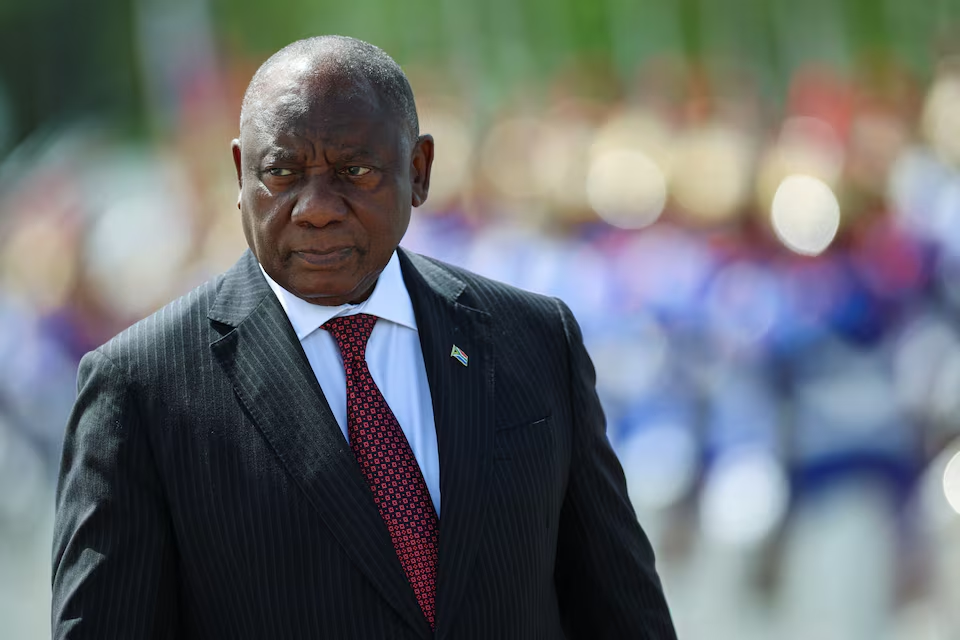
South Africa's President Cyril Ramaphosa REUTERS/Adriano Machado
FacebookTwitterLinkedinEmail
2

JOHANNESBURG, Oct 26 – South African President Cyril Ramaphosa has credited the recovery of the South African Revenue Service (SARS) with improving tax collection and strengthening government finances, saying higher revenue is helping fund social programmes, infrastructure and development priorities.

Writing in his weekly newsletter following the presentation of the Medium-Term Budget Policy Statement (MTBPS) by Finance Minister Enoch Godongwana, Ramaphosa said the revenue service’s turnaround after the State Capture period was providing fresh momentum to public finances.

He described the improvement in the country’s fiscal position as evidence of progress, while stressing that stronger government finances must translate into tangible benefits for households and businesses.

According to Ramaphosa, approximately 60% of non-interest government spending is allocated to the social wage, which supports healthcare, education and services for lower-income households.

You Might Be Interested In
  • Kenya’s Private Sector Returns to Growth in June as Business Activity Stabilises

This spending includes free basic services for more than 11 million households, school meal programmes and social grants reaching over 18 million beneficiaries.

The government is also allocating additional funding to combat gender-based violence and femicide. The measures include hiring more than 3,500 social workers and strengthening investigative and forensic capabilities to support successful prosecutions.

Ramaphosa also pointed to the temporary reduction in the fuel levy as a measure intended to ease financial pressure on households amid elevated living costs.

Infrastructure and spending efficiency

Infrastructure remains the fastest-growing component of the national budget, according to Ramaphosa, who said the government was introducing mechanisms to attract greater private-sector co-investment to support economic growth and job creation.

The approach reflects an effort to expand infrastructure investment while managing fiscal constraints and encouraging private capital to participate in development projects.

The President also highlighted changes in public expenditure management, saying the government was moving away from broad departmental budget cuts towards targeted savings based on efficiency and programme performance.

By rationalising lower-priority or underperforming programmes, the State has identified more than R11 billion in medium-term savings, he said.

A review of the Infrastructure Conditional Grant is also underway to examine persistent underspending, project delays and substandard delivery by provincial and municipal authorities.

The review is intended to address weaknesses in how infrastructure funds are deployed, ensuring that budget allocations translate into completed projects and functioning public assets.

“Our aim is not to spend less but to spend smarter,” Ramaphosa noted, stressing that fixing the nation’s finances requires making sure every single rand is spent honestly and effectively.

Fiscal stability faces a broader economic test

The latest MTBPS has signalled greater fiscal stability and helped support investor confidence, but Ramaphosa cautioned that improvements in government finances should not be mistaken for a resolution of South Africa’s broader economic challenges.

He acknowledged that many citizens continue to face high unemployment, rising living costs and inadequate municipal service delivery, despite the progress in revenue collection and expenditure management.

“We shouldn’t mistake financial stability for the end of the road,” Ramaphosa said.

The distinction highlights the challenge facing the government: stronger tax collection and tighter expenditure controls can improve fiscal sustainability, but they do not automatically generate sufficient employment, raise household incomes or resolve weaknesses in public services.

The recovery of SARS has therefore become an important part of the government’s effort to improve the fiscal position without relying solely on spending cuts. Sustaining those gains will depend on continued revenue performance, more effective public expenditure and the ability to convert infrastructure spending into productive economic activity.

Ramaphosa said the ultimate measure of success would be whether the government could turn that “hard-won stability” into tangible economic opportunities for South Africans.

Read Next

  • Senegal Raises $179 Million in First Bond Auction Since External Debt Revamp Plan

    September 14, 2026
  • Azule Energy Approves $5.1 Billion Greater PAJ Offshore Oil Development in Angola

    June 22, 2026
  • Ghana’s COCOBOD Raises $288 Million in Domestic Debt to Finance Cocoa Purchases

    October 8, 2026
  • Chinese President Xi’s Egypt Visit Deepens China’s Strategic and Economic Ties With Cairo

    September 2, 2026
  • Nigeria’s Foreign Reserves Rise Above $53 Billion to Highest Level Since 2009

    August 27, 2026

Newsletter

Subscribe to our newsletter for trusted insights on Africa’s economies, markets, and business.

African Economy Inc. Logo

About Us

We are a business and economic intelligence platform delivering in-depth reporting, analysis, and insights on markets, companies and economic developments across Africa.

Our Company

  • AEI Intelligence
  • About
  • Editorial Standard
  • Partnerships
  • Advertise With Us
  • Careers
  • Ownership

News

  • Economy
  • Business
  • Markets
  • Finance
  • Credit Ratings
  • Policy
  • Tech

Useful Links

  • Privacy Policy
  • Terms of Use
  • Closed Captioning Policy
  • Accessibility Statement
  • Personal Information
  • Data Tracking
  • Register New Account

Subscribe Newsletter

Subscribe to our newsletter for trusted insights on Africa’s economies, markets, and business.

©2026 Majons Media Inc. All Rights Reserved.

Facebook Twitter Instagram Linkedin
Manage Consent
To provide the best experiences, we use technologies like cookies to store and/or access device information. Consenting to these technologies will allow us to process data such as browsing behavior or unique IDs on this site. Not consenting or withdrawing consent, may adversely affect certain features and functions.
Functional Always active
The technical storage or access is strictly necessary for the legitimate purpose of enabling the use of a specific service explicitly requested by the subscriber or user, or for the sole purpose of carrying out the transmission of a communication over an electronic communications network.
Preferences
The technical storage or access is necessary for the legitimate purpose of storing preferences that are not requested by the subscriber or user.
Statistics
The technical storage or access that is used exclusively for statistical purposes. The technical storage or access that is used exclusively for anonymous statistical purposes. Without a subpoena, voluntary compliance on the part of your Internet Service Provider, or additional records from a third party, information stored or retrieved for this purpose alone cannot usually be used to identify you.
Marketing
The technical storage or access is required to create user profiles to send advertising, or to track the user on a website or across several websites for similar marketing purposes.
  • Manage options
  • Manage services
  • Manage {vendor_count} vendors
  • Read more about these purposes
View preferences
  • {title}
  • {title}
  • {title}
– Business, Finance, Markets & Economic News
  • Economy
  • Business
  • Markets
  • Banking & Finance
  • Energy
  • Tech
  • Policy
  • African Economy Inc.