
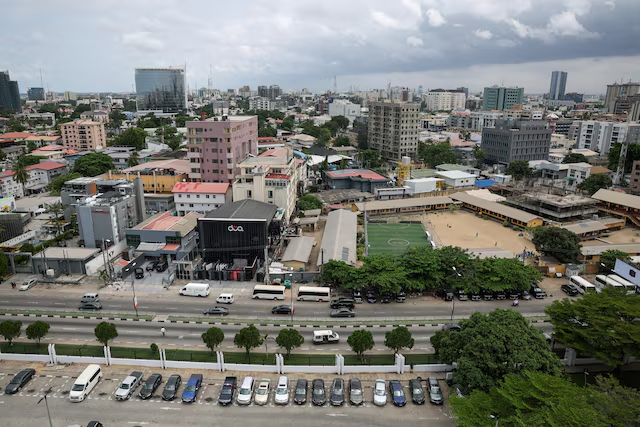
LAGOS, Oct 2 – The World Bank Group’s private-sector arm, the International Finance Corporation, is developing financing platforms and risk-mitigation mechanisms designed to mobilize more private capital for strategic sectors of Nigeria’s economy, including agriculture, infrastructure and small businesses.
Olivier Buyoya, IFC Division Director for Nigeria and Central Africa, outlined the initiative during a press conference in Lagos ahead of the 2026 Africa Financial Summit (AFIS), scheduled for November 3 and 4 in Luanda, Angola.
The initiative forms part of the IFC and World Bank Group’s five-year Country Partnership Framework, which seeks to bring public and private stakeholders together to develop financing solutions for major constraints facing African economies.
Buyoya said the focus is on capital that is already available within the financial system but remains underutilised because investors and financial institutions perceive certain sectors as carrying elevated risks.
“The idea is how do we create platforms, solutions, so that we can mobilize funding that is out there but not being deployed in those sectors because they are deemed risky,” Buyoya said.
IFC Targets Agriculture Financing Gap
Agriculture is one of the sectors identified for greater financial mobilisation. Buyoya said Nigerian commercial banks currently allocate less than 5% of their lending to agriculture, despite the sector’s importance to food security, employment and domestic production.
The IFC and World Bank Group are therefore working on structures intended to provide greater risk protection for banks and capital-market investors financing sectors traditionally viewed as higher risk.
The approach could involve mechanisms that improve the risk-adjusted economics of lending and make longer-term financing more accessible to businesses operating in strategic sectors.
IFC Expands Local-Currency Financing
The IFC is also increasing its use of local-currency financing as currency volatility creates additional challenges for African businesses seeking longer-term capital.
Dafe Oraka, Principal Investment Officer at IFC, said the corporation historically relied heavily on US-dollar financing because of its dollar-denominated balance sheet. However, exchange-rate volatility in markets such as Nigeria has increased the need for financing denominated in local currencies.
Oraka pointed to the IFC’s partnership with Access Bank as an example. The two institutions signed a local-currency borrowing framework in May designed to enable the bank to access local-currency funding across multiple African markets where it operates.
The arrangement is intended to support longer-term local-currency financing for small and medium-sized enterprises and other businesses across the continent, reducing their exposure to currency mismatches.
AFIS Seeks Greater Focus on Execution
The financing discussions are also central to the agenda of the upcoming Africa Financial Summit, which was established in 2021 through a partnership between the IFC and Jeune Afrique Media Group.
AFIS brings together banks, insurers, development finance institutions, fintech companies, policymakers, regulators and other financial-sector participants.
Hicham Al Morabet, Director of AFIS, said the platform has increasingly shifted from providing a forum for discussion toward facilitating greater coordination and practical outcomes.
“The purpose of the project was always to foster financial integration on the continent and to make the financial sector players on the continent work together to make the sector stronger and to finance the real economy,” he said.
The 2026 summit in Luanda will focus on strengthening Africa’s financial sector and mobilising capital for economic development. Organisers expect more than 1,250 senior financial-sector executives and policymakers to attend.
IFC Provides $50 Million to InfraCredit
The IFC is also expanding its direct financing activities in Nigeria. InfraCredit, Nigeria’s specialised infrastructure credit guarantee institution, recently secured a $50 million subordinated unsecured 10-year debt facility from the IFC.
The facility is designed to strengthen InfraCredit’s capital base and increase its capacity to support a growing pipeline of infrastructure transactions while mobilising long-term local-currency financing.
Target sectors include renewable energy, climate-smart agriculture, digital infrastructure, telecommunications, healthcare, transportation and other productive areas of the Nigerian economy.
The financing illustrates the broader strategy of using development-finance institutions and risk-sharing structures to attract private capital into sectors where conventional financing remains constrained.
