
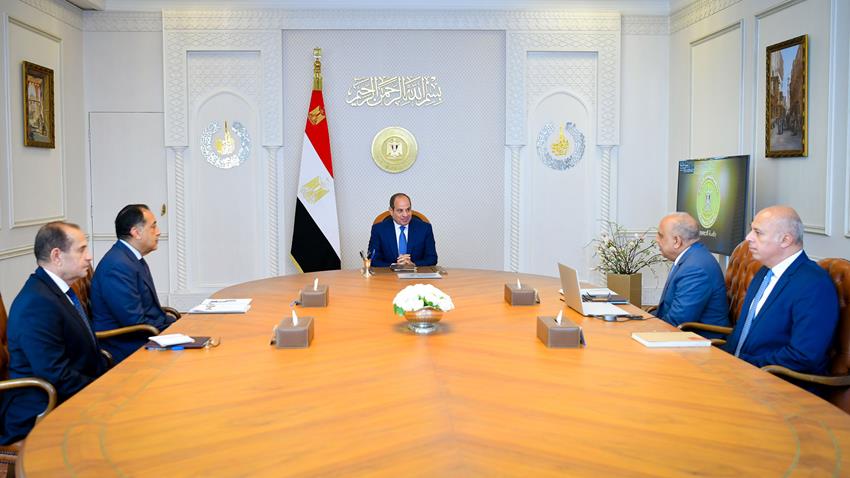
CAIRO, June 15 – Egypt is stepping up efforts to transform its energy sector after President Abdel Fattah El-Sisi directed the government to expand energy storage systems, strengthen electricity infrastructure and accelerate the integration of renewable energy into the national grid.
The directives were issued during a meeting on Sunday with Prime Minister Mostafa Madbouly and Minister of Electricity and Renewable Energy Mahmoud Esmat, where officials reviewed progress on grid modernization and renewable energy projects.
The discussions focused on the second phase of Egypt’s national electricity grid enhancement programme, which comprises approximately 105 projects designed to improve transmission capacity, network reliability and power distribution efficiency.
Officials also reviewed plans to connect additional solar and wind energy projects to the national grid by 2027 as part of Egypt’s broader clean energy strategy.
El-Sisi emphasized the importance of improving electricity supply quality, enhancing the efficiency of conventional fuel use and maintaining the stability of the national grid while the country expands renewable energy generation.
The president also instructed authorities to adhere to implementation timelines and accelerate the connection of new projects to support Egypt’s energy transition and sustainable development objectives.
A key component of the strategy is the expansion of energy storage infrastructure.
The government is targeting a renewable energy share of 45% in Egypt’s electricity mix within the next two years, supported by a combination of utility-scale renewable projects and battery energy storage systems.
According to officials, the first phase of the Obelisk Solar Power Plant has already been commissioned, delivering 500 megawatts of generation capacity alongside a 200 megawatt-hour battery storage facility connected to the national grid.
The second phase of the project, which will add another 500 megawatts of solar generation capacity, is expected to come online in the coming weeks as Egypt prepares to meet rising electricity demand during the summer period.
El-Sisi called for continuous monitoring of renewable energy projects throughout both construction and operational stages and urged stronger cooperation between government institutions and private-sector partners involved in delivering clean energy investments.
The president also highlighted the importance of expanding local-currency financing mechanisms for renewable energy and storage projects to support long-term sector development.
The meeting further reviewed progress on the ambitious Energy Valley project in Minya Governorate, which is expected to become one of the world’s largest integrated clean energy developments.
The project is planned to include 1.7 gigawatts of solar photovoltaic generation capacity supported by battery storage systems totaling 4 gigawatt-hours, with facilities distributed across Minya, Qena and Alexandria governorates.
Egyptian authorities view large-scale storage investments as essential to maximizing the value of renewable energy generation, improving grid flexibility and ensuring system stability as more intermittent energy sources come online.
El-Sisi also underscored the strategic importance of localizing renewable energy manufacturing industries, describing domestic production of clean energy technologies as a critical component of Egypt’s energy security agenda.
The government believes expanding renewable energy capacity, strengthening storage infrastructure and reducing carbon emissions will play a central role in supporting economic growth, improving energy resilience and advancing Egypt’s long-term green transition goals.