
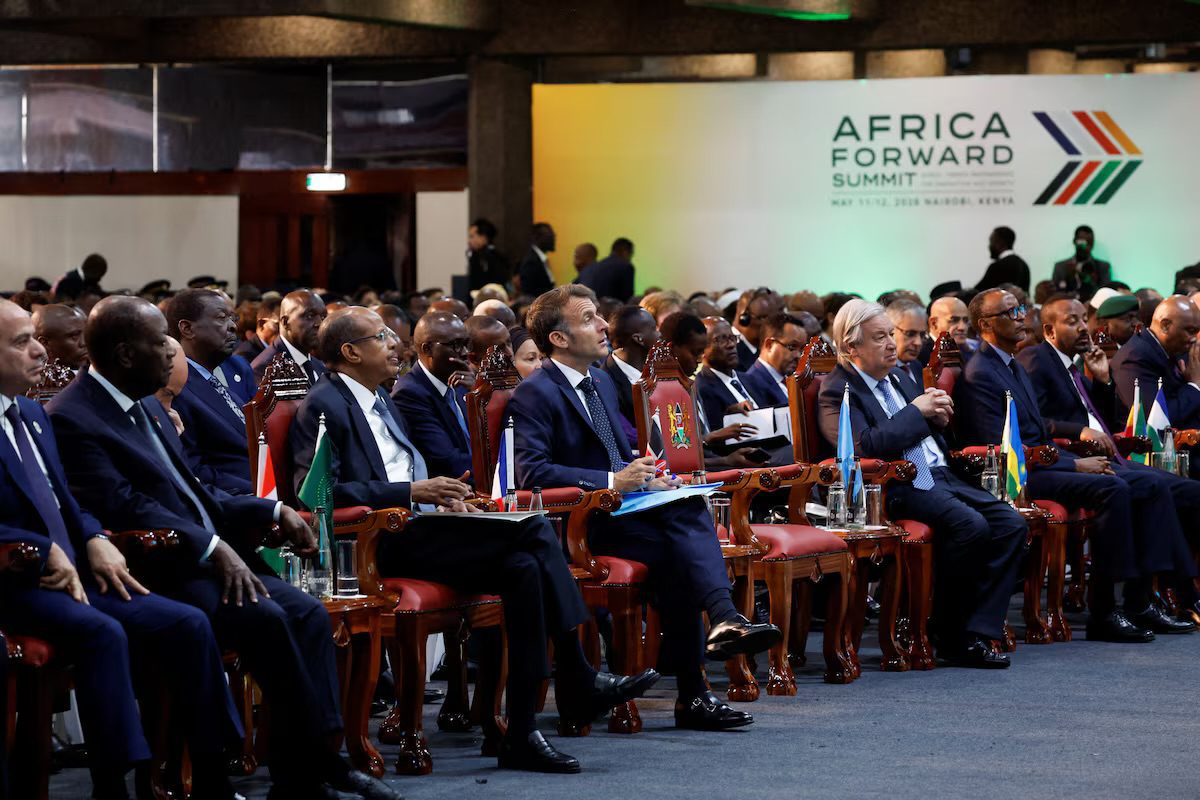
NAIROBI, May 13 – African leaders renewed pressure for reforms to the global financial system during the Africa Forward Summit on Tuesday in Nairobi aimed at lowering borrowing costs and unlocking financing for infrastructure and economic development projects across the continent.
The discussions gained momentum after French President Emmanuel Macron backed the creation of a first-loss guarantee mechanism designed to reduce investment risks in Africa and encourage greater private capital inflows.
Macron said he plans to advocate for the proposal at the upcoming G7 summit in France next month.
African governments have long argued that lenders and investors overstate the continent’s risks, resulting in significantly higher borrowing costs compared with other regions.
“The issue is not liquidity. It is risk architecture,” William Ruto said during remarks at the summit.
Ruto, who was invited by Macron to attend the G7 meeting in Evian-les-Bains, said he hopes discussions in Nairobi will help build support for reforms that improve access to affordable financing for African economies.
The summit brought together more than 30 African heads of state, senior executives, and leaders of multilateral financial institutions. It also marked the first France-Africa summit to be hosted in an English-speaking African country.
France is seeking to strengthen economic ties across the continent as its influence has weakened in several former colonies in West Africa in recent years.
Macron said the summit had already mobilized investment commitments worth 23 billion euros ($27 billion) for projects across Africa.
Antonio Guterres told delegates that African countries continue to face borrowing costs roughly double those paid by advanced economies.
“That is not a market verdict on Africa. It is a verdict on the injustices of the system,” Guterres said.
African governments have also renewed calls for changes to the methodologies used by major credit-rating agencies, arguing that current models unfairly exaggerate sovereign risk on the continent.
Ratings firms including Moody’s Ratings, S&P Global Ratings and Fitch Ratings have rejected accusations of bias, maintaining that their assessments are based on transparent global standards.
The proposed guarantee mechanism forms part of a broader push to attract private investment into Africa at a time when many advanced economies are reducing development financing and prioritizing defense spending and domestic fiscal pressures.
While several G7 countries have expressed support for reforms that make global financial institutions more responsive to African economies, it remains unclear how much backing specific proposals will receive.
