
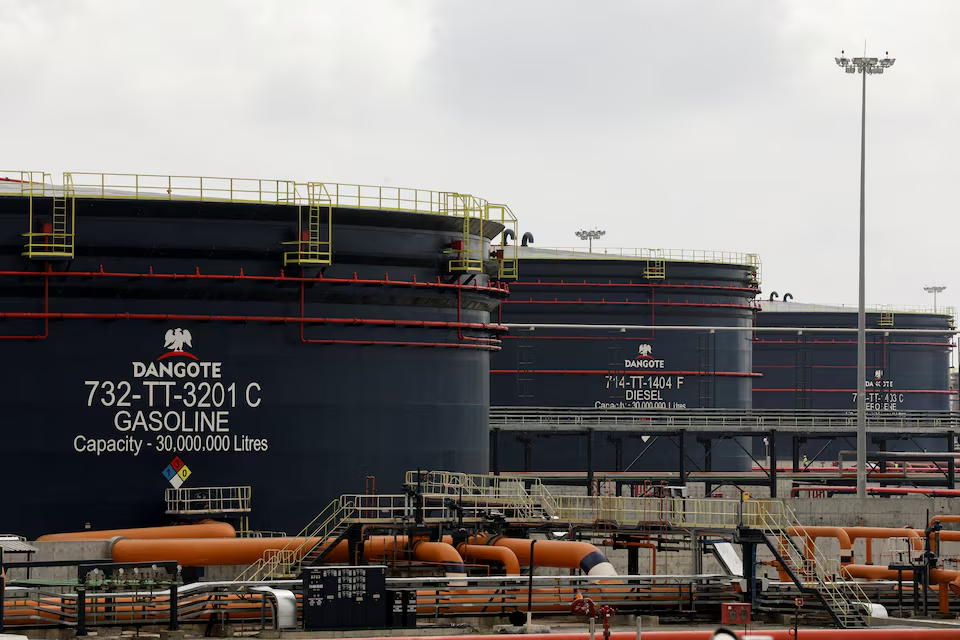
LAGOS, Aug 31 – Nigeria’s Dangote Petroleum Refinery is considering restricting the sale of Premium Motor Spirit (PMS) to fuel marketers that continue importing petrol, as the refinery seeks to protect the quality and reputation of its products in Nigeria’s increasingly competitive downstream market.
The proposed measure could take effect as early as this week, according to people familiar with the refinery’s position, although consultations and possible intervention could still affect the timing. The refinery has raised concerns that petrol imported by marketers could be mixed with products purchased from Dangote before being distributed to consumers.
The concern is that consumers may not be able to distinguish between petrol supplied directly by the refinery and fuel that has subsequently been blended or handled by marketers. Dangote believes that any quality problems associated with such mixtures could ultimately affect the reputation of its own products.
A source familiar with the refinery’s position told The Punch, “It is difficult to understand why we would invest heavily in producing high-quality petroleum products for Nigerians, only for those products to be mixed with imported products of uncertain quality and the resulting product to be associated with the refinery.”
The refinery has also questioned Nigeria’s capacity to independently verify the quality of imported petroleum products. According to sources cited by The Punch, concerns centre on the regulator’s laboratory and quality-control infrastructure, which they said may not be sufficient to independently test and certify the specifications of some imported fuels.
The issue comes as Nigeria’s downstream petroleum industry undergoes a structural transition. For decades, the country relied heavily on imported refined products despite being a major crude oil producer. The expansion of Dangote Refinery is changing that dynamic by increasing the volume of refined petroleum products available from domestic production.
The refinery, with a capacity of 700,000 barrels per day, has increasingly supplied the Nigerian market while also building an export business. Its expansion has coincided with a sharp increase in Nigeria’s seaborne shipments of refined petroleum products.
Data highlighted by the US Energy Information Administration show that Nigeria’s seaborne petroleum-product exports averaged about 561,000 barrels per day in the second quarter of 2026, compared with an annual average of roughly 79,000 barrels per day in 2023.
The figures underline the extent of the change in Nigeria’s position in the refined-products market. The country is increasingly moving from being predominantly dependent on overseas supplies to becoming a significant exporter of refined fuels.
Dangote Refinery has also expanded its presence in international aviation-fuel markets, supplying jet fuel to overseas destinations including Europe and the United States. The development has added another export market for Nigeria’s growing refining capacity.
For Dangote, the continued importation of petrol therefore raises both commercial and quality-control concerns. The refinery is seeking to establish its products as a reliable domestic alternative to imported fuel, while marketers continue to participate in a market where imported and locally refined products can coexist.
Any restriction on sales to importing marketers could have implications for competition and fuel supply, particularly if affected marketers seek alternative sources. The outcome will depend on consultations between the refinery, marketers and relevant authorities, as well as the government’s approach to balancing domestic refining with continued access to imported petroleum products.
The proposed measure highlights a broader issue facing Nigeria’s downstream sector: how to manage the transition from an import-dependent fuel market to one increasingly supplied by domestic refineries while maintaining product quality, competition and reliable supply.
