
ABUJA, Jan 13 – Africa’s security landscape is undergoing a quiet but consequential shift. For decades, the continent’s defense and security needs have relied heavily on imported systems, foreign contractors, and externally designed doctrines.
That model is increasingly under strain. Rising insecurity, expanding digital infrastructure, and the rapid weaponization of artificial intelligence are exposing the limits of dependence on external suppliers.
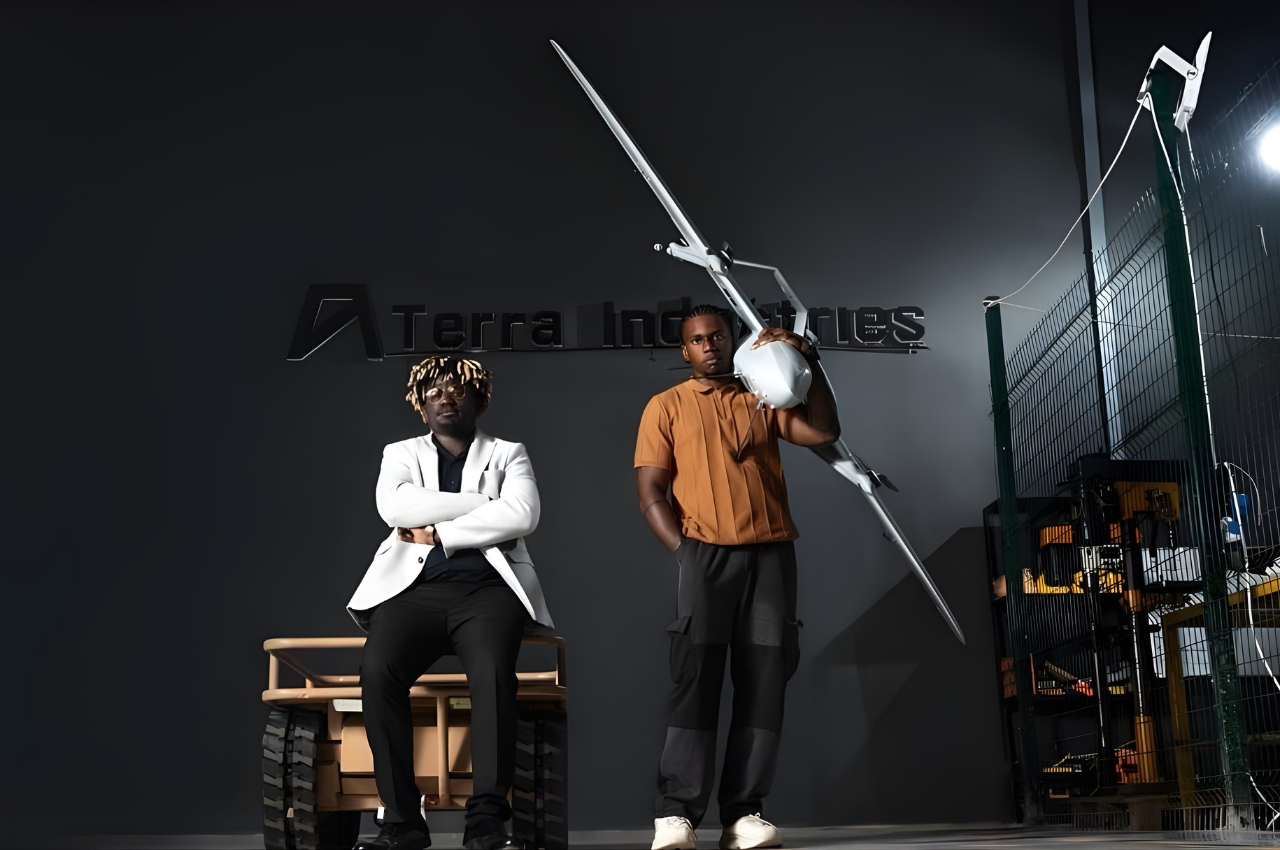
Terra Industries, a Nigeria-founded defense tech Startup focused on building autonomous security systems for Africa’s critical infrastructure, has emerged from stealth and announced a $11.75 million seed financing round.
The round was led by U.S. venture firm 8VC, founded by Palantir co-founder Joe Lonsdale, with participation from Valor Equity Partners, Lux Capital, SV Angel, Leblon Capital, Silent Ventures, Nova Global, and several strategic angel investors, including Micky Malka. Alex Moore, a defense partner at 8VC and a board director at Palantir, joined Terra Industries’ board in 2024.
Founded in 2024 by Nathan Nwachuku, 22, and Maxwell Maduka, 24, Terra Industries designs and manufactures autonomous defense systems that enable governments and infrastructure operators to monitor, secure, and respond to threats across land, air, and maritime domains.
The company’s technology is already deployed to protect power plants, mining operations, and other nationally critical assets across multiple African countries.
The emergence of Terra Industries signals more than the success of a single startup. It points to the early formation of a homegrown African defense technology ecosystem.
“Africa is industrializing faster than any other region, with new mines, refineries, and power plants emerging every month,” said Nwachuku, co-founder and chief executive officer of Terra Industries. “But that progress is fragile without security. Our goal is to give the continent the technological edge needed to protect its industrial future and counter terrorism.”
The company said its systems currently help safeguard infrastructure assets valued at roughly $11 billion across Africa. Terra Industries has secured contracts worth tens of millions of dollars and is building a growing pipeline across both public and private sector clients on the continent.
A shifting security equation
Africa faces an increasingly complex threat environment. Physical insecurity, cybercrime, and hybrid threats now overlap with greater frequency. AI-powered cyberattacks affect a majority of large African enterprises, while financial fraud and adaptive malware remain among the most persistent risks.
At the same time, pipelines, mines, power plants, and transport corridors remain vulnerable to sabotage and theft, costing the continent hundreds of billions of dollars annually in lost output and foregone investment. Traditional responses based on imported hardware and fragmented surveillance systems are struggling to keep pace, particularly across diverse terrain and regulatory environments.
Terra Industries’ strategic proposition
Founded by Nathan Nwachuku and Maxwell Maduka, Terra Industries positions itself as an integrated defense technology platform rather than a niche hardware provider. The company operates what it describes as Africa’s largest drone manufacturing facility in Abuja, with capacity to produce long-range unmanned aerial vehicles, ground robotics, and surveillance infrastructure at scale.
At the core of its offering is ArtemisOS, a software platform that integrates data from air, land, and fixed sensors to deliver real-time situational awareness. The system enables geofencing and threat detection around critical infrastructure, allowing operators to identify and respond to risks before they escalate. This software-centric, multi-domain approach mirrors the direction of advanced defense systems globally.
From import dependence to local capability
Terra’s rise reflects a broader shift in African industrial strategy. Local manufacturing of defense and security systems reduces exposure to geopolitical supply disruptions, enables customization to local threat profiles, and keeps sensitive data within national jurisdictions. It also creates skilled employment in engineering, software development, and advanced manufacturing.
Challenges remain. Access to advanced components is constrained, regulatory frameworks for autonomous systems vary widely, and defense procurement processes are often slow. Still, the presence of viable domestic producers alters the policy landscape. Governments can now design procurement and industrial strategies around existing capability rather than future ambition.
Capital, credibility, and global signaling
The participation of Silicon Valley investors in Terra’s funding round carries both symbolic and practical weight. It signals that African defense technology is investable at global standards, while highlighting the growing recognition that Africa’s security challenges are central to global supply chains, energy markets, and geopolitical stability.
Yet private capital alone is not enough. Defense technology development requires long timelines, patient funding, and consistent demand signals. Without structured public-private collaboration, even promising firms risk stalling before reaching scale.
Strategic implications for Africa
The emergence of companies like Terra Industries raises a central question. Will African governments build the institutional and policy frameworks needed to sustain a domestic defense technology sector, or will such efforts remain isolated successes?
As artificial intelligence becomes integral to security and military capability worldwide, countries without indigenous capacity risk long-term dependency not only on hardware, but also on software updates, data control, and operational doctrine. Those that invest early gain flexibility, resilience, and strategic leverage.
Bottom Line
Terra Industries represents an inflection point in Africa’s approach to security technology. It challenges the assumption that advanced defense systems must be imported and that innovation flows only from established global powers. In a world where AI-driven threats evolve faster than traditional institutions, local capability is no longer optional.
Africa’s security future will increasingly be shaped by those who control the software, data, and manufacturing behind autonomous systems. Terra Industries offers a glimpse of that future. The remaining question is whether the continent moves decisively to scale it.