
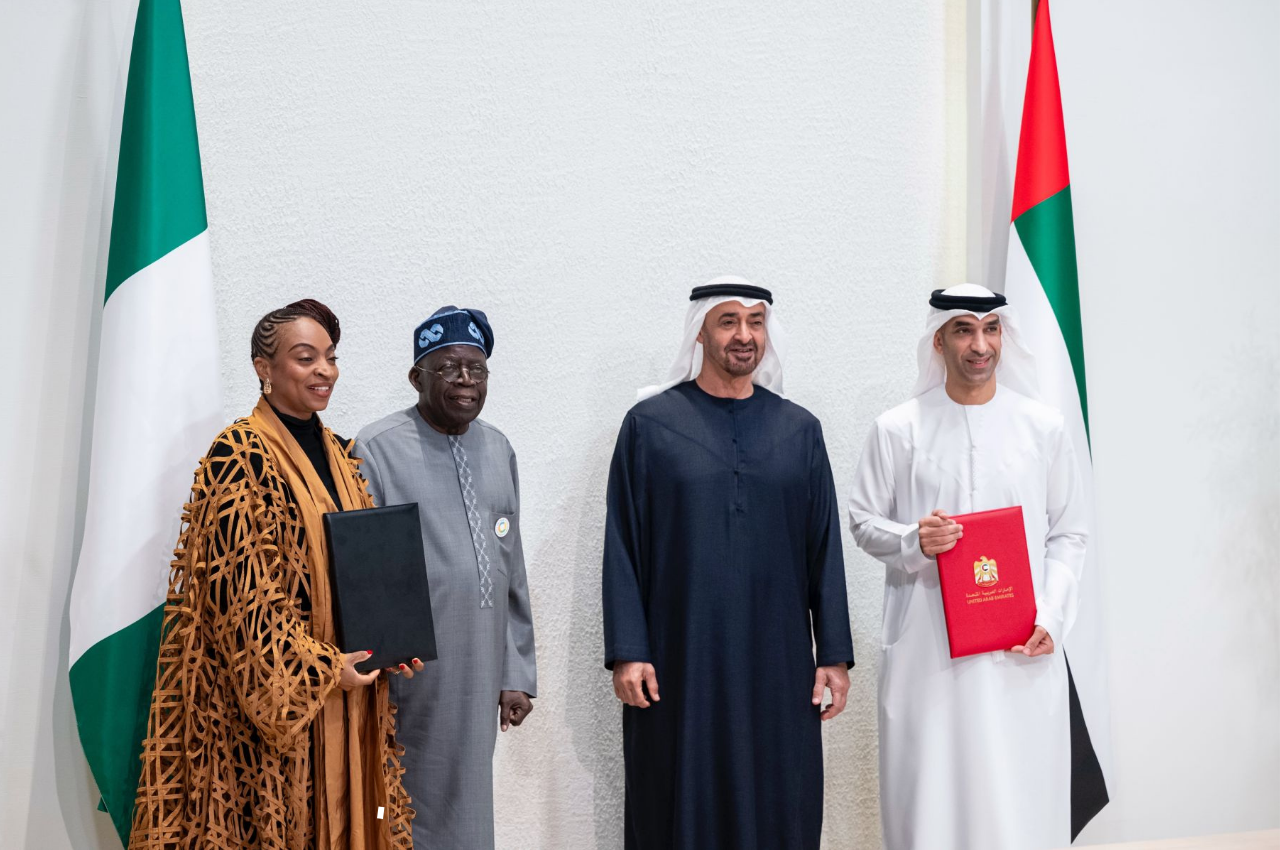
ABU DHABI, Jan 14 – Nigeria and the United Arab Emirates have formally signed a Comprehensive Economic Partnership Agreement, marking one of Nigeria’s most ambitious bilateral trade deals to date and signaling a deeper economic alignment between both countries.
The agreement, signed on January 13, 2026, is designed to significantly expand trade, improve market access, and unlock higher quality investment flows across key sectors including agriculture, manufacturing, financial services, digital trade, infrastructure, and real estate. The signing was witnessed by President Bola Ahmed Tinubu and UAE President Sheikh Mohamed bin Zayed Al Nahyan.
Under the deal, Nigeria will eliminate tariffs on 6,243 products imported from the UAE, while the UAE will remove tariffs on 7,315 Nigerian products. A large share of these tariff eliminations will take effect immediately, with remaining products phased out over three to five years. Clear rules of origin have been established to ensure only goods genuinely produced in either country benefit from the agreement.
For Nigerian exporters, the CEPA provides expanded access to the UAE market for agricultural goods such as fish, cereals, cocoa, fruits, and oilseeds, as well as industrial and manufactured products including pharmaceuticals, chemicals, machinery, apparel, paper products, footwear, and furniture. This is expected to support Nigeria’s push to grow non oil exports and diversify its economy.
The agreement also delivers broad liberalisation in services. Nigeria secured commitments covering 99 specific services across 10 sectors, while the UAE opened 108 services across 11 sectors. Nigerian businesses will be able to establish operations in the UAE, access professional and financial services markets, and enter the country as business visitors for up to 90 days annually. Intra company transferees can stay for renewable three year periods.
From an investment perspective, the CEPA addresses long standing barriers to foreign direct investment from the UAE into Nigeria. Officials say the framework is expected to accelerate deals already underway in agriculture, infrastructure financing, digital banking, retail, and real estate, while strengthening Nigeria’s position as a preferred entry point into ECOWAS and the African Continental Free Trade Area.
Implementation efforts will now begin across trade, customs, investment promotion, and export agencies to ensure Nigerian businesses can fully leverage the agreement.